Senator Jesse David Bright
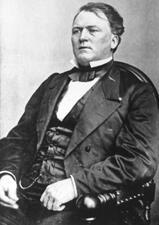
Here you will find contact information for Senator Jesse David Bright, including email address, phone number, and mailing address.
| Name | Jesse David Bright |
| Position | Senator |
| State | Indiana |
| Party | Democratic |
| Status | Former Representative |
| Term Start | December 1, 1845 |
| Term End | March 3, 1863 |
| Terms Served | 3 |
| Born | December 18, 1812 |
| Gender | Male |
| Bioguide ID | B000835 |
About Senator Jesse David Bright
Jesse David Bright (December 18, 1812 – May 20, 1875) was an American politician who served as the ninth Lieutenant Governor of Indiana and as a United States Senator from Indiana from 1845 to 1863. A member of the Democratic Party, he became one of the most prominent Democratic leaders in Indiana in the mid-nineteenth century and was a significant figure in national politics during a period of mounting sectional tension that culminated in the Civil War. Over the course of three terms in the Senate, he contributed to the legislative process and represented the interests of his Indiana constituents, while also emerging as a controversial and polarizing figure because of his Southern sympathies and opposition to the war.
Bright was born on December 18, 1812, in Norwich, New York. In his youth he moved west with his family, settling in Indiana, where he read law and prepared for a career in public life. Coming of age in a rapidly developing frontier state, he aligned himself early with the Democratic Party, which dominated Indiana politics for much of the antebellum period. His legal training and political connections helped him gain prominence in local affairs and laid the groundwork for his later rise to statewide and national office.
By the early 1840s Bright had established himself as a significant Democratic leader in Indiana. He was elected the ninth Lieutenant Governor of Indiana, serving under Governor James Whitcomb. In that capacity he presided over the state senate and played an important role in party organization and patronage. His tenure as lieutenant governor enhanced his visibility and influence within the Democratic Party and positioned him for election to the United States Senate.
Bright entered the United States Senate as a Democrat from Indiana on March 4, 1845, and served continuously until his expulsion on February 5, 1863. During these three terms in office, he participated actively in the legislative process at a time when Congress grappled with issues such as territorial expansion, the extension of slavery, and the preservation of the Union. He rose in seniority and influence, serving as President pro tempore of the Senate on three occasions, a position that placed him in the line of succession to the presidency in the absence of a vice president and underscored his standing among Senate Democrats. His long tenure made him one of the central figures in Indiana’s federal delegation in the years leading up to and during the early stages of the Civil War.
Bright’s Senate career unfolded against the backdrop of intensifying sectional conflict, and his political positions reflected a strong alignment with Southern interests despite his status as a senator from a Northern state. He was a leading Copperhead, part of the faction of Northern Democrats who opposed the Civil War and criticized the policies of President Abraham Lincoln’s administration. His opposition to the war and his perceived sympathy for the Confederacy brought him into frequent and sharp competition with Indiana’s Republican leadership, particularly Governor Joseph A. Wright, the state’s prominent Republican figure. Their rivalry highlighted the deep partisan and ideological divisions within Indiana during the crisis of the Union.
Bright’s Southern sympathies were not merely political but also personal and economic. He owned 21 slaves in Kentucky, an unusual circumstance for a senator representing a free state and one that further fueled controversy over his loyalties. During the Civil War, his conduct and associations came under increasing scrutiny. He was ultimately charged with disloyalty for having written a letter of introduction for an arms dealer to Jefferson Davis, president of the Confederate States of America. On February 5, 1863, the Senate voted to expel him, making him the only senator from a Northern state to be expelled for being a Confederate sympathizer and the last senator to be expelled on grounds related to the Confederate rebellion.
After his expulsion from the Senate, Bright’s national political influence declined sharply. He attempted to remain active in Democratic politics, but the stigma of disloyalty and the changing political climate during and after the Civil War limited his prospects. He eventually left Indiana and resided for a time in Kentucky, where his earlier economic and social ties had been strong. In his later years he lived outside the center of national political life, and his role in public affairs diminished as the country moved into the Reconstruction era.
Jesse David Bright died on May 20, 1875. His career, marked by high office and significant influence as well as by controversy and expulsion, reflected the deep sectional and partisan conflicts of mid-nineteenth-century America. As a long-serving Democratic senator, President pro tempore of the Senate on three occasions, and a leading Copperhead who opposed the Civil War, he remains a notable, if contentious, figure in the political history of Indiana and the United States Congress.