Representative Jesse Johnson Finley
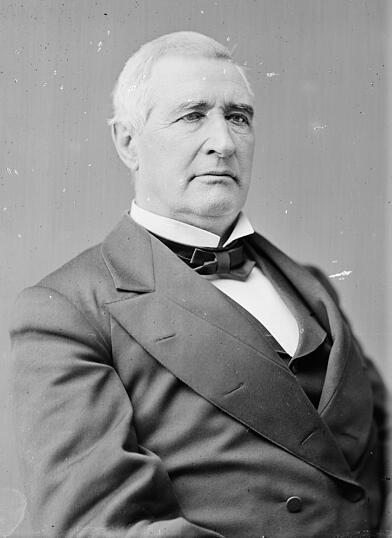
Here you will find contact information for Representative Jesse Johnson Finley, including email address, phone number, and mailing address.
| Name | Jesse Johnson Finley |
| Position | Representative |
| State | Florida |
| District | 2 |
| Party | Democratic |
| Status | Former Representative |
| Term Start | December 6, 1875 |
| Term End | March 3, 1883 |
| Terms Served | 3 |
| Born | November 18, 1812 |
| Gender | Male |
| Bioguide ID | F000134 |
About Representative Jesse Johnson Finley
Jesse Johnson Finley (November 18, 1812 – November 6, 1904) was an American politician, jurist, and military officer who served as a brigadier general in the Confederate States Army during the American Civil War and later as a Democratic member of the United States House of Representatives from Florida after the Reconstruction era. Over a long public career he also served as mayor of Memphis, Tennessee; a volunteer officer in the United States Army during the Second Seminole War; a member of the Arkansas Senate; a member of the Florida Senate; and a circuit court judge in Florida. In Congress, he represented Florida from 1875 to 1883, serving three terms in the House of Representatives.
Finley was born on November 18, 1812, in Wilson County, Tennessee. He spent his early years in Tennessee, where he read law and prepared for a legal and political career in the rapidly developing states of the South and Southwest. Like many young men of his generation on the frontier, he combined legal training with early exposure to public affairs, which helped shape his later roles in municipal and state government.
Finley’s early public service included military duty and local office. During the Second Seminole War, he served as a volunteer officer in the United States Army, gaining experience in field command and frontier conditions that would later inform his Civil War service. He subsequently moved to Memphis, Tennessee, where he entered municipal politics and was elected mayor of Memphis. His tenure as mayor reflected his growing prominence in regional affairs and provided him with administrative experience in governing a rapidly expanding river city.
Seeking further opportunities in the Southwest, Finley relocated to Arkansas, where he entered state politics. He served as a member of the Arkansas Senate, participating in legislative deliberations during a period of territorial expansion and sectional tension in the United States. Later, he moved to Florida, where he continued his legal and political career. In Florida he served as a member of the Florida Senate and was appointed or elected as a circuit court judge, presiding over a broad range of civil and criminal matters and helping to shape the state’s judicial practices in the antebellum period.
With the outbreak of the American Civil War, Finley cast his lot with the Confederacy. Drawing on his earlier military experience, he entered the Confederate States Army and rose to the rank of brigadier general. He commanded troops in several campaigns, and his service as a general officer placed him among the higher-ranking Confederate commanders from Florida. The war and its aftermath profoundly affected his subsequent political trajectory, as he, like many former Confederate leaders, had to navigate the complex legal and political environment of Reconstruction.
After the Civil War and the formal end of Reconstruction, Finley resumed political life in Florida as a member of the Democratic Party. He was elected to the United States House of Representatives as a Democrat from Florida, serving from 1875 to 1883. His three terms in Congress placed him at the center of national debates during a significant period in American history, as the country grappled with the legacies of the Civil War, the reintegration of the Southern states, and the transition from Reconstruction to the so‑called “New South.” As a member of the House of Representatives, Jesse Johnson Finley participated in the democratic process, contributed to the legislative work of the chamber, and represented the interests of his Florida constituents during a time of economic adjustment and political realignment.
Finley’s congressional service marked the culmination of a long and varied public career that had spanned municipal office, state legislatures, the judiciary, and high military command. After leaving Congress in 1883, he withdrew from national office but remained a figure of note in Florida and among former Confederate and Democratic circles. He lived to see the turn of the twentieth century, one of the last surviving Confederate general officers of his generation. Jesse Johnson Finley died on November 6, 1904, closing a life that had intersected with many of the central conflicts and transformations of nineteenth‑century American history.