Senator Jesse Burgess Thomas
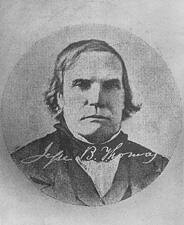
Here you will find contact information for Senator Jesse Burgess Thomas, including email address, phone number, and mailing address.
| Name | Jesse Burgess Thomas |
| Position | Senator |
| State | Illinois |
| Party | Adams |
| Status | Former Representative |
| Term Start | October 26, 1807 |
| Term End | March 3, 1829 |
| Terms Served | 3 |
| Gender | Male |
| Bioguide ID | T000171 |
About Senator Jesse Burgess Thomas
Jesse Burgess Thomas (1777 – May 2, 1853) was an American lawyer, judge, and politician who became one of the earliest prominent public figures associated with the Old Northwest and the emerging state of Illinois. Little is definitively recorded about his exact place of birth, but he was born in 1777 and came of age as the United States expanded westward. He read law in the early national period, entering the legal profession at a time when new territories were being organized and legal institutions were still in formation. His early experiences as a frontier lawyer helped shape his later role in territorial governance and state-building.
Thomas’s formal education followed the common pattern of the era, relying more on legal apprenticeship and practical training than on university study. By the opening years of the nineteenth century he had established himself sufficiently in the law to enter public life in the Indiana Territory. His legal background and growing reputation led to his selection for territorial office and ultimately to representation in the national legislature, where he would first gain experience in federal affairs.
Thomas’s political career began in earnest in the Indiana Territory, where he served as a delegate to the 10th Congress of the United States. As a territorial delegate, he sat in the U.S. House of Representatives without a formal vote on the floor but with the ability to serve on committees and advocate for the interests of the territory. His service in this role introduced him to national politics and the workings of Congress at a time when questions of territorial organization, slavery, and westward expansion were increasingly central to federal policy. His effectiveness in territorial politics and his legal acumen positioned him as a leading figure when the neighboring Illinois Territory moved toward statehood.
With the organization of Illinois and the movement toward admission to the Union, Thomas played a central role in the state’s constitutional formation. He served as president of the constitutional convention that drafted the fundamental law under which Illinois was admitted to the Union in 1818. In this capacity, he presided over debates that defined the structure of the new state government and its relationship to the federal system. His leadership at the convention helped secure Illinois’s transition from territorial status to full statehood, and it established his prominence among the state’s early political leaders.
Upon Illinois’s admission to the Union, Thomas became one of Illinois’s first two United States Senators. According to the existing record, he served as a Senator from Illinois in the United States Congress from 1807 to 1829, completing three terms in office as a member of the Adams Party, and contributing to the legislative process during a significant period in American history. In the Senate he participated in the democratic process and represented the interests of his constituents from the new state, engaging in debates over national development, internal improvements, and the balance of power between free and slave states. He is best known nationally as the author of the Missouri Compromise of 1820, a landmark legislative arrangement that sought to maintain the balance between free and slave states by admitting Missouri as a slave state and Maine as a free state, while prohibiting slavery in most of the remaining Louisiana Purchase territory north of latitude 36°30′. This measure placed him at the center of one of the most consequential sectional debates of the antebellum era.
Thomas’s Senate career unfolded during the administrations of James Monroe and John Quincy Adams, when the so‑called Adams Party and its allies advocated for a strong national government and economic development. As a member of the Adams Party, he aligned himself with policies favoring national improvements and a broad interpretation of federal power. Over the course of his three terms, he served during a period marked by rapid territorial expansion, rising sectional tensions, and the early stirrings of the Second Party System. His authorship of the Missouri Compromise and his broader legislative activity made him a significant, if sometimes controversial, figure in the politics of the expanding republic.
After his retirement from the U.S. Senate in 1829, Thomas withdrew from national public life and settled in Ohio, where he lived for the remainder of his years. He continued to be remembered for his earlier service as a lawyer, judge, territorial delegate, president of the Illinois constitutional convention, and United States Senator. Jesse Burgess Thomas died on May 2, 1853, closing a career that had spanned the formative decades of the United States’ westward growth and the intensifying national struggle over slavery and sectional balance.