Representative Jim Bridenstine
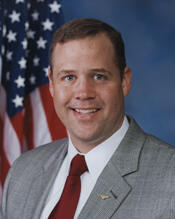
Here you will find contact information for Representative Jim Bridenstine, including email address, phone number, and mailing address.
| Name | Jim Bridenstine |
| Position | Representative |
| State | Oklahoma |
| District | 1 |
| Party | Republican |
| Status | Former Representative |
| Term Start | January 3, 2013 |
| Term End | April 23, 2018 |
| Terms Served | 3 |
| Born | June 15, 1975 |
| Gender | Male |
| Bioguide ID | B001283 |
About Representative Jim Bridenstine
James Frederick Bridenstine (born June 15, 1975) is an American politician and former federal executive who served as the United States representative for Oklahoma’s 1st congressional district and later as the 13th administrator of the National Aeronautics and Space Administration (NASA). A member of the Republican Party, he represented the Tulsa-based district in the U.S. House of Representatives from January 3, 2013, to April 23, 2018, serving three terms in Congress before resigning to lead NASA. His tenure in public office coincided with a period of significant political polarization and renewed national focus on space exploration and commercial space partnerships.
Bridenstine was born on June 15, 1975, and grew up in Oklahoma, a background that would later shape his political identity and constituency base. Details of his early life prior to college, including his family background and early schooling, are less prominently documented in public sources than his later military and political career, but his formative years in the state established a long-standing connection to Oklahoma that he maintained throughout his professional life.
Before entering Congress, Bridenstine pursued higher education and military service, which provided the foundation for his later work on aerospace and defense issues. He attended Rice University, where he earned a Bachelor of Arts degree, and later obtained a Master of Business Administration from Cornell University. He served as a pilot in the United States Navy, flying the E-2C Hawkeye and later transitioning to the Navy Reserve. His military experience, particularly in aviation and national security, informed his interest in aerospace policy and contributed to his credibility on defense and space matters once he entered Congress and later NASA.
Bridenstine’s congressional career began with his challenge to a long-serving incumbent. In September 2011, he launched a campaign to unseat five-term Republican U.S. Representative John Sullivan in Oklahoma’s 1st congressional district. Identifying with the Tea Party movement and perceived as running to Sullivan’s right, Bridenstine nonetheless advanced a policy platform that, in substance, differed little from that of the incumbent. In the June 2012 Republican primary election, he defeated Sullivan with 54 percent of the vote, a result that effectively secured his path to Congress given the district’s strong Republican lean. The 1st District, with a Cook Partisan Voting Index of R+16 and in Republican hands since 1987, was considered safely Republican. In the November 2012 general election, Bridenstine defeated Democratic nominee John Olson by a margin of 63 percent to 32 percent, winning all five counties in the district.
Once in Congress, Bridenstine served three terms, from January 3, 2013, until his resignation on April 23, 2018. During this period, he participated in the legislative process and represented the interests of his Oklahoma constituents in a time of contentious national debates over spending, health care, and federal regulation. He served on the House Committee on Science, Space, and Technology, a role that allowed him to focus on issues related to aerospace, space exploration, and technological innovation. He ran unopposed in the 2014 election, reflecting his consolidation of support within the district. His top campaign contributors that cycle included Northrop Grumman, Latshaw Drilling, the American Optometric Association, Citizens United, and the Every Republican is Crucial Political Action Committee. According to analyses of campaign finance data, he also received $29,000 from donors associated with the Turquoise Council of Americans and Eurasians and the Assembly of the Friends of Azerbaijan (AFAZ). Bridenstine retained his seat in the 2016 election and, following the 2016 presidential contest, was viewed as a possible candidate for positions in the incoming Donald Trump administration, including NASA administrator or Secretary of the Air Force. Consistent with a three-term pledge he had made earlier, he announced that he would not seek re-election in 2018.
On September 1, 2017, President Donald Trump nominated Bridenstine to serve as administrator of NASA. His nomination was the subject of partisan debate in the Senate, reflecting broader political divisions, but he was ultimately confirmed on April 19, 2018, by a party-line vote of 50–49. He became the first elected official ever appointed to lead NASA. Bridenstine resigned his House seat effective April 23, 2018, to assume the NASA post. As administrator, he oversaw the agency during a period of renewed emphasis on lunar exploration, commercial partnerships, and the development of new launch systems. In March 2019, following a directive by Vice President Mike Pence to accelerate NASA’s plans to return humans to the Moon from 2028 to 2024, Bridenstine publicly outlined the technical and programmatic changes required to meet the new timeline. He stated that the Space Launch System (SLS) would need to be accelerated, along with development of the Lunar Orbital Platform-Gateway (LOP-G), an orbiting space station around the Moon. He also considered the potential use of commercial heavy-lift rockets, such as the Delta IV Heavy or SpaceX’s Falcon Heavy, to support aspects of the mission. The specific concept of using a commercial heavy-lift vehicle to launch Orion and its European Service Module was ultimately scrapped due to logistical challenges related to docking and aerodynamics.
During his NASA tenure, Bridenstine cultivated working relationships with leaders in the commercial space sector, notably SpaceX CEO and founder Elon Musk. Under his leadership, NASA advanced its Commercial Crew Program, including the uncrewed DM-1 (Demo-1) mission of SpaceX’s Crew Dragon spacecraft in March 2019. Following that mission, when Musk emphasized the need for a human base on the Moon, Bridenstine responded, “that’s the goal,” underscoring his support for sustained human presence beyond low Earth orbit. His period as administrator also encompassed efforts to strengthen NASA’s partnerships with private companies and international allies, while maintaining a focus on science missions, Earth observation, and technology development.
Bridenstine stepped down as NASA administrator on January 20, 2021, coinciding with the transition to the Biden administration and stating his desire to allow the new administration to select its own leadership for the agency. On March 19, 2021, President Joe Biden announced former U.S. Senator and astronaut Bill Nelson as his nominee to succeed Bridenstine as NASA administrator. After leaving federal service, Bridenstine entered the private sector, drawing on his experience in aerospace, defense, and space policy. He has held positions with Voyager Space Holdings, Viasat, Acorn Growth Companies, and Firefly Aerospace, remaining active in the commercial space and technology industries while continuing to be identified with the Republican Party and his years of service in Congress and at NASA.