Senator Jim DeMint
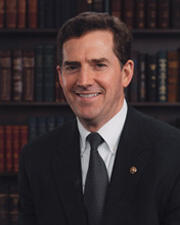
Here you will find contact information for Senator Jim DeMint, including email address, phone number, and mailing address.
| Name | Jim DeMint |
| Position | Senator |
| State | South Carolina |
| Party | Republican |
| Status | Former Representative |
| Term Start | January 6, 1999 |
| Term End | January 1, 2013 |
| Terms Served | 7 |
| Born | September 2, 1951 |
| Gender | Male |
| Bioguide ID | D000595 |
About Senator Jim DeMint
James Warren DeMint (born September 2, 1951) is an American businessman, author, and retired politician who served in both houses of the United States Congress as a Republican from South Carolina and later as president of The Heritage Foundation. A leading figure in the Tea Party movement, he became known nationally as a staunch fiscal and social conservative and as the founder of the Senate Conservatives Fund, a political action committee that supported conservative candidates in Republican primaries and general elections.
DeMint was born in Greenville, South Carolina, and grew up in the Upstate region of the state. He attended local public schools before enrolling at the University of Tennessee, where he earned a bachelor’s degree in 1973. He later returned to South Carolina for graduate study, receiving a master’s degree in business administration from Clemson University in 1975. After completing his education, DeMint entered the private sector, working in marketing and advertising and eventually founding his own marketing consulting firm in Greenville, where he advised businesses on strategic communications and market research.
Before entering elective office, DeMint built a career as a businessman and consultant, gaining experience that he later cited as shaping his views on limited government, taxation, and economic policy. During these years he also became increasingly active in Republican politics and conservative policy circles in South Carolina, aligning himself with the state’s growing conservative movement. His business background and communication skills helped position him as a viable candidate when he decided to seek federal office in the late 1990s.
DeMint was elected to the United States House of Representatives in 1998 as the representative for South Carolina’s 4th congressional district, which includes Greenville and Spartanburg. He took office on January 3, 1999, marking the beginning of his service in Congress. A member of the Republican Party, he served three terms in the House, from 1999 to 2005. During this period he contributed to the legislative process on issues such as tax policy, government spending, and education, and he aligned himself with the party’s conservative wing. He honored a self-imposed term-limit pledge by not seeking a fourth term in the House, instead turning his attention to a campaign for the United States Senate.
On December 12, 2002, after Senator Ernest Hollings announced he would retire following the 2004 elections, DeMint declared his candidacy for the U.S. Senate from South Carolina. He was regarded as the White House’s preferred candidate in the Republican primary. In the June 8, 2004 Republican primary, he placed second, finishing 10.3 percent behind former governor David Beasley and narrowly ahead of businessman Thomas Ravenel. Ravenel subsequently endorsed DeMint in the runoff, which DeMint won handily. In the November 2004 general election, DeMint faced Democratic state superintendent of education Inez Tenenbaum. He led throughout much of the campaign and defeated Tenenbaum by 9.6 percentage points. His victory resulted in South Carolina being represented by two Republican senators for the first time since Reconstruction, when Thomas J. Robertson and John J. Patterson served together in the Senate.
DeMint’s 2004 Senate campaign drew national attention and controversy when, during debates with Tenenbaum, he stated that openly gay people should not be allowed to teach in public schools. When questioned by reporters, he added that single mothers living with their boyfriends should also be excluded from teaching. He later apologized for the remarks, saying they were “distracting from the main issues of the debate,” and emphasized that these were expressions of his personal values rather than issues he would or could address legislatively. Nonetheless, his comments foreshadowed his later prominence as a social conservative critic of same-sex marriage and related policies.
DeMint took office as a United States Senator from South Carolina on January 3, 2005. Although the existing content places his Senate service from 1999 to 2012, that period more accurately encompasses his combined service in Congress, including his House tenure from 1999 to 2005 and his Senate tenure from 2005 to 2013. He was reelected to the Senate in 2010 after easily winning renomination in the Republican primary. In the general election that year, he faced Democratic nominee Alvin Greene, who had won an upset primary victory over Vic Rawl and drew scrutiny from Democratic officials, some of whom called for Greene to withdraw or be replaced on the ballot. On November 2, 2010, DeMint defeated Greene by a margin of 63 percent to 28 percent, with Green Party candidate Tom Clements receiving 9 percent of the vote.
During his Senate career, which lasted until January 2, 2013, DeMint emerged as one of the chamber’s most consistently conservative members. In 2011, Salon identified him as among the most conservative senators. Closely aligned with the Tea Party movement, he advocated for reduced federal spending, lower taxes, and limited government, and he frequently opposed bipartisan compromise measures he believed expanded federal authority. In 2008 he founded the Senate Conservatives Fund (SCF), a political action committee associated with the Tea Party movement and dedicated to supporting conservative Republican candidates, often in primary challenges against more moderate incumbents or establishment-backed contenders. SCF reported raising $9.1 million for the 2010 U.S. Senate elections and endorsed several successful first-time Senate candidates, including Pat Toomey, Rand Paul, Mike Lee, Ron Johnson, and Marco Rubio. DeMint left SCF in 2012.
DeMint was also a prominent social conservative. He repeatedly voted for a constitutional amendment banning same-sex marriage and supported efforts to ban same-sex adoption in Washington, D.C. He argued that government should not redefine religious institutions or marriage, contending that such actions would infringe upon religious liberty and reshape cultural norms in ways he considered harmful. In a 2008 interview, he stated that while government did not have the right to restrict homosexuality, it should not encourage it by legalizing same-sex marriage, citing what he described as “costly secondhand consequences” to society. On October 1, 2010, he reiterated to supporters his view that openly homosexual and unmarried sexually active people should not be teachers, prompting criticism and calls for an apology from organizations including the National Organization for Women, the National Education Association, the Human Rights Campaign, GOProud, and the National Gay and Lesbian Task Force.
On December 6, 2012, DeMint announced that he would resign from the Senate to become president of The Heritage Foundation, a prominent conservative think tank based in Washington, D.C. He formally left the Senate on January 2, 2013, concluding his congressional service after five terms in office—three in the House and two in the Senate—during a period of significant political and economic change in the United States. He began his first full day as president of The Heritage Foundation on April 4, 2013. Under his leadership, Heritage continued its role as an influential voice in conservative policymaking, though internal tensions grew over management style and strategic direction.
On May 2, 2017, DeMint resigned his position at The Heritage Foundation at the request of its board of trustees, following a unanimous vote that reflected a loss of confidence in his leadership. The board stated that a thorough review of the organization’s operations under DeMint had uncovered “significant and worsening management issues that led to a breakdown of internal communications and cooperation.” While acknowledging that the organization had experienced “many successes,” the board concluded that DeMint and a small group of close advisers had failed to resolve these problems. After leaving Heritage, DeMint remained active in conservative advocacy. He became a senior advisor to Citizens for Self-Governance and, in 2017, founded the Conservative Partnership Institute (CPI), an organization devoted to the professional development of conservative staffers and elected officials. He serves as CPI’s founding chairman. Former congressman and White House chief of staff Mark Meadows joined CPI as a senior partner in January 2021, and the Save America PAC contributed $1 million to the organization. A 2022 investigation by National Public Radio reported concerns that CPI’s activities might conflict with federal prohibitions on 501(c)(3) charities providing benefits to political parties, in this case the Republican Party.
In addition to his organizational leadership roles, DeMint has written books and commentary advancing his views on limited government, free markets, and traditional social values. Over the course of his public life, he has remained a prominent figure within the conservative movement, continuing to influence Republican politics and policy debates after his formal retirement from elective office.