Representative Jim Gerlach
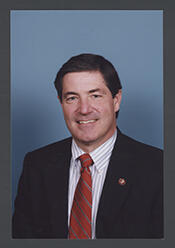
Here you will find contact information for Representative Jim Gerlach, including email address, phone number, and mailing address.
| Name | Jim Gerlach |
| Position | Representative |
| State | Pennsylvania |
| District | 6 |
| Party | Republican |
| Status | Former Representative |
| Term Start | January 7, 2003 |
| Term End | January 3, 2015 |
| Terms Served | 6 |
| Born | February 25, 1955 |
| Gender | Male |
| Bioguide ID | G000549 |
About Representative Jim Gerlach
James William Gerlach (born February 25, 1955) is an American attorney, former state legislator, and former U.S. Representative from Pennsylvania, who served six terms in the United States Congress from 2003 to 2015. A member of the Republican Party, he represented Pennsylvania’s 6th congressional district, a suburban district west of Philadelphia, and became known for his work on land conservation, transportation, and moderate Republican policy initiatives. After completing his sixth term, he retired from Congress in 2015 and subsequently held leadership roles in the private and nonprofit sectors.
Gerlach was born in Ellwood City, Pennsylvania, to Helen Lorraine (née Fitzgerald) and Jack Allen Gerlach. His early life was marked by family hardship when his father was killed by a drunk driver when Jim was five years old, leaving his mother to raise three children on her own. He grew up in western Pennsylvania and later attended Dickinson College in Carlisle, Pennsylvania, where he earned a Bachelor of Arts degree in political science. At Dickinson, he became a member of the Sigma Chi fraternity and the Raven’s Claw Honorary Society, reflecting early recognition of his leadership and academic engagement. He continued his education at the Dickinson School of Law, receiving his J.D. in 1980. During law school, he gained experience in public service by working as a legislative aide in the Pennsylvania State Senate, an early exposure to the legislative process that would shape his later political career.
Following law school, Gerlach entered private practice. In 1985, he moved back to Ellwood City and worked at the Butler County law firm Lindsey & Lutz. Demonstrating an early interest in elective office, he ran in 1986 for the Pennsylvania House of Representatives against Democratic incumbent Frank LaGrotta, but was unsuccessful in that bid. In 1987, he returned to southeastern Pennsylvania, moving to Chester County to join the West Chester law firm Lamb, Windle & McErlane, whose senior partner, William Lamb, was then the Chester County Republican chairman. Gerlach and his wife viewed Chester County as “a great place to work and raise our kids,” and his relocation there laid the groundwork for his subsequent political base in the Philadelphia suburbs.
Gerlach’s legislative career began in earnest with his election to the Pennsylvania House of Representatives. In preparation for the 1990 election in the 155th District, he conducted an intensive door-to-door campaign, visiting approximately 10,000 homes and centering his message on what he viewed as the incumbent Democratic State Representative Sam Morris’s inattentiveness to suburban sprawl. He criticized Morris as “out of touch” with his constituency and proposed expanding open-space preservation by using zoning laws to encourage developers to incorporate open space into projects, as well as creating environmental protection authorities. Although his Democratic opponents accused the western Pennsylvania native of moving to Chester County solely to run for office, Gerlach denied this, emphasizing family and quality-of-life reasons for the move. In a closely contested race, he defeated Morris by only 23 votes out of about 17,000 cast. He was reelected in 1992 with 64 percent of the vote, solidifying his position in the district. During his tenure in the Pennsylvania House, he worked to sponsor legislation making it easier for the commonwealth’s patchwork of municipalities to cooperate in preserving open space, an effort that culminated in legislation signed into law by Governor Tom Ridge in 2000.
In 1994, Gerlach advanced to the Pennsylvania State Senate, winning election with 67 percent of the vote in the newly re-formed 44th District. He defeated Democrat Barry Robertson, whose campaign was heavily supported by former Representative Sam Morris, and was reelected without opposition in 1998. In the State Senate, Gerlach continued to focus on land-use and environmental issues and played a role in changing the state’s welfare laws. His work in both the House and Senate reinforced his reputation as a Republican who emphasized suburban quality-of-life concerns, including farmland preservation and open-space advocacy, and who sought mechanisms for municipalities to coordinate on land-use planning.
Gerlach was first elected to the United States House of Representatives in 2002 from Pennsylvania’s newly created 6th congressional district, sometimes referred to as the “Pterodactyl District” because of its unusual, twisting shape through the outer western suburbs of Philadelphia. Although the district was reportedly drawn to favor a Republican candidate, demographic and political changes in the Philadelphia suburbs made it increasingly competitive, and Gerlach often faced closely contested reelection campaigns. Nonetheless, he served continuously from January 3, 2003, until January 3, 2015, completing six terms. During this period, he participated in the legislative process at a time of significant national events, including the wars in Iraq and Afghanistan, debates over health care reform, and shifts in environmental and energy policy, representing the interests of his suburban Pennsylvania constituents in the U.S. House of Representatives.
In Congress, Gerlach served on the influential Committee on Ways and Means, including the Subcommittee on Oversight and the Subcommittee on Health, where he engaged in tax, health, and oversight matters. He continued his longstanding advocacy for land conservation and open space. On September 27, 2006, the House passed his bill, H.R. 5313, which would have made federal funds available to municipalities nationwide to purchase conservation easements; although the Senate did not act on the measure, he reintroduced it as H.R. 1152 in March 2007. In 2013, he and Representative Mike Thompson of California introduced the Conservation Easement Incentive Act, designed to provide tax benefits to property owners who preserved their land for conservation purposes. Earlier in his congressional tenure, in 2003, he sponsored legislation mandating the establishment of a new veterans cemetery in the Philadelphia area within four years, addressing the need for a burial site closer than the nearest military cemetery then accepting casket burials, which was located 90 miles from the city.
Gerlach’s policy positions reflected a blend of fiscal conservatism, environmental interest, and moderate social views. He strongly supported the proposed Schuylkill Valley commuter rail project and criticized the Bush administration’s decision to reduce the federal share of construction costs from 80 percent to 50 percent, warning that “there’s just not going to be enough state and local funds to do the project. It will be a dead project.” He opposed H.R. 2454, the 2009 cap-and-trade energy and climate bill, arguing that while it contained positive provisions for alternative and renewable energy, it would have a “devastating effect” on working families and job creators in his district and across Pennsylvania. The League of Conservation Voters rated him at 44 percent on its National Environmental Scorecard, and in his 2010 campaign he received $41,250 in contributions from the Energy/Natural Resource sector. He voted against H. Con. Res. 63, which expressed disapproval of the Iraq War troop “surge,” calling the resolution meaningless, vague, and harmful to troop morale. On health care, he voted against the “Health Care and Insurance Law Amendments” (H.R. 3590), commonly known as the Health Care Reform Bill, contending that it was “written behind closed doors,” ushered in “a new era of big government,” and threatened innovation, investment, and jobs in the life sciences and biotechnology sectors in his district through new taxes on medical devices used in procedures such as cancer screening and joint replacement surgery.
On social issues, Gerlach often occupied a centrist position within his party. He was one of four Pennsylvania Republicans—along with Todd Platts, Charlie Dent, and Phil English—to vote in favor of adding sexual orientation and gender identity to the federal hate crimes law. He opposed the Federal Marriage Amendment, which would have amended the U.S. Constitution to define marriage as a union between one man and one woman. At the same time, he voted in 2007 against a bill that would have repealed the “Don’t Ask, Don’t Tell” policy regarding military service by gay and lesbian personnel, and in 2010 he voted against the Defense Appropriations Act that included a repeal of “Don’t Ask, Don’t Tell” contingent on military certification and review. He defended this stance by arguing that voting on the issue six months before Defense Secretary Robert Gates was scheduled to complete a thorough review did not improve national security or military morale. Interest-group ratings reflected his mixed record: in 2007–2008, the Family Research Council rated his support at 64 percent; the liberal Americans for Democratic Action rated his 2005 voting record at 35 out of 100; the American Conservative Union rated him at 56 out of 100; and the American Public Health Association scored his support at 44 percent in 2009. He also advocated expanding federal regulation of so-called “puppy mills” and cosponsored medical liability legislation.
Within Congress, Gerlach participated in numerous caucuses reflecting both his policy interests and his district’s character. He was active in the Congressional COPD Caucus and the Congressional Arts Caucus, and he co-founded the German-American Caucus with Representative Tim Holden, a Democrat from Pennsylvania, highlighting the state’s significant German-American heritage. He was also involved in the House Land Conservation Caucus, the House Land Trust Caucus, the House Ukraine Caucus, the International Conservation Caucus, the Small Brewer Caucus, and the Congressional Cement Caucus. Ideologically, he was associated with moderate Republican organizations, including the Republican Main Street Partnership, which supports government-funded embryonic stem-cell research, and Republicans for Environmental Protection, underscoring his reputation as a centrist Republican with a particular focus on environmental and conservation issues. On January 6, 2014, Gerlach announced that he would not seek reelection, stating that he wished to spend more time with his wife and family, and he left office at the conclusion of his sixth term in January 2015.
After leaving Congress, Gerlach transitioned to work in the private and advocacy sectors. He joined the law firm Venable LLP, where he drew on his legislative and regulatory experience. In 2015, he was announced as the new president and chief executive officer of BIPAC, the Business-Industry Political Action Committee, an organization that works to increase the political effectiveness of the business community. He later continued his leadership in regional economic development, and on March 6, 2020, the board of directors of the Greater Reading Chamber Alliance announced that Gerlach had been named president and CEO of that organization, reflecting his ongoing engagement in Pennsylvania’s civic and economic life. He is also a member of the ReFormers Caucus of Issue One, a bipartisan group of former elected officials focused on political reform and strengthening democratic institutions.