Representative Jim Nance McCord
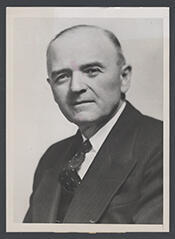
Here you will find contact information for Representative Jim Nance McCord, including email address, phone number, and mailing address.
| Name | Jim Nance McCord |
| Position | Representative |
| State | Tennessee |
| District | 5 |
| Party | Democratic |
| Status | Former Representative |
| Term Start | January 6, 1943 |
| Term End | January 3, 1945 |
| Terms Served | 1 |
| Born | March 17, 1879 |
| Gender | Male |
| Bioguide ID | M000360 |
About Representative Jim Nance McCord
Jim Nance McCord (March 17, 1879 – September 2, 1968) was an American journalist and Democratic politician who served as the 40th governor of Tennessee from 1945 to 1949 and as a United States Representative from Tennessee from 1943 to 1945. Over a long public career, he also served as Commissioner of the Tennessee Department of Conservation from 1953 to 1958, was a delegate to the limited state constitutional convention of 1953, and held local office as Mayor of Lewisburg, Tennessee, from 1916 to 1942. A prominent figure in Tennessee journalism, he was publisher and editor of the Lewisburg-based Marshall Gazette, and his tenure as governor was marked by major expansions in education funding, the institution of a state sales tax, and the enactment of right-to-work legislation.
McCord was born in Unionville, Bedford County, Tennessee, the second of seven children of Thomas McCord, a farmer, and Iva (Steele) McCord. His father had fought for the Confederacy under General Nathan B. Forrest during the Civil War and suffered a wound that required the amputation of part of his leg. Thomas McCord had been married twice before marrying Iva Steele, and Jim Nance McCord had several half-siblings from these earlier marriages, including a twin brother, Ed, who died at a relatively young age. McCord was educated in the public schools and by private instructors. In 1894 he moved to Shelbyville, Tennessee, where he worked as a clerk in a hardware store, and in 1896 he and his half-brother, W. A. McCord, opened a bookstore in Lewisburg in Marshall County. From 1900 to 1910 he worked as a traveling salesman, an experience that gave him extensive familiarity with the needs and concerns of Middle Tennessee farmers.
In 1901 McCord married Vera Kercheval, daughter of William Kercheval, publisher of the Marshall Gazette. In 1910 he began his long newspaper career when he purchased a stake in the Gazette from his father-in-law and became its editor and publisher; two years later he bought out the remaining shares and assumed full control of the paper. As an editor, McCord aligned himself in the early 1910s with the “Independent” Democrats, a pro-temperance faction within the Tennessee Democratic Party. In the 1930s he was an outspoken supporter of President Franklin D. Roosevelt and the New Deal, and in 1942 he was elected president of the Tennessee Press Association, reflecting his prominence in the state’s journalistic community. Alongside his newspaper work, McCord developed a lifelong interest in livestock breeding, particularly Jersey cattle and Tennessee Walking Horses. Beginning in 1920 he worked as an auctioneer of purebred Jersey cattle and in the 1930s helped persuade the U.S. Department of Agriculture to establish an experimental dairy farm specializing in Jersey cattle near Lewisburg. In 1935 he helped form the Tennessee Walking Horse Breeders Association, further cementing his influence in agricultural and livestock circles.
McCord’s formal political career began in 1914, when he was elected to the Marshall County Court. Two years later, in 1916, he was elected Mayor of Lewisburg, a position he would hold for 13 consecutive terms until 1942. During these years he built a reputation as a capable local executive while maintaining his role as a newspaper publisher. He also became increasingly active in state and national Democratic politics. He served as a presidential elector for Franklin D. Roosevelt in 1932 and was a delegate to the Democratic National Convention in 1940. His growing stature within the party and his close ties to rural and small-town constituencies laid the groundwork for his entry into national office.
In 1942 McCord ran unopposed for the U.S. House of Representatives from Tennessee’s 5th congressional district after the incumbent, Percy Priest, had been redistricted. A member of the Democratic Party, he served one term in the Seventy-eighth Congress from 1943 to 1945. His service in Congress occurred during World War II, a significant period in American history, during which he participated in the legislative process and represented the interests of his Middle Tennessee constituents. Although his tenure in the House was brief, it enhanced his statewide visibility and positioned him for higher office. He chose not to seek reelection to Congress in 1944, instead pursuing the governorship.
In 1944 McCord sought the Democratic nomination for governor to succeed term-limited incumbent Prentice Cooper. With the backing of powerful Memphis political boss E. H. Crump, he won the primary by a wide margin over Nashville attorney Rex Manning and Knoxville law professor John R. Neal, then defeated Republican candidate John Wesley Kilgo, a Greeneville attorney, in the general election by a vote of 275,746 to 158,742. As governor, McCord greatly increased funding for education, securing $4 million in appropriations for monthly raises for teachers and principals and establishing tuition assistance for returning World War II veterans. He also signed a retirement law for state employees. In the 1946 gubernatorial campaign he turned back a primary challenge from former governor Gordon Browning, who was serving in Germany and did not actively campaign, and he easily defeated Republican W. O. Lowe in the general election. The 1946 primary season was marred by the “Battle of Athens,” an armed uprising in Athens, Tennessee, in which several hundred World War II veterans attacked the local jail where the sheriff and Crump-aligned officials had taken ballot boxes, allegedly to manipulate election results. McCord dispatched the state guard to restore order in the aftermath of the violence.
During his second term as governor, McCord enacted a 2 percent state sales tax, a measure that E. H. Crump had reluctantly agreed not to oppose. Revenue from the tax was used to construct new schools, purchase school buses, and implement Tennessee’s first comprehensive program for grades 1 through 12, significantly expanding the state’s public education system. McCord also signed right-to-work legislation made possible by the federal Taft–Hartley Act of 1947, a move that alienated organized labor, an important Democratic constituency. In the 1948 gubernatorial race, Browning mounted a determined campaign to break the Crump political machine, attacking McCord for the sales tax and accusing Crump of voter fraud. Veterans, Black voters, rural constituencies, and organized labor gradually shifted away from McCord and Crump, and on election day Browning defeated McCord for the Democratic nomination by 231,852 votes to 158,854. This loss marked the first major defeat for a Crump-backed candidate in a statewide race in more than twenty years.
After leaving the governorship, McCord remained active in state public affairs. He was a delegate to the limited Tennessee constitutional convention of 1953, which submitted several important amendments to the voters, including the extension of the gubernatorial term from two to four years and the repeal of the state poll tax. That same year he joined the cabinet of Governor Frank G. Clement as Commissioner of Conservation, serving from 1953 to 1958 and overseeing the state’s conservation and natural resources programs. In 1958, at the age of 79, he made an unsuccessful bid to return to the governor’s office, running as an independent candidate against the Democratic nominee, Buford Ellington, his former campaign manager and fellow member of the Clement cabinet. McCord received about 32 percent of the vote to Ellington’s 58 percent, signaling the end of his competitive electoral career.
McCord’s personal life was marked by long involvement in his community and several later-life marriages. His first wife, Vera Kercheval McCord, with whom he had no children, died in 1953. In 1954 he married Sula (Tatum) Sheeley, and after her death he married Nell (Spence) Estes in 1967. McCord himself had no children from any of his marriages. He continued to be honored in Tennessee for his contributions to education and public service; buildings on the campuses of Austin Peay State University, the University of Tennessee at Knoxville, the University of Memphis, Tennessee Technological University, Tennessee State University, and the University of Tennessee at Martin have been named in his honor. McCord died in Nashville on September 2, 1968, at the age of 89, a decade after his final run for governor. At the time of his death he was the third-oldest former governor in Tennessee history, behind John I. Cox and Tom Rye, both of whom lived to age 90, though Winfield Dunn has since surpassed their ages. McCord was buried in Lone Oak Cemetery in Lewisburg, Tennessee.