Representative Jo Bonner
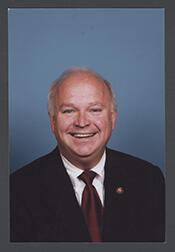
Here you will find contact information for Representative Jo Bonner, including email address, phone number, and mailing address.
| Name | Jo Bonner |
| Position | Representative |
| State | Alabama |
| District | 1 |
| Party | Republican |
| Status | Former Representative |
| Term Start | January 7, 2003 |
| Term End | August 2, 2013 |
| Terms Served | 6 |
| Born | November 19, 1959 |
| Gender | Male |
| Bioguide ID | B001244 |
About Representative Jo Bonner
Josiah Robins Bonner Jr. (born November 19, 1959) is an American academic administrator and former politician who has served in a variety of prominent roles in Alabama public life, including six terms as a United States Representative and, subsequently, as the fourth president of the University of South Alabama. A member of the Republican Party, he represented Alabama’s 1st congressional district in the U.S. House of Representatives from 2003 to 2013, contributing to the legislative process during a significant period in American history and representing the interests of his Gulf Coast constituents.
Bonner was born in Selma, Alabama, and raised in the state’s Black Belt region. He attended local schools before enrolling at the University of Alabama in Tuscaloosa. There he studied journalism, an interest that reflected his early engagement with public affairs and communication. He earned a Bachelor of Arts degree in journalism in 1982. His education at the University of Alabama laid the foundation for his subsequent career in politics and public service, and it also began a long association with the University of Alabama System that would later shape his post-congressional career.
Following his graduation, Bonner entered public service as a staff member in the U.S. House of Representatives. He joined the office of Congressman Sonny Callahan of Alabama, eventually rising to the position of chief of staff. In that capacity, he gained extensive experience in federal legislative work, constituent services, and the operations of a congressional office. His years on Capitol Hill as a senior aide to Callahan helped establish his reputation in Alabama politics and prepared him for his own bid for Congress when Callahan retired at the end of the 107th Congress.
Bonner was first elected to the U.S. House of Representatives in 2002 and took office on January 3, 2003, as the representative for Alabama’s 1st congressional district. A Republican, he quickly became known as an attentive district representative, focusing on economic development, coastal and maritime issues, and military and veterans’ affairs, all of which were central to his Mobile- and Gulf Coast–based district. His service in Congress occurred during a consequential era marked by the wars in Iraq and Afghanistan, the aftermath of the September 11 attacks, and the Great Recession, and he participated in the democratic process as the House addressed national security, economic, and domestic policy challenges.
During the 2004–2010 election cycles, Bonner consolidated his political strength in the district. He won his re-elections with more than 63 percent of the vote each time and ran unopposed in both the 2008 and 2010 general elections, reflecting the strong support he enjoyed among his constituents and the absence of organized opposition from other parties. After redistricting, he chose to run for a sixth term. In the Republican primary, he faced three opponents, and for the third election in a row no other party fielded a candidate, making the Republican primary effectively decisive. An anti-incumbent super PAC, the Campaign for Primary Accountability, spent approximately $21,000 in an effort to unseat him. Bonner, referencing the Supreme Court’s campaign finance decisions, told The New York Times that “obviously, when the Supreme Court made their decision to open up corporate war chests, this is the result.” He expressed confidence that he would withstand the challenge, noting that his own campaign expenditures far exceeded the money being spent against him: “If I hadn’t had $1 million in my account, I could be underwater right now.” According to Federal Election Commission records, he spent about $650,000 on his re-election campaign, while his three opponents together spent under $275,000. No Democratic candidates filed to run against him in the general election, and he won the Republican primary with 56 percent of the vote, carrying all of the counties in the district.
Bonner’s decade in Congress, spanning from January 3, 2003, until his resignation on August 2, 2013, was marked by his role as a reliable Republican vote and as a representative closely identified with the interests of southwest Alabama. Over six terms in office, he served on key committees and worked on issues ranging from hurricane recovery and coastal restoration to economic development projects important to the Port of Mobile and the region’s growing aerospace and shipbuilding sectors. His tenure coincided with major federal responses to natural disasters affecting the Gulf Coast, and he was involved in efforts to secure federal resources and support for his district. Throughout, he maintained a strong emphasis on constituent services, reinforcing his electoral strength and his reputation as a hands-on district representative.
On August 2, 2013, Bonner resigned from Congress to accept a position with the University of Alabama, bringing to a close his ten-year career in the House of Representatives. In his new role, he worked within the University of Alabama System on governmental and external affairs, drawing on his congressional experience and longstanding ties to the institution. His move from elective office to higher education administration reflected a shift from direct legislative work to broader engagement in public policy, education, and institutional leadership within the state.
Bonner returned to state government in 2019 when he was appointed Chief of Staff to Alabama Governor Kay Ivey, a position he held from 2019 to 2021. As chief of staff, he played a central role in managing the governor’s office, coordinating policy initiatives, and overseeing the administration’s interactions with the legislature and other state agencies during a period that included significant economic development efforts and the onset of the COVID-19 pandemic. In 2021, he was selected to become the fourth president of the University of South Alabama in Mobile. He assumed the presidency that year and was officially inaugurated in December 2021. In this capacity, Bonner has led a major public research university and academic medical center, continuing his long career in service to Alabama through higher education leadership while maintaining the political and administrative experience he gained during his years in Congress and state government.