Representative Joe Richard Pool
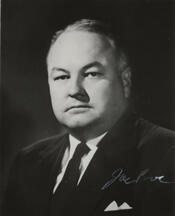
Here you will find contact information for Representative Joe Richard Pool, including email address, phone number, and mailing address.
| Name | Joe Richard Pool |
| Position | Representative |
| State | Texas |
| District | 3 |
| Party | Democratic |
| Status | Former Representative |
| Term Start | January 9, 1963 |
| Term End | January 3, 1969 |
| Terms Served | 3 |
| Born | February 18, 1911 |
| Gender | Male |
| Bioguide ID | P000426 |
About Representative Joe Richard Pool
Joe Richard Pool (February 18, 1911 – July 14, 1968) was an American lawyer, businessman, and Democratic politician who served as a U.S. Representative from Texas from 1963 until his death in 1968. Over three terms in Congress, he first represented Texas at large from January 3, 1963, to January 3, 1967, when such districts in multi-district states were banned by the Supreme Court, and then represented the 3rd Congressional District, encompassing the western half of Dallas County, from January 3, 1967, until July 14, 1968. His congressional service occurred during a significant period in American history, and he participated actively in the legislative process and in oversight of federal agencies, particularly in areas related to postal services, national security, and internal subversive organizations.
Pool was born in Fort Worth, Texas, on February 18, 1911, to William Wesley Pool and the former Bonnie Jean King. The family moved to Dallas in 1913, and in 1914 his father established a mattress manufacturing business, Direct Mattress. Pool attended public schools in Dallas and graduated from Oak Cliff High School (now W. H. Adamson High School) in 1929. He enrolled at the University of Texas at Austin from 1929 to 1933, majoring in pre-law and business. While at the university he was active in student leadership, serving as chairman of the Judiciary Council, and he began a lifelong friendship with fellow council member Claudia Alta “Lady Bird” Taylor, later the wife of Lyndon B. Johnson. He joined Pi Kappa Alpha fraternity and Phi Alpha Delta legal fraternity, and his family were members of the Methodist Church. The economic hardships of the Great Depression forced him to withdraw from the University of Texas in 1933, but he continued his legal education part-time at Southern Methodist University, from which he graduated in 1937. That same year he was admitted to the Texas bar and commenced the practice of law in Dallas with his partner J. Frank Wilson. Over the course of his early professional life, Pool became a member of the American Legion, the Dallas and Texas Bar Associations, and was honored with a life membership in the Dallas Chamber of Commerce.
During World War II, Pool temporarily set aside his legal career to volunteer for military service. He moved back to Dallas in 1943 and entered the U.S. Army Air Corps, where he served primarily in intelligence work, investigating military accidents for possible sabotage. He rose from the rank of private to staff technical sergeant and received an honorable discharge in 1945. After the war he returned to Dallas and resumed his law partnership with J. Frank Wilson. At the same time, he assisted in expanding his father’s mattress business and began to develop his own business interests. In 1947 he founded Alden Comfort Mills, a down comforter refurbishing company in Ennis, Texas, which moved to Plano, Texas, in 1950. The business helped support his growing political ambitions. In early 1959 he also entered the Dallas real estate market and later that year engaged in oil drilling ventures in southeastern Kentucky, reflecting a broadening portfolio of commercial activities alongside his legal and political work.
Pool’s formal political career began in 1952, when he successfully ran as a Democrat for the Texas House of Representatives from Dallas County, winning the District 51, Place 5 seat. He was re-elected in 1954 and 1956. During his tenure in the Texas legislature he served on numerous committees and quickly assumed leadership roles. For four years he was vice-chairman of the Insurance Committee, where he helped draft reform legislation that later became part of the Texas Insurance Code. He also served as chairman of the Motor Traffic Committee, the Conservation and Reclamation Committee, and the House Investigating Committee. In 1955 he co-authored the bill creating the Trinity River Authority, intended to study and promote a navigation canal on the Trinity River from the Dallas–Fort Worth area to Galveston Bay between 1955 and 1974. Although the canal proposal enjoyed significant local support in the 1950s and 1960s, voters ultimately rejected a $150 million bond issue for the project in 1973 amid rising environmental opposition. In 1957 he authored the Pool Election Law, which required runoff elections for Texas U.S. Senate races in which no candidate received a majority of the vote. This law later enabled Lyndon B. Johnson to run simultaneously for re-election to the Senate and for the Democratic presidential nomination in 1960; Johnson lost the nomination to John F. Kennedy but retained his Senate seat, which he vacated when he became Kennedy’s running mate.
Pool’s experience and connections in Texas politics led him into national campaigns and advisory roles. In 1946 he had managed his law partner J. Frank Wilson’s successful congressional campaign. Pool himself sought a seat in Congress from the 5th District of Texas (Dallas County) in 1958, losing the Democratic primary to Barefoot Sanders. He ran again in 1960, winning the Democratic nomination but losing the general election to Republican incumbent Bruce Alger. During the 1960 campaign he appeared on the Dallas County Democratic ticket alongside Senator John F. Kennedy and Senator Lyndon B. Johnson. Through his longstanding acquaintance with Lady Bird Johnson, Pool came to the attention of the national ticket, which regarded his candidacy as important to their efforts to secure Texas in the presidential election. President-elect Kennedy appointed him to the Kennedy–Johnson Natural Resources Advisory Committee, on which he served from September 23, 1960, until he began his campaign for Congress at large in 1962. In this role, Pool focused on flood control in North Texas, drawing on data he had compiled while co-authoring the 1955 Trinity River Authority Act. He produced a detailed flood control report for North Texas, dated December 15, 1960, analyzing flood-prone watersheds in the 18,000-square-mile Trinity Basin and recommending federal corrective measures. He advocated a navigation canal from Fort Worth to the Gulf of Mexico, criticized “polluter cities” for inadequate water conservation and enforcement, and urged greater state control over rivers wholly within Texas. He also endorsed additional reservoirs on the Elm Fork of the Trinity River and on Denton Creek, and called attention to the uncontrolled Mountain Creek watershed, recommending a project there for both flood control and water conservation. The Kennedy–Johnson Natural Resources Advisory Committee acknowledged receipt of his report on December 20, 1960.
In the 1960 congressional reapportionment, Texas gained an additional seat in the U.S. House of Representatives, but the legislature did not immediately redraw district lines, instead creating an at-large seat. In 1962 Pool won the Democratic nomination for this new position and defeated his Republican opponent in the general election, entering the Eighty-eighth Congress on January 3, 1963, as congressman-at-large for the entire state of Texas. He was re-elected at large to the Eighty-ninth Congress in 1964, becoming the last congressman-at-large from Texas and, after subsequent court rulings, the last such member from any state. His unique statewide constituency, combined with his personal relationship with President Johnson through Lady Bird Johnson, gave him an influence that extended beyond that of many rank-and-file members, enabling him to advance favored projects. He and his wife Elizabeth served as delegates pledged to President Johnson at the 1964 Democratic National Convention in Atlantic City. In Wesberry v. Sanders (1964), the U.S. Supreme Court effectively ended the use of at-large congressional districts in multi-district states, and Texas subsequently redrew its congressional boundaries. Pool was elected in 1966 to the Ninetieth Congress from the newly configured 3rd District, representing the western half of Dallas County, and continued in that capacity until his death.
During his years in the U.S. House of Representatives, Pool served on the Committee on Post Office and Civil Service and was a subcommittee chairman from January 3, 1963, until July 14, 1968. In this role he conducted oversight of postal operations, including traveling to Vietnam to inspect postal facilities serving American troops and participating in an inspection tour of postal facilities in Los Angeles and Houston at the time of his death. He also pressed for investigations into federal government research and development contracts, reflecting his broader interest in governmental efficiency and accountability. Pool was active in conservation and infrastructure legislation, serving as author or co-author of funding bills for land acquisition and development of two major Texas federal recreation areas: Guadalupe Mountains National Park and Padre Island National Seashore. Beginning in 1966 he co-authored the House funding measures for the acquisition of approximately 18,000 acres to develop Dallas/Fort Worth Regional (later International) Airport, a key transportation project for North Texas.
Pool played a prominent role on the House Committee on Un-American Activities (HUAC), particularly in its mid-1960s investigations of extremist and terrorist organizations. As congressman-at-large, he served as acting chairman of HUAC hearings from 1965 to 1966. Early in 1965, as civil rights activists faced harassment and violence in the South, Pool predicted that HUAC would move to investigate groups such as the Ku Klux Klan, the Minutemen (an anti-Communist organization), the Black Muslims, and the American Nazi Party. He publicly endorsed inquiries into all four organizations, echoing President Johnson’s suggestion that Congress examine Klan activities. Pool argued that Congress should determine whether a constitutional law could be crafted to outlaw the Klan, which he described as “almost as great a threat to America as the Communist Party,” noting that both sought to destroy American ideals. He maintained that exposing the subversive nature of such groups would diminish their influence and criticized the Minutemen and the Klan for damaging the public image of conservative principles. By late October 1965, with the Klan hearings well underway, Pool stated that he was convinced 40 to 50 Klan leaders would face jail time as a result of HUAC’s work. As acting chairman, he supported contempt of Congress charges against Klan leaders who refused to produce subpoenaed records, and he anticipated that the Internal Revenue Service and the Post Office Department would review committee findings for possible violations. Addressing the Dallas Federal Business Association, he decried what he had observed during the hearings as a “flagrant disrespect of values which are meaningful to me—law and order, respect for fellow human beings, justice and the American way of life.”
Joe Richard Pool’s congressional service ended abruptly when he died of a heart attack on July 14, 1968, at Hobby Airport in Houston, Texas, while on an official postal facility inspection tour. His death was widely mourned in Texas and in Washington. President Lyndon B. Johnson, in a statement published in the Dallas Times Herald, praised Pool’s dedication, noting that “as a member of Congress—and before that as a member of the Texas State Legislature—Joe Pool served with dedication and love for his country,” and extended condolences from himself and Mrs. Johnson to Elizabeth Pool and their four sons. On the floor of the House of Representatives, Speaker John W. McCormack of Massachusetts eulogized him, saying, “It can truly be said he died in the line of duty. He was one of the foremost men of the country in fighting for those ideals for which America stands, for measures that would strengthen our institutions of government and combatting those that would destroy our government.” In another House tribute, Republican Minority Leader and future President Gerald R. Ford of Michigan described Pool as “a real patriot, greatly interested in our national security, deeply concerned about elements he thought were undermining our nation.” At his funeral at Tyler Street Methodist Church in the Oak Cliff neighborhood of Dallas where he had grown up, Texas State Senator Jimmy Phillips told the 900 mourners in attendance that Pool “gave his life for his country.” Joe Richard Pool was interred at Laurel Land Memorial Park in the Oak Cliff area of Dallas, leaving a legacy as a Texas legislator and congressman who combined legal training, business experience, and a strong interest in infrastructure, natural resources, and internal security in his public service.