Representative Joel T. Broyhill
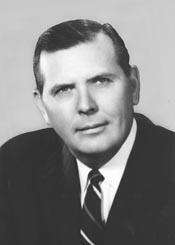
Here you will find contact information for Representative Joel T. Broyhill, including email address, phone number, and mailing address.
| Name | Joel T. Broyhill |
| Position | Representative |
| State | Virginia |
| District | 10 |
| Party | Republican |
| Status | Former Representative |
| Term Start | January 3, 1953 |
| Term End | January 3, 1975 |
| Terms Served | 11 |
| Born | November 4, 1919 |
| Gender | Male |
| Bioguide ID | B000967 |
About Representative Joel T. Broyhill
Joel Thomas Broyhill (November 4, 1919 – September 24, 2006) was an American politician aligned with the Republican Party who served as a Representative from Virginia in the United States Congress for 11 terms, from 1953 to 1974. He represented Virginia’s 10th congressional district, which at the time consisted largely of the rapidly growing suburbs of Arlington, Falls Church, and sections of Fairfax County and Alexandria. Over more than two decades in the House of Representatives, he became known both for his vigorous advocacy on behalf of federal workers and his extensive constituent services, as well as for his outspoken opposition to racial integration and to expanded self-government for the District of Columbia. His service in Congress occurred during a significant period in American history, spanning the Eisenhower through Nixon administrations and encompassing the civil rights era, the New Frontier, and the Great Society.
Broyhill was born on November 4, 1919, in Hopewell, Virginia, into a family that would later become prominent in business and politics. He grew up in Virginia and North Carolina, where his family was involved in the furniture industry, and he was distantly related to future North Carolina congressman Jim Broyhill. His early years coincided with the Great Depression, and like many of his generation he came of age in the shadow of economic hardship and global conflict. These formative experiences, along with his Southern upbringing, helped shape the conservative political outlook he would later bring to Congress.
During World War II, Broyhill served in the United States Army, an experience that interrupted his early civilian career and exposed him to national service at a time of global crisis. After the war, he returned to civilian life and entered the real estate and development business in Northern Virginia. As the Washington metropolitan area expanded rapidly in the postwar years, he became active in local civic affairs and Republican Party politics. His business background and community involvement positioned him as a representative of the emerging suburban middle class that was transforming the political landscape of Northern Virginia and the South more broadly.
Broyhill was elected to the U.S. House of Representatives in 1952 and took office on January 3, 1953, beginning a congressional career that would last until January 3, 1975. Although he was a Republican, he shared a strongly conservative ideology with many senior Southern Democrats, including Virginia’s influential Representative Howard W. Smith, chairman of the House Rules Committee. Smith took an avuncular interest in the new congressman, instructing him in the techniques of legislative maneuvering. Their relationship symbolized a broader political realignment in the South, in which the conservative mantle and much of the region’s political power gradually passed from Old Guard Democrats to a new generation of Southern Republicans. Over the course of 11 terms, Broyhill participated actively in the legislative process and represented the interests of his Northern Virginia constituents during a period of intense federal growth and suburbanization.
As a lawmaker, Broyhill was best known for his focus on local and regional issues affecting the Washington metropolitan area. He sponsored legislation that led to the construction of the Theodore Roosevelt Bridge and the Woodrow Wilson Bridge across the Potomac River, as well as the second span of the 14th Street Bridge, and he backed measures that resulted in the widening of Shirley Highway (Interstate 395). He fought for better pay and working conditions for federal employees, federal aid to local school systems, and financial support for the development of the Washington Metro system. His attention to constituent needs became a hallmark of his tenure; the Almanac of American Politics in 1972 noted that “there were few offices that took care of constituents’ needs and complaints with more efficiency,” and Broyhill himself estimated that he had aided more than 100,000 residents of the 10th Congressional District during his more than 20 years in office. He also supported measures such as aid to grandparents caring for their grandchildren and backed the 23rd Amendment, which allowed District of Columbia residents to vote for president and vice president, and the 26th Amendment, which lowered the voting age to 18.
Broyhill’s committee assignments reflected both his regional focus and his influence within the House. He served on the powerful House Ways and Means Committee, which oversaw tax and revenue legislation, and on the House Post Office and Civil Service Committee, where he was well positioned to advocate for federal workers and retirees. As a longtime member of the committee overseeing the District of Columbia, he played a central role in shaping policy for the nation’s capital. On national issues, he generally supported the Republican legislative programs of Presidents Dwight D. Eisenhower and Richard M. Nixon, while opposing many of the domestic initiatives advanced under Democratic Presidents John F. Kennedy and Lyndon B. Johnson, including key elements of the New Frontier and Great Society programs. In 1963 he was joined in the House by his distant cousin Jim Broyhill of North Carolina, who, like Joel, became known for strong constituent service.
Broyhill also became known as a strident opponent of racial integration and of expanded home rule for the District of Columbia. In 1955 he was one of 81 U.S. Representatives who vowed to oppose by “every lawful means” the Supreme Court’s decision in Brown v. Board of Education, which declared school segregation unconstitutional, and he and fellow Virginian Richard Harding Poff were the only two Republicans to sign the Southern Manifesto. He voted against the Civil Rights Acts of 1957, 1960, 1964, and 1968, and against the Voting Rights Act of 1965, though he did vote in favor of the 24th Amendment, which abolished the poll tax in federal elections. As a senior member of the District of Columbia oversight apparatus, he joined with several other members of Congress in recommending that schools in the District reinstitute segregation, and in 1972 he voiced opposition to federal subsidization of housing in Washington’s suburbs, arguing that it “smacks of forced integration.” He was an unrelenting and outspoken opponent of home rule for the District, contending that the Constitution vested ultimate responsibility for the capital in Congress. His stance drew bitter criticism from D.C. leaders, who attributed racial motives to his opposition to self-government for the majority-Black city, but it won him strong support in Northern Virginia, where many constituents viewed his position as a defense against potential taxation of suburban commuters by the District.
By the early 1970s, Broyhill’s long tenure and the changing political climate began to intersect with national controversies. In 1974 he announced his intention to retire from Congress but was persuaded to seek another term at the request of Vice President Gerald R. Ford, who was then working to shore up Republican strength in the wake of the Watergate scandal. Running for reelection in a difficult year for his party, Broyhill was defeated by Democrat Joseph L. Fisher in what was widely regarded as one of the biggest congressional upsets of the 1974 elections, as Republicans suffered heavy losses nationwide. His service in Congress formally ended on January 3, 1975, concluding 22 years in the House of Representatives.
After leaving office, Broyhill remained active in Republican politics and in the business community of Northern Virginia. He served as campaign manager for Republican John W. Warner’s successful first run for the U.S. Senate in the 1978 election, helping to launch Warner’s long senatorial career. Primarily, however, Broyhill returned to and expanded his work in real estate development. His firm played a significant role in shaping the suburban landscape of Northern Virginia, developing several residential communities, including Broyhill McLean Estates and Broyhill Forest in Fairfax County and Sterling Park in Loudoun County. These projects reflected both the region’s rapid growth and Broyhill’s enduring ties to the suburban constituency he had represented in Congress.
Joel Thomas Broyhill died on September 24, 2006. His long public career left a complex legacy: he was remembered in Northern Virginia for his effectiveness in securing infrastructure improvements, championing federal employees, and providing meticulous constituent service, while his record of opposition to civil rights legislation and to home rule for the District of Columbia remained a defining and controversial aspect of his tenure in the House of Representatives.