Senator J. Glenn Beall Jr.
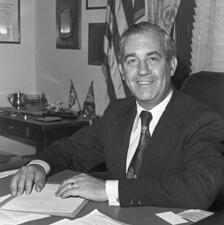
Here you will find contact information for Senator J. Glenn Beall Jr., including email address, phone number, and mailing address.
| Name | J. Glenn Beall Jr. |
| Position | Senator |
| State | Maryland |
| Party | Republican |
| Status | Former Representative |
| Term Start | January 3, 1969 |
| Term End | January 3, 1977 |
| Terms Served | 3 |
| Born | June 19, 1927 |
| Gender | Male |
| Bioguide ID | B000272 |
About Senator J. Glenn Beall Jr.
John Glenn Beall Jr. (June 19, 1927 – March 24, 2006) was an American politician and businessman from Cumberland, Maryland, who served in both chambers of the United States Congress and in the Maryland General Assembly. A member of the Republican Party, he served one term in the United States House of Representatives from 1969 to 1971 and one term in the United States Senate from 1971 to 1977, and earlier served in the Maryland House of Delegates from 1962 to 1968. Over the course of his public career, Beall contributed to the legislative process at the state and federal levels during a significant period in American political history.
Beall was born in Cumberland, Allegany County, Maryland, the eldest of three children in a politically prominent family. His father, James Glenn Beall, known as J. Glenn Beall, served in both chambers of the United States Congress as a U.S. Representative from Maryland’s 6th congressional district from 1943 to 1953 and as a U.S. Senator from Maryland from 1953 to 1965. His younger brother, George Beall, later served as United States Attorney for the District of Maryland from 1970 to 1975 and in 1973 prosecuted Vice President Spiro T. Agnew on charges of bribery, a case that led to Agnew’s resignation. Growing up in this environment, John Glenn Beall Jr. was exposed early to public service and Republican Party politics in western Maryland.
During World War II, Beall served in the United States Navy from 1945 to 1946. After his military service, he pursued higher education at Yale University, where he graduated in 1950. While at Yale, he was an active member of the Yale Political Union, an experience that further developed his interest in politics and public affairs. Following his graduation, Beall entered the private sector, joining the general insurance firm of Beall, Garner & Geare, Inc., in Cumberland. His work in the insurance business established his credentials as a businessman and provided a foundation for his later political career.
Beall’s formal political career began in state government. In 1962, he was elected as a Republican to the Maryland House of Delegates, representing his home region in western Maryland. He was re-elected in 1966 and quickly rose in the ranks of the minority party, serving as minority floor leader from 1963 until 1968. In this role, he helped shape Republican strategy in the House of Delegates and gained legislative experience that would serve him in higher office. His service in the Maryland House of Delegates continued until his election to the 91st Congress in 1968.
In 1968, Beall was elected to the United States House of Representatives as a Republican from Maryland’s 6th congressional district, the same district his father had represented. He served one term in the House from January 3, 1969, to January 3, 1971. During this period, which coincided with the early years of the Nixon administration and the Vietnam War era, he participated in the work of the House and represented the interests of his largely rural and small-town constituency in western Maryland. After a single term, he chose not to seek re-election to the House, instead running for the United States Senate.
In 1970, Beall ran for the U.S. Senate from Maryland and narrowly defeated incumbent Democratic Senator Joseph D. Tydings in a closely contested race, beginning his Senate service on January 3, 1971. He served in the Senate until January 3, 1977, completing one full term. As a member of the Senate during a period marked by the end of the Vietnam War, the Watergate scandal, and significant economic challenges, Beall participated in the democratic process and represented Maryland’s interests at the national level. He sponsored legislation that created the Senate Budget Office and the Congressional Budget Office and served as one of the first members of the newly formed Senate Budget Committee, helping to shape the modern congressional budget process. He was a principal sponsor of the Physician Manpower Shortage Act, which sought to address shortages of medical professionals by bringing more doctors to rural areas, and of the C&O Canal Development Act, which established the Chesapeake and Ohio Canal National Historical Park, preserving an important historic and recreational resource. His Senate tenure thus combined fiscal policy innovation with attention to health care access and environmental and historical preservation.
In 1976, Beall sought re-election to the Senate but was defeated by Democratic Representative Paul S. Sarbanes. Sarbanes won by a margin of 57 percent to 39 percent, an eighteen-point difference that was noted as one of the wider margins of defeat for an incumbent U.S. senator in modern history. Two years later, in 1978, Beall returned to statewide politics as the Republican nominee for governor of Maryland, with Aris T. Allen as his running mate for lieutenant governor. In that race he was defeated by Democratic nominee Harry R. Hughes by an overwhelming margin, marking the end of his bids for elective office.
After leaving the Senate, Beall resumed his work in the insurance business in Cumberland, returning to Beall, Garner & Geare, Inc., and remained active in civic and charitable endeavors. Beginning in 1978, he served as president and chairman of the charity The League for Crippled Children, a position he held until his death, reflecting a long-term commitment to assisting children with disabilities and their families. He was also active in the local community in western Maryland, maintaining a public presence even after his congressional service concluded.
John Glenn Beall Jr. died of cancer on March 24, 2006, at the age of 78. He passed away in Maryland and was interred in Frostburg Memorial Park Cemetery in Frostburg, Maryland. His career, spanning service in the Maryland House of Delegates, the U.S. House of Representatives, and the U.S. Senate, as well as his later business and charitable work, reflected both his family’s political legacy and his own contributions to state and national public life.