Representative John Dillard Bellamy
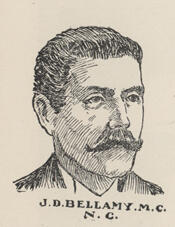
Here you will find contact information for Representative John Dillard Bellamy, including email address, phone number, and mailing address.
| Name | John Dillard Bellamy |
| Position | Representative |
| State | North Carolina |
| District | 6 |
| Party | Democratic |
| Status | Former Representative |
| Term Start | December 4, 1899 |
| Term End | March 3, 1903 |
| Terms Served | 2 |
| Born | March 24, 1854 |
| Gender | Male |
| Bioguide ID | B000349 |
About Representative John Dillard Bellamy
John Dillard Bellamy Jr. (March 24, 1854 – September 25, 1942) was a Democratic U.S. Congressman from North Carolina who represented his state in the United States House of Representatives from 1899 to 1903. A member of the Democratic Party, he served two terms in Congress during a significant period in American history and contributed to the legislative process while representing the interests of his constituents. His election to Congress came in the wake of the Wilmington massacre of 1898, in which he was identified as one of the leaders of a mob that destroyed Black-owned property and helped overthrow the city’s elected government.
Bellamy was born in Wilmington, North Carolina, into one of the area’s wealthiest and most influential families. His father was among the richest men in the region, and the Bellamy name carried substantial social and political weight in Wilmington and New Hanover County. As a young man, he formed a close friendship with future President Woodrow Wilson, a relationship that reflected his early integration into elite Southern political and intellectual circles.
Bellamy was educated in local common schools and at the Cape Fear Military Academy in Wilmington before pursuing higher education. He attended Davidson College, from which he graduated in 1873, and then studied law at the University of Virginia in Charlottesville, graduating in 1875. That same year he was admitted to the bar and commenced the practice of law in Wilmington. His legal career advanced rapidly; he became city attorney of Wilmington, serving in that capacity from 1892 to 1894, and built a substantial practice that later included major corporate clients.
Owing to the prominence and influence of the Bellamy family, as well as his own professional success, Bellamy quickly rose to positions of authority in Wilmington’s civic and business life. In February 1889 he was elected to the board of directors of the Chamber of Industry, and in March of that year he was chosen as its vice president. He also served as a director of the Bellevue Cemetery Company, president of the Industrial Manufacturing Company, chairman of the New Hanover County Democratic Executive Committee, and chairman of the Democratic organization in Wilmington’s Third Ward. In addition, he was active in fraternal affairs as a member of the Rightworthy Grand Lodge of the Independent Order of Odd Fellows of North Carolina, representing Cape Fear Lodge No. 2.
Bellamy entered state-level politics as a Democrat and was elected on the county Democratic ticket to the North Carolina Senate in 1890, representing New Hanover and Pender Counties in the 1891 session. He ran on a platform that emphasized support for the agricultural and laboring classes and the principle of equal rights and laws. During his term in the North Carolina Senate from 1891 to 1892, he served on numerous committees, including the Judiciary, Education, Salaries and Fees, Penal Institutions, Public Buildings and Grounds, and Military Affairs Committees, and he was chairman of the Committee on Corporations. Among the measures he supported was Senate Bill 12, which established the Agricultural and Mechanical College for the Colored Race, now North Carolina Agricultural and Technical State University. The General Assembly faced the loss of federal Morrill Act funding if it failed to create a land-grant institution for Black North Carolinians, and Bellamy introduced SB 12 in response. In his 1942 autobiography, “Memoirs of an Octogenarian,” written in the last year of his life, he recalled that “many other bills…were passed” during his legislative service but discussed in detail only his role in founding the college, stating that he “drafted the charter for the Negro Agricultural College at Greensboro.” He did not clearly explain his motivations for supporting SB 12, leaving historians to conclude that his support likely reflected a mixture of pragmatic concern for federal funding and other political considerations.
By the late 1890s Bellamy was deeply enmeshed in the politics of white supremacy that dominated North Carolina’s Democratic Party. He was close to the South Carolina Red Shirts, a paramilitary arm of the Democratic Party, in their campaign against Alex Manly, the African American editor of the Wilmington Daily Record, whose writings on interracial relationships enraged white supremacists. Before the 1898 election, a group of Red Shirts met in Bellamy’s office to plan the lynching of Manly; they were welcomed there and “enjoyed a drink.” Bellamy dissuaded them from lynching the editor but supported punitive measures against the newspaper, and when Manly fled Wilmington before the election, Bellamy declared that “Wilmington has been rid of the vilest slanderer in North Carolina.” In November 1898 he participated in the municipal coup d’état known as the Wilmington Insurrection of 1898, in which white supremacist leaders forced the city’s elected mayor, aldermen, and chief of police to resign and violently suppressed the Black community. A contemporary African American letter dated November 13, 1898 identified Bellamy as one of the leaders of a street mob that destroyed property in the African American section of Wilmington three days earlier. Wilmington lawyer William Henderson, one of many targeted during the insurrection, later wrote that Bellamy “walks cheerfully to his seat over broken homes, broken hearts, disappointed lives, dead husbands and fathers, the trampled rights of freedmen and not one word of condemnation is heard.”
In this context Bellamy was elected as a Democrat to the Fifty-sixth Congress in 1898, amid widespread voter fraud, intimidation, and the systematic suppression of Black voters that accompanied the Wilmington massacre and the broader white supremacy campaign. His election was contested by Republican Oliver H. Dockery, but the challenge was unsuccessful, and Bellamy took his seat in the U.S. House of Representatives in March 1899. He was re-elected and served in the Fifty-sixth and Fifty-seventh Congresses from March 4, 1899, to March 3, 1903. During his two terms in Congress, he participated in the legislative process at a time of rapid industrialization, imperial expansion, and the entrenchment of Jim Crow in the South, representing the interests and political outlook of his Democratic constituents in North Carolina. He was unsuccessful in his bid for a third term and left Congress after 1903. Beyond his congressional service, he was also a delegate to the Democratic National Conventions of 1892, 1908, and 1920, reflecting his continued prominence within the party at the state and national levels.
After leaving Congress, Bellamy returned to Wilmington and resumed the practice of law. He developed a substantial corporate practice, counting among his clients the Seaboard Air Line Railway, the Southern Bell Telephone Company, and the Western Union Telegraph Company. His stature in North Carolina public life remained significant well into the twentieth century. In 1932 he was appointed by Governor Angus McLean as a commissioner from North Carolina to the national celebration of the two-hundredth anniversary of the birth of George Washington, a ceremonial role that recognized his long public career and standing as a senior Democratic figure in the state.
In his final years Bellamy turned to writing and reflection on his long life in law and politics. In 1942 he self-published “Memoirs of an Octogenarian,” which has since become an important primary source for historians studying late nineteenth-century North Carolina history, politics, and law, and particularly the Wilmington Insurrection of 1898 and the rise of white supremacy in the state. John Dillard Bellamy Jr. died in Wilmington, North Carolina, on September 25, 1942, closing a life that spanned the Civil War, Reconstruction, the establishment of Jim Crow, and the transformations of the early twentieth century.