Representative John Armor Bingham
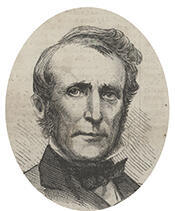
Here you will find contact information for Representative John Armor Bingham, including email address, phone number, and mailing address.
| Name | John Armor Bingham |
| Position | Representative |
| State | Ohio |
| District | 16 |
| Party | Republican |
| Status | Former Representative |
| Term Start | December 3, 1855 |
| Term End | March 3, 1873 |
| Terms Served | 8 |
| Born | January 21, 1815 |
| Gender | Male |
| Bioguide ID | B000471 |
About Representative John Armor Bingham
John Armor Bingham (January 21, 1815 – March 19, 1900) was an American politician, lawyer, and diplomat who served as a Republican Representative from Ohio in the United States Congress from 1855 to 1873 and later as United States Minister to Japan. Over eight terms in the House of Representatives, he became one of the leading Republican voices of the Civil War and Reconstruction eras. As a congressman, he served as assistant Judge Advocate General in the trial of the Abraham Lincoln assassination conspirators and as a House manager (prosecutor) in the impeachment trial of President Andrew Johnson. He is widely regarded as the principal framer of Section 1 of the Fourteenth Amendment to the United States Constitution, a provision that fundamentally reshaped American civil rights law.
Bingham was born in Mercer County, Pennsylvania, where his father, Hugh Bingham, a carpenter and bricklayer who had served in the War of 1812, had settled. He attended local public schools in Mercer County. His mother died in 1827, and after his father remarried, Bingham clashed with his stepmother and moved west to Ohio to live with his uncle, Thomas Bingham, a merchant and prominent Presbyterian in Harrison County. In Ohio, he apprenticed for two years as a printer, helping to publish the Luminary, an anti-Masonic newspaper, which introduced him early to partisan politics and reform movements. He then returned to Pennsylvania to study at Mercer College before resuming his education in Ohio, studying law at Franklin College in New Athens, Harrison County. At Franklin College he befriended Titus Basfield, a former slave who became the first African American to graduate from a college in Ohio; the two men maintained a correspondence for many years. Bingham’s family and close associates were deeply involved in abolitionist and reform causes. Both Hugh and Thomas Bingham were longtime abolitionists and early adherents of the Anti-Masonic Party, aligning themselves with figures such as Pennsylvania Governor Joseph Ritner and state representative Thaddeus Stevens. One of Bingham’s childhood friends, Matthew Simpson, later became a bishop in the Methodist Episcopal Church and a prominent supporter of President Abraham Lincoln; Simpson urged Lincoln to issue the Emancipation Proclamation and later delivered a prayer at the White House and the funeral oration at Lincoln’s interment in Springfield, Illinois.
After completing his formal studies, Bingham returned to Mercer, Pennsylvania, to read law under John James Pearson and William Stewart. He was admitted to the Pennsylvania bar on March 25, 1840, and to the Ohio bar later that same year. Bingham then settled in Cadiz, Ohio, where he began his legal practice and entered public life. An active Whig, he campaigned for presidential candidate William Henry Harrison in 1840. His uncle Thomas Bingham had earlier served as an associate judge of the Harrison County Court of Common Pleas from 1825 to 1839, helping to establish the family’s reputation in local legal and political circles. John Bingham’s law practice soon extended into neighboring Tuscarawas County and its seat, New Philadelphia. In 1846 he won his first elective office as district attorney for Tuscarawas County, serving from 1846 to 1849. During these years he developed a reputation as a capable lawyer and an opponent of slavery, reflecting the abolitionist convictions that ran through his family and political associations.
Bingham’s national political career began as the Whig Party declined in the 1850s. Running as a candidate of the short-lived Opposition Party, he was elected to the 34th Congress from Ohio’s 21st congressional district and took his seat in March 1855. In Washington, he boarded at the same house as Representative Joshua Giddings, one of Ohio’s most prominent abolitionists, whom Bingham admired and with whom he shared antislavery views. After the formation of the Republican Party, Bingham was reelected as a Republican to the 35th, 36th, and 37th Congresses. His service in Congress thus spanned the tumultuous decade before and during the Civil War, a significant period in American history during which he participated in the legislative process and represented the interests of his Ohio constituents. Following the 1860 census, Ohio lost two congressional districts, and Bingham’s district was eliminated in redistricting. He ran in the newly configured 16th district but, known for his strong abolitionist and Unionist views, lost his bid for the 38th Congress to Democratic peace candidate Joseph W. White. His defeat was due in part to the fact that many Republican-leaning Union soldiers from Ohio, then serving in the field, were not permitted to vote by mail.
During his hiatus from Congress in the early years of the Civil War, Bingham remained an ardent supporter of the Union and became identified with the Radical Republicans. President Abraham Lincoln appointed him Judge Advocate of the Union Army with the rank of major, and in 1865 he briefly served as solicitor of the United States Court of Claims. His service as a judge advocate was notable for his involvement as prosecutor or appellate reviewer in three significant military trials: those of General Fitz John Porter in 1863, Surgeon General William Hammond in 1864, and the military commission trial of the Lincoln assassination conspirators in 1865. In the latter case, after Lincoln’s assassination on April 14, 1865, and the wounding of Secretary of State William H. Seward by Lewis Powell, Bingham’s longtime friend from Cadiz, Secretary of War Edwin M. Stanton, appointed him Assistant Judge Advocate General. Working alongside General Henry Burnett and Judge Advocate General Joseph Holt, Bingham helped prosecute George Atzerodt, David Herold, Lewis Powell (also known as Paine), Samuel Arnold, Michael O’Laughlen, Edman Spangler, Dr. Samuel Mudd, and Mary Surratt. The trial began on May 10, 1865, and on June 29, 1865, all eight defendants were found guilty for their roles in the conspiracy. Spangler received a six-year prison sentence; Arnold, O’Laughlen, and Mudd were sentenced to life imprisonment; and Atzerodt, Herold, Powell, and Surratt were sentenced to death and hanged on July 7, 1865. Mary Surratt thus became the first woman executed by the federal government. O’Laughlen died in prison in 1867, while Arnold, Spangler, and Mudd were pardoned by President Andrew Johnson in early 1869.
Bingham returned to elective office when he defeated Joseph Worthington White in the next congressional election after Ohio changed its law to allow soldiers in the field to vote by mail. He reentered the House in the 39th Congress, which convened on March 4, 1865, and continued to serve through the 40th, 41st, and 42nd Congresses, remaining in office until 1873. During Reconstruction he emerged as a leading Republican in the House. In 1866, during the 39th Congress, he was appointed to a subcommittee of the Joint Committee on Reconstruction charged with considering proposals on suffrage and constitutional reform. Bingham submitted several drafts of an amendment designed to apply the protections of the federal Bill of Rights to the states. His final language, accepted by the committee on April 28, 1866, declared: “No State shall make or enforce any law which shall abridge the privileges or immunities of citizens of the United States; nor shall any State deprive any person of life, liberty, or property without due process of law, nor deny to any person within its jurisdiction the equal protection of the laws.” This text became the core of Section 1 of the Fourteenth Amendment. Introduced in the spring of 1866, the amendment passed both houses of Congress by June 1866 and was ratified in 1868; Ohio ratified it on January 4, 1867. In floor debates, Bingham argued that the amendment was necessary to remedy “flagrant violations of the guarantied privileges of citizens of the United States” by state governments and to provide national protection against “cruel and unusual punishments” inflicted under state law. Although the Supreme Court initially declined to interpret the Fourteenth Amendment as fully incorporating the first eight amendments of the Bill of Rights—most notably in the Slaughter-House Cases and United States v. Cruikshank—Justice Hugo Black later relied heavily on Bingham’s speeches in his dissent in Adamson v. California (1947) to argue for full incorporation. Over the subsequent decades, the Court adopted a doctrine of selective incorporation that extended most Bill of Rights protections to the states. The National Constitution Center has since described Bingham as a “Second Founder” and “the 14th Amendment’s James Madison,” emphasizing his central role in writing into the Constitution the Declaration of Independence’s promises of freedom and equality.
Within Congress, Bingham held important committee assignments and played a complex role in the struggle over President Andrew Johnson’s conduct during Reconstruction. He served as chairman of the Committee on Claims from 1867 to 1869 and as a member of the House Committee on the Judiciary from 1869 to 1873. Although a Radical Republican on many issues, he initially resisted efforts by some Radicals to impeach Johnson without a fully developed evidentiary record. On March 7, 1867, during debate on a resolution renewing the first impeachment inquiry, he responded to questioning by Representative Benjamin Butler by declaring that he opposed impeaching the president before hearing testimony. When the Judiciary Committee’s first impeachment report came to the floor, Bingham joined the majority on December 7, 1867, in voting against impeachment. However, after Johnson attempted to remove Secretary of War Edwin M. Stanton in apparent violation of the Tenure of Office Act, Bingham voted on February 24, 1868, to impeach the president. The House then selected him as one of the managers (prosecutors) in Johnson’s impeachment trial before the Senate, a role in which he helped present the constitutional and statutory case against the president. Bingham’s long congressional career ended after he was implicated in the Crédit Mobilier scandal, which damaged the reputations of numerous Republican lawmakers. In 1872, three local Republican political bosses arranged to replace him as the party’s nominee with Lorenzo Danford, who was elected to represent the 16th district in the 43rd Congress and would be reelected several times thereafter, with a brief interruption.
Following his departure from Congress, Bingham continued his public service in the diplomatic corps. President Ulysses S. Grant, a political ally, appointed him United States Minister to Japan in 1873, a post that at the time carried both diplomatic and significant economic responsibilities for the small American legation in Tokyo. Although Bingham initially tried to exchange assignments with John Watson Foster of Indiana, who had been appointed minister to Mexico, Foster declined, and Bingham accepted the Japan post. He sailed to Japan with his wife and two of his three daughters and took up his duties on May 31, 1873. He served longer than any other American minister to Japan in the nineteenth century, remaining in office through the administrations of four Republican presidents until July 2, 1885. During his tenure, the legation was later upgraded to embassy status and the title of minister to ambassador in the early twentieth century, though this change came after his service. In Japan, Bingham moved the American mission from an unsuitable location, replaced a problematic interpreter with a Presbyterian missionary from Ohio, and checked the imperialistic schemes of Charles Le Gendre, a fellow Union veteran. He developed a deep respect for Japanese culture but also expressed concern that Japan’s strong military traditions might hinder its long-term development. Distinguishing himself from many Western diplomats, Bingham consistently opposed the unequal treaties imposed on Japan, particularly provisions granting extraterritorial rights to foreigners and foreign control over Japanese tariffs. He supported Japan’s authority to regulate foreign hunting and to impose quarantines on incoming ships to prevent the spread of cholera. In 1877 he negotiated the return of the Shimonoseki indemnity to Japan, and in 1879 he concluded a revision of the U.S.–Japan treaty that restored some tariff autonomy to Japan, contingent on similar revisions by other Western powers.
After his recall in 1885, Bingham returned to the United States and lived out his remaining years away from public office. His long career had encompassed service as a local prosecutor in Ohio, eight terms in the U.S. House of Representatives during the nation’s gravest constitutional crisis, a central role in the prosecution of Lincoln’s assassins, leadership in framing and defending the Fourteenth Amendment, participation as a House manager in the impeachment of President Andrew Johnson, and more than a decade as the senior American diplomat in Japan. John Armor Bingham died on March 19, 1900. Over time, his reputation has grown as scholars and jurists have increasingly recognized his pivotal contribution to American constitutional development and civil rights.