Representative John Charles Brophy
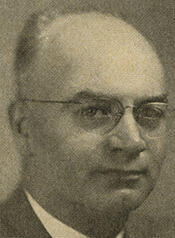
Here you will find contact information for Representative John Charles Brophy, including email address, phone number, and mailing address.
| Name | John Charles Brophy |
| Position | Representative |
| State | Wisconsin |
| District | 4 |
| Party | Republican |
| Status | Former Representative |
| Term Start | January 3, 1947 |
| Term End | January 3, 1949 |
| Terms Served | 1 |
| Born | October 8, 1901 |
| Gender | Male |
| Bioguide ID | B000891 |
About Representative John Charles Brophy
John Charles Brophy (October 8, 1901 – December 26, 1976) was an American labor union organizer and Progressive and Republican politician from Milwaukee, Wisconsin. He served as a Representative from Wisconsin in the United States Congress from 1947 to 1949, representing Wisconsin’s 4th congressional district during the 80th Congress. A member first of the Wisconsin Progressive Party and later of the Republican Party, he contributed to the legislative process during one term in office and also served as a member of the Milwaukee Common Council. Earlier in his career, he was active in the Coke and Gas Workers’ union and was president of the Milwaukee local.
Brophy was born in the town of Eagle, in Waukesha County, Wisconsin, on October 8, 1901. During his childhood, he moved with his family to nearby Milwaukee, where he was raised and educated. He graduated from St. Patrick’s School in Milwaukee and then attended Marquette Academy for one year. Just before turning eighteen, about a year after the armistice ending World War I, he enlisted in the United States Navy. He served on active duty from August 1919 to May 1921 and received an honorable discharge.
After leaving the Navy, Brophy attended Milwaukee Vocational School and learned mechanical trades. He worked as a mechanic for aircraft manufacturers and railroads, employment that brought him into close contact with industrial labor and the emerging strength of organized unions. Through this work he became involved with the Coke and Gas Workers’ union, in which he rose to leadership as president of the Milwaukee local. His union activity established his public reputation and provided the foundation for his entry into municipal and later national politics.
Brophy’s formal political career began at the local level. In 1939 he was elected to the Milwaukee Common Council, where he served as a council member through the 1940s until his election to Congress. During this period he was aligned with the Wisconsin Progressive Party, which had grown out of the La Follette progressive movement and remained influential in state and local politics. His council service coincided with the later years of the Great Depression and World War II, when issues of labor, public works, and social welfare were central to municipal governance.
In 1942, Brophy made his first bid for national office, running as the Wisconsin Progressive Party nominee for the U.S. House of Representatives in Wisconsin’s 4th congressional district, which then comprised the southern half of Milwaukee County. He faced incumbent Democratic Representative Thaddeus Wasielewski and Republican former Representative John C. Schafer. In the three-way race, Wasielewski prevailed with nearly 49 percent of the vote, while Brophy finished a distant third with 18 percent. Four years later, in 1946, the Wisconsin Progressive Party voted to disband, with most delegates choosing to rejoin the Republican Party of Wisconsin. Brophy followed this course, becoming a Republican and seeking the party’s nomination for the 4th district seat that year. In a crowded Republican primary field of eight candidates, he secured the nomination with 24 percent of the vote. On the Democratic side, incumbent Thaddeus Wasielewski lost his primary to union organizer Edmund V. Bobrowicz, who was soon accused of communist ties. Wasielewski then re-entered the race as an independent, creating a three-way general election. In November 1946, Brophy won the seat with 36.5 percent of the vote, while Wasielewski received 28.6 percent.
Brophy served in the U.S. House of Representatives during the 80th Congress, from January 3, 1947, to January 3, 1949, as a Republican from Wisconsin’s 4th congressional district. This Congress, controlled by Republicans, was famously labeled the “Do-Nothing Congress” by President Harry S. Truman for its perceived inaction on key domestic issues in the immediate post–World War II period. As a member of the House of Representatives, Brophy participated in the democratic process and represented the interests of his Milwaukee-area constituents during a significant period in American history marked by reconversion to a peacetime economy, early Cold War tensions, and debates over labor policy. Although his tenure was brief, one enduring consequence of his congressional service was his nomination of Juneau High School graduate James A. “Jim” Lovell to attend the United States Naval Academy; Lovell later became a NASA astronaut and commander of the Apollo 13 mission.
In the 1948 elections, which produced a strong national resurgence for the Democratic Party, Brophy sought reelection but lost his seat in a Democratic wave. Running again in Wisconsin’s 4th district, he received about 39 percent of the vote and was defeated by Democratic State Senator Clement J. Zablocki, who won with approximately 56 percent. Brophy attempted a comeback in 1950, again challenging Zablocki. He first faced a competitive Republican primary but prevailed over two Republican opponents to secure the nomination. In the general election that year, Brophy and Zablocki were the only candidates on the ballot; Zablocki was reelected by a wide margin, taking about 61 percent of the vote, and Brophy’s congressional career came to a close.
Although he never returned to elected office after 1950, Brophy remained active in Republican politics. In 1952 he was selected as a member of the Republican slate for the Electoral College in the United States presidential election. When Republican nominee Dwight D. Eisenhower carried Wisconsin, Brophy served as one of the state’s twelve presidential electors, casting his vote for Eisenhower and his running mate, Richard M. Nixon. In his later years, he worked in sales and public relations, maintaining a presence in civic and political circles in Milwaukee.
John Charles Brophy died of cancer on December 26, 1976. He was buried in Mount Olivet Cemetery in Milwaukee, Wisconsin. His life reflected the trajectory of a working-class labor organizer who moved into municipal and national politics, serving one term in Congress and remaining engaged in public affairs in Wisconsin for decades.