Representative John Byrnes
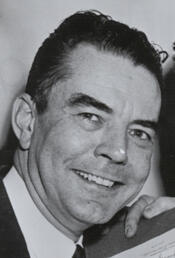
Here you will find contact information for Representative John Byrnes, including email address, phone number, and mailing address.
| Name | John Byrnes |
| Position | Representative |
| State | Wisconsin |
| District | 8 |
| Party | Republican |
| Status | Former Representative |
| Term Start | January 3, 1945 |
| Term End | January 3, 1973 |
| Terms Served | 14 |
| Born | June 12, 1913 |
| Gender | Male |
| Bioguide ID | B001216 |
About Representative John Byrnes
John William Byrnes (June 12, 1913 – January 12, 1985) was an American politician and attorney who served as a Republican U.S. Representative from Wisconsin from 1945 to 1973. Over the course of 14 consecutive terms in the United States House of Representatives, he represented Wisconsin’s 8th congressional district and became one of its longest-serving members, playing a significant role in Republican policy formation and national tax and economic legislation during a pivotal era in American history.
Byrnes was born in Green Bay, Brown County, Wisconsin, the son of Harriet (Schumacher) Byrnes and Charles W. Byrnes. As a small child he contracted polio, an illness that left a lasting impact but did not deter him from pursuing higher education and public service. He attended local schools in Green Bay before enrolling at the University of Wisconsin in Madison. He received his bachelor’s degree from the University of Wisconsin in 1936 and then continued his studies at the University of Wisconsin Law School. After completing his legal education, he was admitted to the bar and returned to his hometown to begin practicing law in Green Bay.
Early in his career, Byrnes combined legal practice with public administration at the state level. From 1938 to 1941 he served as deputy commissioner of the Wisconsin Department of Banking, gaining experience in financial regulation and state economic policy. His work in banking oversight helped establish his reputation as a careful and knowledgeable administrator. In 1941 he was elected to the Wisconsin State Senate from the 2nd District, where he served until 1945. During his tenure in the state senate, he participated in legislative deliberations during the World War II years, building the legislative experience and political base that would support his subsequent election to Congress.
Byrnes was elected in 1944 as a Republican to the 79th Congress from Wisconsin’s 8th congressional district, defeating one-term Democratic incumbent LaVern Dilweg, a former professional football player with the Green Bay Packers. He took office on January 3, 1945, at the outset of the 79th Congress. Byrnes was reelected to the thirteen succeeding Congresses, serving a total of 28 years from January 1945 to January 1973, making him the 8th district’s longest-serving representative. His service in Congress spanned the end of World War II, the early Cold War, the Korean and Vietnam Wars, and the civil rights era, and he consistently participated in the legislative process and represented the interests of his Wisconsin constituents during these transformative decades.
Within the House Republican Conference, Byrnes rose to positions of significant influence. From 1959 to 1965 he served as chairman of the House Republican Policy Committee, a key leadership post responsible for helping to shape and articulate Republican legislative priorities. He later became the ranking minority member of the powerful Committee on Ways and Means, serving in that role from 1963 to 1972. On Ways and Means, he was deeply involved in federal tax, trade, and social welfare legislation, contributing to major debates over fiscal policy and the structure of federal programs. His long tenure and committee responsibilities made him an important figure in national policymaking within the Republican Party.
Byrnes’s voting record reflected engagement with many of the major issues of mid‑20th‑century American politics. He voted in favor of the Civil Rights Acts of 1957, 1960, 1964, and 1968, supporting landmark federal legislation to combat racial discrimination and protect civil rights. He also supported the 24th Amendment to the United States Constitution, which abolished the poll tax in federal elections, and voted for the Voting Rights Act of 1965, further strengthening protections for minority voters. In addition, he backed the establishment of the Wisconsin Islands Wilderness, reflecting attention to conservation and the protection of natural resources in his home state. In 1964, the Wisconsin delegates to the Republican National Convention were initially pledged to support Byrnes, underscoring his stature within the state party, but he released the delegates so they could support the presidential candidates of their individual choice. He chose not to seek a fifteenth term in 1972 and did not run for reelection to the 93rd Congress, concluding his House service on January 3, 1973.
After leaving Congress, Byrnes remained in Washington, D.C., where he continued to practice law and stayed active in professional and civic affairs. He took up residence in Arlington, Virginia, maintaining ties both to the national capital region and to his home state of Wisconsin. In January 1985, while traveling to Wisconsin for a medical checkup at the Marshfield Clinic, Byrnes suffered a stroke at Central Wisconsin Airport in Mosinee. He died several days later, on January 12, 1985, in Marshfield, Wisconsin. John William Byrnes was buried in Allouez Catholic Cemetery in Green Bay, Wisconsin, returning in death to the community where his life and public career had begun.