Representative John Thomas Caine
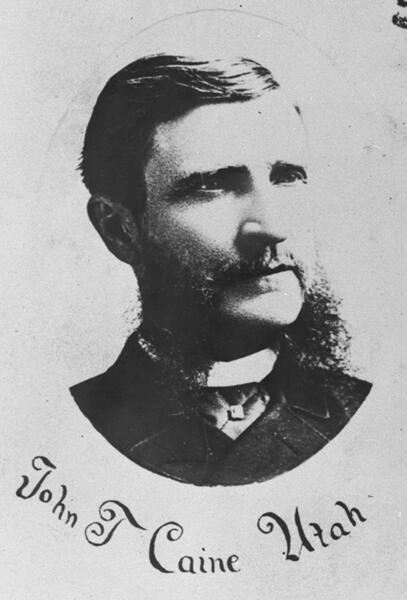
Here you will find contact information for Representative John Thomas Caine, including email address, phone number, and mailing address.
| Name | John Thomas Caine |
| Position | Representative |
| State | Utah |
| District | -1 |
| Party | Democratic |
| Status | Former Representative |
| Term Start | December 5, 1881 |
| Term End | March 3, 1893 |
| Terms Served | 6 |
| Born | January 8, 1829 |
| Gender | Male |
| Bioguide ID | C000023 |
About Representative John Thomas Caine
John Thomas Caine (January 8, 1829 – September 20, 1911) was a Democratic politician and newspaper editor who served as a delegate and Representative from the Territory of Utah in the United States Congress from 1881 to 1893. Over six terms in office, he contributed to the legislative process during a significant period in American history, representing the interests of his constituents in the House of Representatives and playing a prominent role in the political development of Utah.
Caine was born in the parish of Patrick on the Isle of Man and attended the common schools in nearby Douglas. In 1846 he immigrated to the United States, settling first in New York City. While living there, he converted to the Church of Jesus Christ of Latter-day Saints (LDS Church) in March 1847. On October 22 of that year, he married Margaret Nightingale. In 1848 he moved westward to St. Louis, Missouri, and in 1852 he continued on to the Territory of Utah, where he established himself in the growing community and initially worked as a schoolteacher.
Soon after his arrival in Utah, Caine became active in territorial government and public affairs. He served as secretary of the territorial council during the sessions of 1856, 1857, 1859, and 1860, gaining experience in legislative procedure and administration. He was a member of the territorial council in 1874, 1876, 1880, and 1882, and he also held municipal office as City Recorder of Salt Lake City in 1876, 1878, 1880, and 1882. In addition to his governmental roles, he was one of the founders of the Salt Lake Herald in 1870 and served as its managing editor and president, using the paper as a vehicle for political commentary and the promotion of local interests. He further participated in the movement for statehood as a delegate to the Utah constitutional conventions of 1872 and 1882.
Caine’s entry into national politics came amid a contested election for Utah’s territorial delegate. The election to the Forty-seventh Congress had been won by George Quayle Cannon with 18,567 votes, while another contestant, Allen G. Campbell, received 1,357 votes and successfully challenged the outcome. The House of Representatives ultimately refused to seat either Cannon or Campbell and instead elected Caine, a Democrat, to fill the vacancy. He was subsequently reelected as a Democrat to the Forty-eighth, Forty-ninth, and Fiftieth Congresses, and then on the People’s Party ticket to the Fifty-first and Fifty-second Congresses, serving continuously from November 7, 1882, to March 3, 1893. Over these six terms he participated in debates and votes on issues affecting the Utah Territory and the broader nation. He was not a candidate for renomination in 1892.
Caine’s congressional service coincided with a critical period in the relationship between the federal government and the LDS Church, particularly over the issue of polygamy. When LDS Church president Wilford Woodruff issued the Manifesto in September 1890, declaring that the Church would no longer sanction additional plural marriages, Caine played a key role in communicating this policy shift to federal authorities and the public. He disseminated the contents of the Manifesto to members of Congress and to the media in the eastern United States, helping to ease tensions and to shape national understanding of the Church’s new position at a time when Utah’s political future and prospects for statehood were under close scrutiny.
After leaving Congress, Caine remained active in Utah politics. In 1895 he ran unsuccessfully as the Democratic candidate to become the first governor of the newly formed State of Utah; the act admitting Utah to the Union took effect on January 2, 1896. That same year he was elected to the Utah State Senate, where he served one term in the early years of statehood. Following his legislative service, he returned to private life and resumed management of the Salt Lake Herald, continuing his long association with journalism and public discourse.
John Thomas Caine died of cystitis in Salt Lake City, Utah, on September 20, 1911. He was interred in the Salt Lake City Cemetery. His legacy in Utah includes his contributions to territorial and state governance, his six terms as Utah’s delegate in the United States House of Representatives, and his role in the dissemination of the 1890 Manifesto. The town of Caineville, Utah, bears his name in recognition of his prominence in the territory’s political and civic life.