Senator John Snyder Carlile
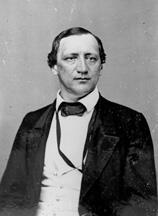
Here you will find contact information for Senator John Snyder Carlile, including email address, phone number, and mailing address.
| Name | John Snyder Carlile |
| Position | Senator |
| State | Virginia |
| Party | Unionist |
| Status | Former Representative |
| Term Start | December 3, 1855 |
| Term End | March 3, 1865 |
| Terms Served | 3 |
| Born | December 16, 1817 |
| Gender | Male |
| Bioguide ID | C000150 |
About Senator John Snyder Carlile
John Snyder Carlile (December 16, 1817 – October 24, 1878) was an American merchant, lawyer, slaveowner, and politician who served in both the United States House of Representatives and the United States Senate. A strong supporter of the Union cause during the American Civil War, he represented the loyalist faction of Virginia at a time when the Commonwealth was divided and its northwestern counties ultimately became the separate state of West Virginia. Although the existing record has sometimes placed his Senate service between 1855 and 1865, his tenure as a United States senator in fact ran from 1861 to 1865, during which he was closely identified with the Unionist Party and the Restored Government of Virginia.
Carlile was born in Winchester, Virginia, on December 16, 1817. He was educated at home by his mother until the age of fourteen, when he entered the workforce as a salesman in a store. Demonstrating early initiative and business acumen, he went into business on his own account at the age of seventeen. After several years in mercantile pursuits, he turned to the study of law, was admitted to the bar in 1840, and began the practice of law in Beverly, in what was then western Virginia. His early professional life thus combined experience as a merchant with the development of a legal career that would soon lead him into public office.
Carlile’s political career began in the Democratic Party, which he joined as he entered public life in the 1840s. He was elected to the Virginia State Senate and served there from 1847 to 1851, participating in state legislative affairs during a period of growing sectional tension in the United States. In 1850 he was selected as a delegate to the Virginia state constitutional convention, where he took part in debates over representation and governance that reflected the longstanding political and economic differences between eastern and western Virginia. By the mid-1850s he had aligned himself with the emerging Know Nothing movement, and in 1854 he was elected to the United States House of Representatives from Virginia’s 11th Congressional District, serving one term in Congress. During these years he also continued his legal practice and maintained his status as a slaveowner, a fact that would shape his later positions on federal power and emancipation.
Carlile’s most consequential public service came during the secession crisis and the Civil War. In 1861 he was chosen as a delegate from Harrison County to the Virginia secession convention, where he voted against the ordinance of secession and emerged as a leading figure in the anti-secession movement in the northwestern counties. He was prominent in the Wheeling Convention of June 1861, which brought together Unionist delegates from across western Virginia. At the first session of the Second Wheeling Convention, on June 13, 1861, Carlile authored “A Declaration of the People of Virginia,” a pivotal document that declared Virginia’s Ordinance of Secession illegal on the ground that the convention which adopted it had been convened by the General Assembly rather than by popular referendum. The declaration further asserted that, by attempting to secede from the United States, Virginia’s state officers had vacated their positions, thereby justifying the reorganization of the state government. On this basis, the pro-Union Restored Government of Virginia was established at Wheeling and was quickly recognized by President Abraham Lincoln and the United States Congress as the legitimate government of the entire Commonwealth, with Wheeling as its provisional capital. Although he was a strong Unionist, Carlile was notably averse to the creation of a new state from the loyal counties of Virginia and opposed the formation of what became West Virginia.
In the midst of these developments, Carlile returned to national office. In 1861 he was again chosen to Congress by the Union Party and briefly held a seat in the United States House of Representatives from July 4 to July 13, 1861. Shortly thereafter he was elected by the Restored Government of Virginia as one of its two United States senators. In this capacity he served in the United States Senate from 1861 until 1865, during a significant period in American history marked by civil war and constitutional crisis. As a member of the Senate, Carlile participated actively in the legislative process and represented the interests of his Unionist constituents in Virginia. He was known for his strict constructionist interpretation of the Constitution, consistently opposing measures that, in his view, treated the conflict as a rebellion of states rather than of individuals. Reflecting both his constitutional philosophy and his status as a slaveowner, he denied the right of Congress to interfere with slavery in the states and opposed federal initiatives that he believed exceeded constitutional limits. Throughout his Senate service he frequently met with President Lincoln in efforts to secure support for his positions on constitutional and wartime issues.
After the close of the Civil War and the expiration of his Senate term in 1865, Carlile withdrew from active politics. He returned to his home region in what had by then become the state of West Virginia and resumed the practice of law, devoting his later years to his legal profession and private affairs. John Snyder Carlile died in Clarksburg, West Virginia, on October 24, 1878. He was interred in the Odd Fellows Cemetery in Clarksburg, leaving a legacy as a complex figure: a Unionist leader and architect of the Restored Government of Virginia who nonetheless opposed the creation of West Virginia and resisted federal interference with slavery, and a legislator whose career spanned the fracturing and remaking of his native state.