Senator John Griffin Carlisle
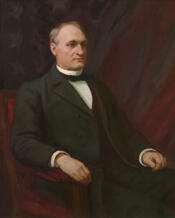
Here you will find contact information for Senator John Griffin Carlisle, including email address, phone number, and mailing address.
| Name | John Griffin Carlisle |
| Position | Senator |
| State | Kentucky |
| Party | Democratic |
| Status | Former Representative |
| Term Start | October 15, 1877 |
| Term End | December 31, 1893 |
| Terms Served | 7 |
| Born | September 5, 1834 |
| Gender | Male |
| Bioguide ID | C000152 |
About Senator John Griffin Carlisle
John Griffin Carlisle (September 5, 1834 – July 31, 1910) was an American attorney and Democratic Party politician from Kentucky who became one of the leading Bourbon Democrats of the late nineteenth century. Born in what is now Kenton County, Kentucky, he was well educated in local schools and early on took a position as a teacher in Covington, Kentucky. His father died in 1853, leaving Carlisle, still a young man, with the responsibility of supporting his family. He read law under the guidance of John W. Stevenson, a prominent Kentucky lawyer and future governor, and at the age of 23 joined the Covington law firm of William Kinkeard. On January 15, 1857, he married Mary Jane Goodson; the couple had five children, all of whom predeceased their parents.
Carlisle’s legal training and growing reputation at the bar quickly drew him into public life. During the 1860s, a period dominated by the American Civil War and its aftermath, he adopted a politically difficult neutral stance on the conflict, a position that cost him support in some quarters but did not prevent his steady rise in Kentucky politics. He served for much of that decade in the Kentucky General Assembly, first as a member of the Kentucky House of Representatives and then in two terms in the Kentucky Senate. In 1871 he was elected Lieutenant Governor of Kentucky, succeeding his former legal mentor John W. Stevenson, and thereby solidified his status as one of the state’s leading Democratic figures. Throughout these years he continued to practice law in Covington, balancing his legal work with legislative responsibilities.
Carlisle entered national politics in 1877, when he was elected as a Democrat to the United States House of Representatives from Kentucky. He represented his state in the House from 1877 to 1890, a period that encompassed seven consecutive terms in Congress and coincided with the turbulent post-Reconstruction era and the rapid industrialization of the United States. Within the House he quickly emerged as an influential legislator and party leader. In 1883 he was chosen as the 31st Speaker of the House of Representatives, a position he held until 1889. His tenure as Speaker was widely regarded as distinguished; contemporaries noted that his written opinions on parliamentary questions read like the decisions of an eminent judge, and his fairness and courtesy toward members of both parties earned him unusual personal esteem.
As Speaker, Carlisle’s impartiality and the sweetness of his manner prompted minority (Republican) members to present him with a loving cup as a token of their affection and respect. Yet the procedural rules of the House at that time limited his effectiveness in controlling obstruction. Dilatory motions, the tactic of the disappearing quorum, and his refusal to ascertain the presence of a quorum by counting members physically present in the chamber made him, in the words of later commentators, “the slave of filibusters.” His Republican rival and eventual successor as Speaker, Thomas Brackett Reed, acknowledged Carlisle’s abilities even as he criticized the rules under which he had to operate, remarking that “he is the ablest man they have on that side of the House, but no Speaker could do any better with his hands tied by the rules we are working under.” Carlisle’s performance in the chair placed his name on the short list of great Speakers of the House in the nineteenth century.
During these years Carlisle also rose to prominence within the national Democratic Party as a leader of the conservative, pro-business Bourbon Democrats, who favored limited government, low tariffs, and adherence to the gold standard. He was repeatedly mentioned as a potential presidential candidate. At the Democratic National Conventions of 1880 and 1884, however, the party passed him over in favor of Winfield S. Hancock and Grover Cleveland, respectively, with post–Civil War discomfort about nominating a southerner contributing to his failure to secure the nomination. In 1892 his name again surfaced at the Democratic convention as a possible candidate for president, but on that occasion Carlisle asked that he not be considered. Contemporary reports indicated that he withdrew with the understanding that, if Cleveland were returned to the presidency, Carlisle would be appointed to a Cabinet post.
In 1890 Carlisle’s congressional career shifted from the House to the Senate. He was elected to represent Kentucky in the United States Senate and served there from 1890 to 1893. His service in Congress, encompassing his long tenure in the House from 1877 to 1890 and his Senate service from 1890 to 1893, occurred during a significant period in American history marked by economic transformation, sectional reconciliation, and intense debates over monetary policy and tariffs. As a Senator from Kentucky, he participated actively in the legislative process and represented the interests of his constituents while continuing to articulate the Bourbon Democratic commitment to fiscal conservatism and sound money.
Carlisle reached the pinnacle of his public career in 1893, when President Grover Cleveland, beginning his second administration, appointed him the 41st Secretary of the Treasury. He held that office from 1893 to 1897, a tenure dominated by the severe economic downturn known as the Panic of 1893. As Secretary, Carlisle confronted a crisis of confidence in the nation’s currency and gold reserves, and he became a central figure in the struggle to maintain the gold standard against mounting pressure for the free coinage of silver. His policies, including support for bond issues to replenish the Treasury’s gold supply, aligned with Cleveland’s conservative economic views and further identified him as a leading spokesman for the pro-business wing of the Democratic Party. These stances, while consistent with his long-held principles, contributed to divisions within the party and alienated many agrarian and silver advocates.
After leaving the Treasury Department in 1897, Carlisle withdrew from elective office but remained active in legal and public affairs. He resumed the practice of law, eventually relocating to New York City, where he continued to be consulted on financial and constitutional questions and maintained his association with the conservative Democratic tradition. His later years were marked by the loss of all five of his children, who predeceased him, a personal sorrow that contrasted with his public reputation for composure and dignity. John Griffin Carlisle died on July 31, 1910. He was interred at Linden Grove Cemetery in Covington, Kentucky, where his career had begun, and he is remembered as a major congressional leader, a powerful Speaker of the House, and a principal architect and defender of Bourbon Democratic policies in the late nineteenth century.