Representative John Wilson Cassingham
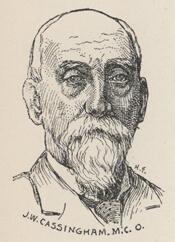
Here you will find contact information for Representative John Wilson Cassingham, including email address, phone number, and mailing address.
| Name | John Wilson Cassingham |
| Position | Representative |
| State | Ohio |
| District | 17 |
| Party | Democratic |
| Status | Former Representative |
| Term Start | December 2, 1901 |
| Term End | March 3, 1905 |
| Terms Served | 2 |
| Born | June 22, 1840 |
| Gender | Male |
| Bioguide ID | C000239 |
About Representative John Wilson Cassingham
John Wilson Cassingham (June 22, 1840 – March 14, 1930) was a U.S. Representative from Ohio who served two terms in the United States Congress from 1901 to 1905. A member of the Democratic Party, he represented his Ohio constituents in the House of Representatives during a significant period in American history at the turn of the twentieth century, contributing to the legislative process as the nation confronted issues of industrial expansion, economic change, and the aftermath of the Spanish-American War.
Born on June 22, 1840, Cassingham came of age in the decades leading up to the Civil War, in a state that was rapidly developing as a political and economic center of the Midwest. Details of his early life and family background are sparse in the historical record, but his later professional activities indicate that he was closely connected to the commercial and civic life of his community. Growing up in Ohio during this era would have exposed him to the state’s evolving political culture and the early debates over slavery, union, and economic development that shaped his generation.
Cassingham’s formal education is not extensively documented, but like many public men of his time, he likely combined schooling with practical experience in business and local affairs. His subsequent career suggests that he developed a solid grounding in commerce and public administration, skills that would later inform his work as a legislator. The trajectory of his life reflects the pattern of many nineteenth-century Midwestern politicians who moved from local business and civic engagement into state and national politics.
Before entering Congress, Cassingham established himself in Ohio’s professional and civic circles, building the reputation that would support his election to national office. His work in these years, though not fully detailed in surviving accounts, positioned him as a representative figure of his district’s interests at a time when Ohio was a key battleground in national politics. His affiliation with the Democratic Party placed him in the minority in a state often dominated by Republicans, underscoring the significance of his eventual election to the House of Representatives.
Cassingham was elected as a Democrat to the United States House of Representatives and served two consecutive terms from 1901 to 1905. During these years he participated in the democratic process at the federal level, representing the interests of his Ohio constituents in the Fifty-seventh and Fifty-eighth Congresses. His service coincided with the presidency of William McKinley and then Theodore Roosevelt, a period marked by debates over trust regulation, tariff policy, and America’s growing international role. Within this context, Cassingham contributed to the legislative work of the House, engaging in deliberations that reflected both national priorities and the concerns of his district.
As a member of the House of Representatives, Cassingham’s responsibilities included consideration of legislation affecting commerce, infrastructure, and the evolving regulatory state, as well as matters of war, peace, and foreign policy that followed the Spanish-American War. While specific committee assignments and sponsored bills are not extensively recorded, his participation in the legislative process formed part of the broader Democratic response to Republican dominance in Congress and the White House. He completed his second term in 1905, after which he left national office.
Following his departure from Congress, Cassingham returned to private life in Ohio. Like many former members of the House in his era, he likely resumed his earlier business and civic pursuits, remaining a respected figure in his community. His long life allowed him to witness profound changes in American society, from the Civil War era of his youth through the First World War and into the modern industrial age.
John Wilson Cassingham died on March 14, 1930, closing a life that spanned nearly ninety years and encompassed service at the highest legislative level of the federal government. Remembered as a Democratic representative who served Ohio in the United States Congress from 1901 to 1905, his career reflects the experience of early twentieth-century lawmakers who navigated the transition of the United States into a more complex, industrial, and internationally engaged nation.