Representative John Winthrop Chanler
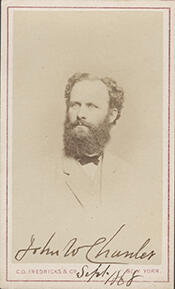
Here you will find contact information for Representative John Winthrop Chanler, including email address, phone number, and mailing address.
| Name | John Winthrop Chanler |
| Position | Representative |
| State | New York |
| District | 7 |
| Party | Democratic |
| Status | Former Representative |
| Term Start | December 7, 1863 |
| Term End | March 3, 1869 |
| Terms Served | 3 |
| Born | September 14, 1826 |
| Gender | Male |
| Bioguide ID | C000302 |
About Representative John Winthrop Chanler
John Winthrop Chanler (September 14, 1826 – October 19, 1877) was a New York lawyer and Democratic U.S. Representative from New York who served in the United States Congress from 1863 to 1869. A member of the prominent Stuyvesant family, he further strengthened his social and political connections through his 1862 marriage to Margaret Astor “Maddie” Ward, a granddaughter of William Backhouse Astor Sr. and a member of the influential Astor family. Through this union, Chanler was linked to several of the most notable mercantile and political lineages in New York.
Chanler pursued a legal career in New York, establishing himself as an attorney before entering national politics. His family background, rooted in the old Dutch and colonial aristocracy of New York through the Stuyvesants, and his marriage into the Astor and Ward families, placed him within the city’s social and economic elite. These connections, combined with his professional standing at the bar, helped provide a platform for his later political career and his emergence as a Democratic spokesman during the tumultuous years of the Civil War and Reconstruction.
In 1862, Chanler married Margaret Astor Ward, whose parents were Samuel Cutler Ward and Emily Astor. Through her mother, Margaret was a granddaughter of William Backhouse Astor Sr. and a great-granddaughter of John Jacob Astor, founder of the Astor fortune, as well as a great-granddaughter of John Armstrong Jr. and Samuel Ward Jr. Together, John and Margaret Chanler had eleven children: John Armstrong “Archie” Chanler (1862–1935); Winthrop Astor “Wintie” Chanler (1863–1926); Emily Astor Chanler (1864–1872), who died of scarlet fever; Elizabeth Astor Winthrop Chanler (1866–1937); William Astor “Willie” Chanler (1867–1934), a politician, soldier, and explorer; Marion Ward Chanler (1868–1883); Lewis Stuyvesant Chanler (1869–1942), a future politician; Margaret Livingston Chanler (1870–1963), later a nurse with the American Red Cross during the Spanish–American War; Robert Winthrop Chanler (1872–1930), an artist; Alida Beekman Chanler (1873–1969); and Egerton White Chanler (1874–1882), who died of a brain tumor. Several of these children went on to notable public, artistic, and philanthropic careers, extending the family’s influence well into the twentieth century.
Chanler was elected as a Democrat to the Thirty-eighth, Thirty-ninth, and Fortieth Congresses, serving three consecutive terms in the U.S. House of Representatives from March 4, 1863, to March 3, 1869. Representing a New York constituency during the Civil War and the early Reconstruction era, he participated in the legislative process at a time of profound national crisis and transformation. As a member of the House of Representatives, he represented the interests of his constituents while aligning with the Democratic Party’s opposition to many of the Republican-led Reconstruction measures then being advanced in Congress.
During his congressional service, Chanler served on several important committees, including the Committee of Bankrupt Law, the Committee on Patents, and the Committee on Southern Railroads. Through these assignments he engaged with issues ranging from commercial regulation and intellectual property to the rebuilding and integration of Southern infrastructure after the Civil War. His tenure was marked by vigorous partisanship and outspoken criticism of congressional policies he viewed as overreaching or punitive toward the former Confederate states.
Chanler became particularly well known for a censure imposed on him by the House of Representatives on May 14, 1866. The censure arose from a resolution he introduced expressing support for President Andrew Johnson’s vetoes of key Reconstruction legislation. In that resolution, Chanler denounced acts of Congress that Johnson had vetoed as “wicked and revolutionary,” and he characterized members of the House who overrode those vetoes as “malignant and mischievous.” The language was deemed an insult to the House, and the resulting formal censure underscored the intense partisan and constitutional conflicts of the Reconstruction period. Despite his prominence, Chanler was defeated in his bid for reelection to the Forty-first Congress, a loss that many contemporary observers attributed in part to his hostility to New York political boss William M. “Boss” Tweed and the Tammany Hall organization.
After leaving Congress in 1869, Chanler returned to private life and his legal and family interests in New York. His household remained a center of social and political activity, and his children’s subsequent prominence in politics, the arts, and public service reflected the continuing stature of the Chanler-Astor connection. His wife, Margaret Astor Chanler, died of pneumonia in December 1875, shortly after attending the funeral of her grandfather William Backhouse Astor Sr. She was buried at Trinity Church Cemetery in New York City. In her will, she left $55,000 to her husband, $1,000 a year to her father, and directed that the remainder of her estate be divided among their children.
John Winthrop Chanler died on October 19, 1877. By the time of his death, he had left a record as a forceful Democratic voice in the House of Representatives during the Civil War and Reconstruction, and as a figure whose family connections linked him to several of the most influential political, commercial, and cultural families in New York and the United States.