Representative John Gordon Cooper
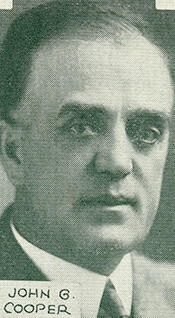
Here you will find contact information for Representative John Gordon Cooper, including email address, phone number, and mailing address.
| Name | John Gordon Cooper |
| Position | Representative |
| State | Ohio |
| District | 19 |
| Party | Republican |
| Status | Former Representative |
| Term Start | December 6, 1915 |
| Term End | January 3, 1937 |
| Terms Served | 11 |
| Born | April 27, 1872 |
| Gender | Male |
| Bioguide ID | C000757 |
About Representative John Gordon Cooper
John Gordon Cooper (April 27, 1872 – January 7, 1955) was an Anglo-American railroad worker and politician who served 11 terms as a U.S. Representative from Ohio from 1915 to 1937. A member of the Republican Party, he represented his constituents in the United States House of Representatives during a period marked by World War I, the Roaring Twenties, the onset of the Great Depression, and the early New Deal era. Over more than two decades in Congress, John Gordon Cooper contributed to the legislative process and participated actively in the democratic governance of the nation.
Cooper’s early life was shaped by his Anglo-American background and by the rapid industrial and transportation expansion of the late nineteenth century. Born on April 27, 1872, he came of age as the United States was consolidating its railroad network and transforming from a largely rural society into an industrial power. His family background and early experiences placed him in close contact with the working world of railroads, an industry that would define his first career and inform his later political outlook.
Before entering public office, Cooper worked in the railroad industry, gaining firsthand experience with the economic and labor conditions of the time. As a railroad worker, he was directly involved in the operations of a sector that was central to commerce, migration, and national integration. This practical experience in transportation and industry helped shape his understanding of infrastructure, labor relations, and economic development, and it provided him with a perspective that resonated with many of his future constituents in Ohio, where railroads played a crucial role in local and regional economies.
Cooper’s transition from railroad work to politics reflected the broader pattern of early twentieth-century American public life, in which individuals with practical industrial experience increasingly sought to influence policy. Aligning with the Republican Party, he entered electoral politics in Ohio, a key industrial and agricultural state. His background as a working man in a vital national industry helped him build credibility among voters and positioned him as a representative who understood both the challenges and opportunities of a rapidly modernizing economy.
John Gordon Cooper was elected to the United States House of Representatives as a Republican from Ohio and began his congressional service in 1915. He went on to serve continuously until 1937, completing 11 terms in office. During these years, he represented the interests of his constituents in the House of Representatives, participating in debates and votes on legislation that addressed wartime mobilization during World War I, postwar economic adjustments, Prohibition, agricultural and industrial policy, and the federal response to the Great Depression. His long tenure in Congress reflected sustained electoral support and indicated that his advocacy and legislative priorities aligned with the concerns of his district.
Throughout his congressional career, Cooper took part in the broader legislative process that shaped federal policy in the early twentieth century. As a member of the House during the administrations of Woodrow Wilson, Warren G. Harding, Calvin Coolidge, Herbert Hoover, and the early years of Franklin D. Roosevelt, he witnessed and contributed to the evolving role of the federal government in economic regulation, social welfare, and infrastructure development. His service spanned the shift from pre-war progressivism through the prosperity of the 1920s and into the crisis conditions of the 1930s, and he consistently participated in the democratic process on behalf of his Ohio constituents.
After leaving Congress in 1937, Cooper concluded his long period of federal legislative service and returned to private life. His post-congressional years were spent away from the national political stage, but his earlier work as both a railroad employee and a long-serving representative left a record of engagement with the central economic and political issues of his era. John Gordon Cooper died on January 7, 1955, closing a life that bridged the world of nineteenth-century industrial expansion and the mid-twentieth-century United States, and that combined practical railroad experience with more than two decades of service in the U.S. House of Representatives.