Senator John Fairfield Dryden
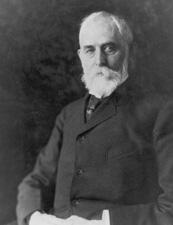
Here you will find contact information for Senator John Fairfield Dryden, including email address, phone number, and mailing address.
| Name | John Fairfield Dryden |
| Position | Senator |
| State | New Jersey |
| Party | Republican |
| Status | Former Representative |
| Term Start | January 29, 1902 |
| Term End | March 3, 1907 |
| Terms Served | 1 |
| Born | August 7, 1839 |
| Gender | Male |
| Bioguide ID | D000507 |
About Senator John Fairfield Dryden
John Fairfield Dryden (August 7, 1839 – November 24, 1911) was an American insurance executive and Republican politician who represented New Jersey in the United States Senate from 1902 to 1907. Widely known as the “father of industrial insurance,” he founded what became the Prudential Insurance Company and the Fidelity Trust Company, and he served as president of Prudential from 1881 until his death. A member of the Republican Party, Dryden contributed to the legislative process during one term in office, representing the interests of his New Jersey constituents during a significant period in American political and economic development.
Dryden was born in Temple, Maine, on August 7, 1839. In 1846 he moved with his parents to Worcester, Massachusetts, where he spent much of his youth. He was educated at Worcester Academy, from which he graduated, and he later attended Yale College. His early exposure to New England’s commercial and intellectual life helped shape the business acumen and reform-minded outlook that would characterize his later career in finance and public service.
By the 1870s Dryden had settled in Newark, New Jersey, where he began to develop the concept of industrial insurance—small, regularly collected premiums designed to provide working-class families with burial and basic life insurance benefits. In 1875 he founded the Widows and Orphans Friendly Society in Newark, an enterprise that would evolve into Prudential Financial. Dryden became the company’s first secretary and, in 1881, its president, a position he held until his death in 1911. Under his leadership, Prudential expanded rapidly and became a pioneering institution in the field of industrial insurance, extending coverage to large numbers of wage earners who previously had little access to such financial protection.
In addition to his work with Prudential, Dryden was one of the founders of the Fidelity Trust Company and played a prominent role in the establishment and management of various street railways, banks, and other financial enterprises in New Jersey, New York, and Pennsylvania. His business activities helped to modernize transportation and finance in the region and reinforced his reputation as a leading figure in American corporate development at the turn of the twentieth century. His influence in these sectors, combined with his insurance innovations, made him a central figure in the economic life of Newark and the broader Mid-Atlantic region.
Dryden entered national politics as a Republican and was elected to the United States Senate from New Jersey to fill the vacancy caused by the death of Senator William J. Sewell. He served from January 29, 1902, to March 3, 1907. During his term, he participated actively in the legislative process at a time when the nation was grappling with issues of industrial regulation, economic growth, and international relations. In the Senate, Dryden served as chairman of the Committee on Relations with Canada during the 57th Congress and as a member of the Committee on Enrolled Bills during the 58th and 59th Congresses. Although he sought reelection, he withdrew his candidacy because of a deadlock in the New Jersey state legislature, which at that time elected U.S. Senators.
Dryden’s personal life was closely intertwined with his business and political endeavors. He married Cynthia Jennings Fairchild (1842–1916), and the couple had two children who would themselves become prominent figures. Their son, Forrest Fairchild Dryden (1864–1932), married Grace Marion Carleton (1865–1936) and succeeded his father as president of Prudential, serving in that capacity until 1922. Their daughter, Susan Fairchild “Susie” Dryden (1870–1932), married Anthony R. Kuser, a prominent businessman and philanthropist. Through these family connections, Dryden’s influence extended into subsequent generations of business and public life; his grandson, John Dryden Kuser, later served as a New Jersey state senator and was the first husband of socialite and philanthropist Brooke Astor.
In his later years, Dryden continued to lead Prudential and to oversee his various financial interests while maintaining residences that reflected his considerable wealth and status. At the time of his death, his estate was valued at approximately $50,000,000 (about $1.22 billion in 2024 dollars). He maintained a home in Bernardsville, New Jersey, and was in the process of constructing a large residence at High Point, New Jersey, intended to be one of the largest homes in the country. After his death, his daughter Susan used part of the Prudential-derived fortune to donate 10,500 acres at New Jersey’s highest elevation for a state park, thereby creating a lasting public memorial associated with the family name.
John Fairfield Dryden died in Newark, New Jersey, on November 24, 1911, from pneumonia that developed following the surgical removal of gallstones two weeks earlier. A funeral service was held at the Third Presbyterian Church in Newark, reflecting his prominence in the city he had helped transform into a financial and industrial center. He was buried at Mount Pleasant Cemetery in Newark. Upon his death, the presidency of Prudential passed to his son Forrest F. Dryden, ensuring continuity in the company he had built and cementing his legacy as a leading figure in American insurance, finance, and public service.