Representative John Jacob Esch
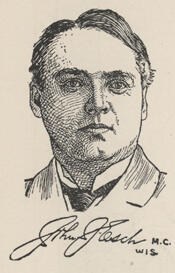
Here you will find contact information for Representative John Jacob Esch, including email address, phone number, and mailing address.
| Name | John Jacob Esch |
| Position | Representative |
| State | Wisconsin |
| District | 7 |
| Party | Republican |
| Status | Former Representative |
| Term Start | December 4, 1899 |
| Term End | March 3, 1921 |
| Terms Served | 11 |
| Born | March 20, 1861 |
| Gender | Male |
| Bioguide ID | E000212 |
About Representative John Jacob Esch
John Jacob Esch (March 20, 1861 – April 27, 1941) was an American lawyer, Republican politician, and federal regulator from La Crosse, Wisconsin. He served 22 years as a member of the U.S. House of Representatives, representing Wisconsin’s 7th congressional district from 1899 to 1921, and later was a member of the Interstate Commerce Commission from 1921 to 1927, with a contested recess appointment in 1928. Over eleven consecutive terms in Congress, he played a central role in shaping early twentieth-century transportation and regulatory policy.
Esch was born near Norwalk, Monroe County, Wisconsin, on March 20, 1861, the son of Rev. Henry Esch and Agnes Mathilda (Menn) Esch. His father, an immigrant from Westphalia, Germany, had come to the United States as a Lutheran minister. Soon after John’s birth, Rev. Esch retired from the ministry because of poor health and entered the manufacturing trade, and the family remained in western Wisconsin. John Esch attended local schools and graduated from Sparta High School. He then enrolled at the University of Wisconsin, where he completed his undergraduate studies and graduated in 1882.
Following his graduation, Esch read law for a year but lacked the funds for immediate formal legal training. To support further study, he taught school for three years. In 1886, he returned to the University of Wisconsin to pursue a law degree, completing the required two years of coursework in a single year while simultaneously teaching geometry at Madison High School. He was admitted to the Wisconsin bar in 1887 and began the practice of law in La Crosse, Wisconsin, where he became a partner in the firm of Winter, Esch & Winter. On June 26, 1889, he married Anna Herbst; the couple had two sons and five daughters.
In addition to his legal career, Esch was active in military and civic affairs in Wisconsin. In 1883, he organized a volunteer military company known as the Sparta Rifles, which later became part of the Wisconsin National Guard, and he commanded that company from 1883 to 1887. After moving to La Crosse, he helped organize another Guard company, the Gateway City Guards, serving first as first lieutenant and later as captain. His service and legal training led to his appointment in 1894 as acting judge advocate general of the Wisconsin National Guard by Governor William H. Upham. Esch also became involved in Republican politics in the 1890s, serving as a delegate to the Wisconsin Republican state conventions in 1894 and 1896, which helped establish his standing within the party.
Esch was first elected to Congress in 1898 as a Republican from Wisconsin’s 7th congressional district and took his seat in the Fifty-sixth Congress on March 4, 1899. He was subsequently re-elected to ten succeeding Congresses, serving continuously until March 3, 1921. His 22 years in the House of Representatives spanned a significant period in American history, including the Progressive Era and World War I, during which he participated in the legislative process and represented the interests of his constituents in western Wisconsin. Initially, Esch served on the Committee on Public Lands and the Committee on Military Affairs, where he was associated with military legislation following the Spanish–American War. After six years in the House, he was appointed to the Committee on Interstate and Foreign Commerce and relinquished his earlier committee assignments to devote his full attention to that panel.
On the Committee on Interstate and Foreign Commerce, Esch became one of the House’s leading authorities on transportation and regulatory policy. He played a major role in drafting and advancing legislation that expanded federal oversight of railroads and other carriers. The Hepburn Act of 1906, which significantly strengthened the powers of the Interstate Commerce Commission over railroad rates and practices, was based heavily on an earlier bill he had introduced. Among his other legislative achievements were the Hours of Service Act, regulating the working hours of railroad employees; the Esch Car Service Act, addressing the allocation and use of railroad cars; the Boiler Inspection Act, improving safety standards for locomotive boilers; the Federal Water Power Act, establishing a framework for the development of hydroelectric power on navigable waters; and the Esch-Cummins Act, also known as the Transportation Act of 1920, which reorganized federal control and regulation of railroads following World War I and brought him national prominence. On April 5, 1917, Esch was among 50 members of the House who voted against declaring war on Germany, a stance that placed him in a minority within his party and the chamber.
Esch’s long tenure in Congress ended after he was defeated in the Republican primary in 1920. When he left the House for the final time on March 3, 1921, members on both sides of the aisle stood and cheered him, an unusual tribute reflecting broad respect for his service. Shortly thereafter, on March 11, 1921, President Warren G. Harding nominated him to serve on the Interstate Commerce Commission. The Senate adjourned without acting on the nomination, and Harding granted Esch a recess appointment on March 21; Esch took the oath of office on March 28, 1921. When the Senate reconvened, it confirmed him on April 18, 1921, by a vote of 52 to 3. He served on the Commission through 1927 and was elected chairman for that year.
On December 19, 1927, President Calvin Coolidge reappointed Esch to a second term on the Interstate Commerce Commission. The Senate did not act on the nomination before his initial term expired at the end of 1927, so Coolidge granted him a recess appointment on January 3, 1928. Esch’s renomination became the focus of intense controversy centered on a case involving freight rates from Pennsylvania coalfields to Lake Erie ports. Esch had first voted in the minority against granting the preferential rates, but when the Commission reconsidered the matter, he changed his vote and joined the majority in favor of the new rates. Southern coal interests and their Senate allies, adversely affected by the decision, charged that he had altered his vote to secure his renomination by Coolidge. Esch denied any political motive, citing new data submitted to the Commission and a congressional resolution directing the Commission to consider local economic conditions as the basis for his change. Nonetheless, on March 16, 1928, the Senate rejected his nomination by a vote of 39 to 29. His recess appointment expired with the adjournment of Congress on May 29, 1928, and he left the Commission, an outcome that angered many of his fellow commissioners, who believed members should be free to vote their consciences without fear of political retaliation.
After leaving federal service, Esch remained in Washington, D.C., and returned to the practice of law, becoming a partner in a major Washington law firm. He continued to be active in professional and civic organizations, serving as president of the Association of Practitioners Before the Interstate Commerce Commission from 1930 to 1931 and as a member of the Washington Board of Trade. Reflecting his longstanding interest in international affairs and conflict prevention, he also served as president of the American Peace Society from 1930 to 1938. In 1938, Esch retired from active professional life and returned to Wisconsin. He died on April 27, 1941, closing a career that had spanned local military service, a prominent role in Congress, and influential work in federal regulation of transportation and commerce.