Representative John R. Fellows
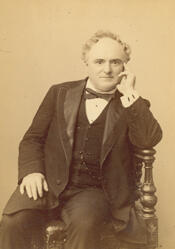
Here you will find contact information for Representative John R. Fellows, including email address, phone number, and mailing address.
| Name | John R. Fellows |
| Position | Representative |
| State | New York |
| District | 14 |
| Party | Democratic |
| Status | Former Representative |
| Term Start | December 7, 1891 |
| Term End | March 3, 1895 |
| Terms Served | 2 |
| Born | July 29, 1832 |
| Gender | Male |
| Bioguide ID | F000067 |
About Representative John R. Fellows
John R. Fellows (July 29, 1832 – December 7, 1896) was an American lawyer and politician who built a prominent career in both Arkansas and New York, serving as New York County District Attorney and as a Democratic Representative from New York in the United States Congress from 1891 to 1895. He served as New York County District Attorney from 1888 to 1890 and again from 1894 until his death in 1896, and he was a member of the U.S. House of Representatives for two terms, from March 4, 1891, until his resignation effective December 31, 1893.
Fellows was born in Troy, Rensselaer County, New York, the son of Tisdale Eddy Fellows (1800–1874), a farmer who later became Superintendent of the Halfmoon Cemetery, and Eliza (Harris) Fellows (1809–1867). During his childhood the family moved to a farm in Stillwater, in Saratoga County, New York, in an area that is now part of the city of Mechanicville. He attended local country schools and grew up in a rural environment that shaped his early years. Among his boyhood playmates was Elmer E. Ellsworth, who later became nationally known as the first Union officer killed in the Civil War.
In 1850, at the age of eighteen, Fellows left New York and went to Camden, Ouachita County, Arkansas, to live with an uncle. There he read law, studied in local offices, and was admitted to the bar in 1855. He established a legal practice in Camden and at one time was in partnership with Walter L. Bragg, who later became a federal official. Fellows quickly entered public life in Arkansas. In 1860 he ran for presidential elector on the Constitutional Union ticket of John Bell and Edward Everett, although Arkansas was carried by Southern Democrat John C. Breckinridge. He served as a delegate to the Arkansas state secession convention in 1861, aligning himself with the state’s decision to leave the Union.
With the outbreak of the Civil War, Fellows enlisted in the 1st Arkansas Infantry Regiment of the Confederate States Army. Following the Battle of Shiloh in April 1862, he was promoted to colonel and assigned to staff duties as assistant adjutant to Confederate General William Beall. He later served as inspector general at Port Hudson, Louisiana, a key Confederate stronghold on the Mississippi River. When Port Hudson fell to Union forces on July 9, 1863, Fellows was captured and became a prisoner of war. He remained in Union custody until the end of the Civil War and was released on June 10, 1865.
After the war, Fellows returned to Camden and resumed the practice of law. He entered Reconstruction-era politics and served as a member of the Arkansas Senate from 1866 to 1867. On July 4, 1867, he married Lizzie Reynolds; the couple had six children. His oratorical skills and growing reputation brought him to the attention of national Democratic leaders. In 1868 he was a delegate to the Democratic National Convention held in the new Tammany Hall building in New York City. There he attracted the notice of Tammany Hall boss William M. Tweed, who regarded him as an eloquent and effective campaign speaker. At Tweed’s urging, Fellows moved to New York City to continue his legal career and to campaign on behalf of the Tammany organization.
Upon his relocation to New York, Fellows was drawn into the city’s legal and political establishment. In 1868, through Tweed’s influence, Corporation Counsel Richard O’Gorman appointed him Assistant Corporation Counsel. The following year, in 1869, New York County District Attorney Samuel B. Garvin appointed Fellows an Assistant New York County District Attorney. He served in that capacity until the end of 1872, when Garvin’s term expired and a Republican district attorney took office. After the fall of Tweed and the exposure of the Tammany Ring, Fellows broke with Tammany Hall and joined the Anti-Tammany Democrats in New York City, a group known at various times as the “Young Democracy,” the “County Democracy,” and “Irving Hall.” In 1882 he was reappointed Assistant District Attorney by John McKeon and continued in that post under successive district attorneys John Vincent, Wheeler H. Peckham, Peter B. Olney, and Randolph B. Martine.
Fellows’s prominence in New York legal circles culminated in his election as New York County District Attorney in November 1887. Running on both the Tammany Hall and County Democracy tickets, he defeated his fellow Assistant District Attorney De Lancey Nicoll, a Democrat who had accepted the Republican nomination. The campaign was fiercely contested and marred by controversy when The New York Times published two letters Fellows had written to William M. Tweed on February 1, 1873, requesting a loan of $523, a sum later estimated to be roughly $13,727 in 2024 dollars. The Times asserted that this “loan,” which was never repaid, represented compensation for Fellows’s role in securing a disagreement of the jury in a Tweed corruption trial the previous day. Despite the allegations, Fellows was elected and served as district attorney from 1888 to 1890. He chose not to seek reelection in November 1890, preferring instead to rejoin Tammany Hall and pursue a seat in Congress; Nicoll was then elected on the Tammany ticket to succeed him as district attorney.
As a member of the Democratic Party, Fellows was elected to the United States House of Representatives from New York and served during a significant period in American political and economic history. He won election to the Fifty-second and Fifty-third Congresses and served from March 4, 1891, to December 31, 1893, representing his New York constituency for two full terms. During his tenure in Congress, he participated in the legislative process, contributed to debates on issues of the day, and represented the interests of his constituents in the House of Representatives. His service in Congress coincided with the administration of President Benjamin Harrison and the early years of President Grover Cleveland’s second term, a time marked by tariff debates, monetary policy disputes, and the approach of the Panic of 1893. Fellows resigned his seat effective December 31, 1893, to return to New York City and resume the office of New York County District Attorney.
Returning to local office, Fellows was again elected on the Tammany ticket as New York County District Attorney and took office on January 1, 1894. He held this position until his death in 1896, overseeing prosecutions in the nation’s largest city during a period of intense political factionalism and public scrutiny of urban corruption. In addition to his local and congressional roles, Fellows maintained a continuous presence in national Democratic politics. He was a delegate to every Democratic National Convention from 1868 onward. In 1896 he attended the Democratic National Convention that nominated William Jennings Bryan on a Free Silver platform, but he repudiated Bryan’s candidacy and the party’s monetary policy plank. Aligning himself with the “Gold Democrats,” he became a delegate in September 1896 to the National Democratic Convention in Indianapolis, which nominated John M. Palmer and Simon B. Buckner on a pro–gold standard ticket for the 1896 presidential election.
John R. Fellows died of stomach cancer on December 7, 1896, at his home at 610 West 152nd Street in New York City, while still serving as New York County District Attorney. He was buried in Trinity Church Cemetery in Manhattan. His career, spanning Confederate military service, Reconstruction politics in Arkansas, and high-profile legal and political roles in New York, reflected the turbulent transitions of the United States in the latter half of the nineteenth century and left a record of sustained engagement in both local and national Democratic Party affairs.