Representative John William Flannagan
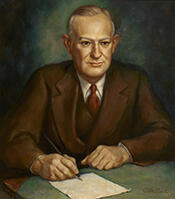
Here you will find contact information for Representative John William Flannagan, including email address, phone number, and mailing address.
| Name | John William Flannagan |
| Position | Representative |
| State | Virginia |
| District | 9 |
| Party | Democratic |
| Status | Former Representative |
| Term Start | December 7, 1931 |
| Term End | January 3, 1949 |
| Terms Served | 9 |
| Born | February 20, 1885 |
| Gender | Male |
| Bioguide ID | F000191 |
About Representative John William Flannagan
John William Flannagan Jr. (February 20, 1885 – April 27, 1955) was an American politician of the Democratic Party who represented Virginia in the United States House of Representatives from 1931 to 1949. He served nine consecutive terms in Congress during a significant period in American history, contributing to the legislative process and representing the interests of his constituents. The John W. Flannagan Dam in Virginia is named in his honor, reflecting his influence on regional development and public works.
Flannagan was born on a farm near Trevilians in Louisa County, Virginia, on February 20, 1885. Raised in a rural environment in central Virginia, he was familiar from an early age with the agricultural and economic concerns that would later shape much of his public career. His early life on the farm informed his understanding of the challenges faced by farmers and small communities in the South during the late nineteenth and early twentieth centuries.
Flannagan pursued higher education in law and attended Washington and Lee University in Lexington, Virginia. He earned his law degree in 1907 and was admitted to the bar that same year. Immediately thereafter, he began the practice of law, establishing himself as an attorney in southwestern Virginia. His legal training and early professional experience provided the foundation for his later work in public office and legislative service.
Flannagan’s public career began at the local level when he became the Commonwealth’s attorney for Buchanan County, Virginia, serving in that position in 1916 and 1917. In this role he was responsible for prosecuting criminal cases on behalf of the state, gaining practical experience in public law and administration. After his term as Commonwealth’s attorney, he returned to private legal practice but also expanded his professional activities into banking. From 1917 to 1930 he was engaged both in the practice of law and in banking, building a reputation in legal, financial, and civic affairs in his region of Virginia.
In 1930, Flannagan was elected as a Democrat to the Seventy-second Congress and took his seat on March 4, 1931. He was subsequently reelected to the eight succeeding Congresses, serving continuously until January 3, 1949. His eighteen years in the House of Representatives spanned the Great Depression, the New Deal era, World War II, and the immediate postwar period. As a member of the House of Representatives, John William Flannagan participated actively in the democratic process and represented the interests of his constituents in Virginia, particularly those in rural and agricultural communities.
During his congressional service, Flannagan rose to positions of significant responsibility. He served as chairman of the House Committee on Agriculture during the Seventy-eighth and Seventy-ninth Congresses, a period that covered much of World War II and the early postwar years. In this capacity he played a central role in shaping federal agricultural policy, including measures related to farm production, price supports, and food distribution at a time when agricultural output was critical to both domestic needs and the war effort. In 1945 he served as a congressional adviser to the first session of the Food and Agriculture Organization of the United Nations, held at Quebec, reflecting his expertise in agricultural issues and his involvement in the emerging framework of international cooperation on food and farming.
Flannagan chose not to be a candidate for renomination in 1948 and concluded his congressional service on January 3, 1949. After leaving Congress, he resumed the practice of law in Bristol, Virginia. He continued his legal work there until his death, remaining an active figure in the community and in the legal profession. John William Flannagan Jr. died in Bristol on April 27, 1955. He was interred in Mountain View Cemetery, leaving a legacy marked by long service in the House of Representatives, leadership in agricultural policy, and recognition in the form of the John W. Flannagan Dam that bears his name.