Representative John Joyce Gilligan
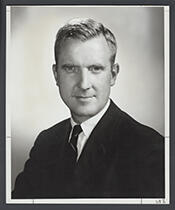
Here you will find contact information for Representative John Joyce Gilligan, including email address, phone number, and mailing address.
| Name | John Joyce Gilligan |
| Position | Representative |
| State | Ohio |
| District | 1 |
| Party | Democratic |
| Status | Former Representative |
| Term Start | January 4, 1965 |
| Term End | January 3, 1967 |
| Terms Served | 1 |
| Born | March 22, 1921 |
| Gender | Male |
| Bioguide ID | G000208 |
About Representative John Joyce Gilligan
John Joyce “Jack” Gilligan (March 22, 1921 – August 26, 2013) was an American World War II veteran, educator, and Democratic politician from Ohio who served as a U.S. Representative and as the 62nd governor of Ohio from 1971 to 1975. A member of the Democratic Party, he represented Ohio’s 1st Congressional District in the United States House of Representatives from 1965 to 1967, contributing to the legislative process during one term in office. He was the father of Kathleen Sebelius, who later served as governor of Kansas and as United States Secretary of Health and Human Services, making them the first father–daughter duo to serve as governors in the United States.
Gilligan was born in Cincinnati, Hamilton County, Ohio, on March 22, 1921, the son of Harry Gilligan, a funeral home operator, and his wife, Blanche. He had a twin sister, Jeanne Joyce Gilligan, and was raised in an Irish Catholic family. He attended local schools and graduated from St. Xavier High School in Cincinnati in 1939. He then enrolled at the University of Notre Dame, from which he graduated in 1943. His education was interrupted by military service during World War II, after which he continued his studies in law, earning a degree from the University of Cincinnati College of Law in 1947.
During World War II, Gilligan served in the United States Navy, seeing duty in the Atlantic, Pacific, and Mediterranean theaters. He was assigned as a destroyer gunnery officer, a role that placed him in active naval operations across multiple fronts. His wartime experience, which he later discussed publicly, including in conversations with his daughter Kathleen Sebelius, shaped his outlook on public service and international affairs. Following his discharge, he returned to Ohio to complete his legal education and begin his professional and academic career.
After the war and completion of law school, Gilligan embarked on a career in education and local politics. From 1948 to 1953 he taught literature at Xavier University in Cincinnati. He entered public office as a member of the Cincinnati city council, serving from 1953 to 1963. His decade on the council established him as a prominent Democratic figure in southwestern Ohio. In 1962 he was a candidate for Ohio Congressman-at-Large, marking his first bid for statewide federal office, and further raising his profile within the Democratic Party.
In 1964, Gilligan was elected as a Democrat to the Eighty-ninth Congress as the U.S. Representative for Ohio’s 1st District, serving from January 3, 1965, to January 3, 1967. His service in Congress occurred during a significant period in American history, amid the Great Society legislative agenda and the escalation of U.S. involvement in Vietnam. As a member of the House of Representatives, John Joyce Gilligan participated in the democratic process and represented the interests of his Cincinnati-area constituents. He narrowly lost his bid for re-election to the Ninetieth Congress in 1966 to Republican Robert Taft Jr., after the Republican-controlled Ohio General Assembly redrew his district in a manner widely viewed as favoring the Republican Party. In 1968, he sought a seat in the United States Senate and defeated incumbent Senator Frank J. Lausche in the Democratic primary, but he narrowly lost the general election to Republican William B. Saxbe after Lausche declined to support him in the fall campaign.
Gilligan returned to statewide politics in 1970 and won election as governor of Ohio, defeating Republican state auditor Roger Cloud by 342,903 votes. He served as the 62nd governor from 1971 to 1975. His signature achievement in office was the creation of Ohio’s modern state income tax, a major restructuring of the state’s fiscal system that financed expanded public services, including education and social programs. Although widely regarded as a favorite for a second term, he was defeated for re-election in 1974 in an upset during the strongly Democratic Watergate year, losing to former Republican governor James A. Rhodes—who had been barred from running in 1970 due to term limits—by only 11,488 votes. Many observers attributed his defeat to a backlash from segments of big business opposed to his tax and regulatory policies and supportive of Rhodes’s return. During his governorship, on October 17, 1973, Gilligan publicly claimed to have seen an unidentified flying object while driving near Ann Arbor, Michigan, later recounting at a press conference, “I saw one (UFO) the other night, so help me. I’m absolutely serious. I saw this.”
Following his gubernatorial term, Gilligan continued to hold significant positions in public service and civic life. From 1977 to 1979 he served as administrator of the United States Agency for International Development (USAID), overseeing American foreign assistance programs during the Carter administration. In 1980 he was elected to the National Governing Board of Common Cause, a nonpartisan citizens’ advocacy organization. He served as director of the Institute for Public Policy from 1979 to 1986, and from 1986 to 1992 he returned to his alma mater, the University of Notre Dame, as a member of the faculty, teaching and writing on public policy and government. He later served as director of the civic issues forum at the University of Cincinnati College of Law, further extending his engagement with legal and public affairs education.
In his later years, Gilligan remained active in local education and community affairs. In 1999 he was elected to the Board of Education of the Cincinnati Public Schools, contributing his experience in government and policy to the governance of the city’s school system. He chose not to stand for re-election when his term expired in 2007. Gilligan was the father of four children, including Kathleen Sebelius, whose own political career as governor of Kansas and U.S. Secretary of Health and Human Services underscored the family’s multigenerational involvement in public life. John Joyce Gilligan died at his home in Cincinnati on August 26, 2013, at the age of 92. His son reported that the cause of death was congestive heart failure.