Representative John Montgomery Glover
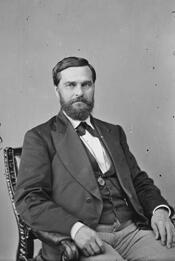
Here you will find contact information for Representative John Montgomery Glover, including email address, phone number, and mailing address.
| Name | John Montgomery Glover |
| Position | Representative |
| State | Missouri |
| District | 12 |
| Party | Democratic |
| Status | Former Representative |
| Term Start | December 1, 1873 |
| Term End | March 3, 1879 |
| Terms Served | 3 |
| Born | September 4, 1822 |
| Gender | Male |
| Bioguide ID | G000245 |
About Representative John Montgomery Glover
John Montgomery Glover (September 4, 1822 – November 15, 1891) was an American politician and lawyer who served as a U.S. Representative from Missouri and was a member of the Democratic Party. He represented Missouri in the United States House of Representatives from 1873 to 1879, serving three consecutive terms during a significant period in American history following the Civil War and Reconstruction. He was also the uncle of John Milton Glover, who later served as a U.S. Representative from Missouri.
Glover was born on September 4, 1822, and came of age in the antebellum United States, a time of rapid territorial expansion and intensifying national debate over slavery and states’ rights. Details of his early childhood and family background are not extensively documented in standard reference works, but his later professional and political activities indicate that he received a level of education sufficient to enter the legal profession and participate actively in public life. His formative years unfolded against the backdrop of a growing nation, and this environment helped shape his subsequent engagement with law and politics.
Educated in the law, Glover prepared for a career as an attorney, a common pathway into politics in the nineteenth century. After reading law, as was customary at the time, he was admitted to the bar and entered legal practice. His work as a lawyer provided him with experience in statutory interpretation, public affairs, and advocacy, skills that would later inform his legislative career. Through his legal practice and involvement in civic matters, he established himself as a figure of some prominence, which facilitated his entry into elective office.
By the early 1870s, Glover had become sufficiently well known in Missouri Democratic circles to secure election to the United States House of Representatives. A member of the Democratic Party, he was elected to represent Missouri in Congress beginning with the Forty-third Congress, taking office on March 4, 1873. He was subsequently reelected to the Forty-fourth and Forty-fifth Congresses, serving continuously until March 3, 1879. During these three terms in office, he contributed to the legislative process at a time when the nation was grappling with the aftermath of the Civil War, the end of Reconstruction, economic instability, and debates over federal authority and civil rights.
As a member of the House of Representatives, Glover participated in the democratic process and represented the interests of his Missouri constituents in national affairs. His service coincided with major issues such as the adjustment of Southern states to postwar conditions, questions of amnesty and reconciliation, and the economic challenges of the 1870s, including the Panic of 1873 and its long recessionary aftermath. Within this context, he worked within the Democratic Party’s congressional ranks as they sought to influence federal policy and respond to the concerns of voters in Missouri and across the country.
After leaving Congress in 1879, Glover returned to private life. Like many former members of the House in his era, he likely resumed his legal practice and remained engaged in local and state affairs, drawing on his experience in national government. Although he did not return to federal office, his three-term tenure in the House placed him among the notable Missouri Democrats who helped shape the state’s role in national politics during the late nineteenth century.
John Montgomery Glover died on November 15, 1891. His career reflected the trajectory of many nineteenth-century American politicians who combined legal training with public service and who served in Congress during the turbulent decades following the Civil War. His familial connection to John Milton Glover, who later also served as a U.S. Representative from Missouri, underscored the presence of a political tradition within the Glover family and linked his public life to a broader pattern of political continuity in Missouri’s representation in Congress.