Senator John Chandler Gurney
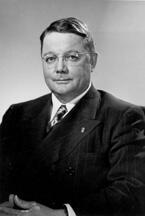
Here you will find contact information for Senator John Chandler Gurney, including email address, phone number, and mailing address.
| Name | John Chandler Gurney |
| Position | Senator |
| State | South Dakota |
| Party | Republican |
| Status | Former Representative |
| Term Start | January 3, 1939 |
| Term End | January 3, 1951 |
| Terms Served | 2 |
| Born | May 21, 1896 |
| Gender | Male |
| Bioguide ID | G000532 |
About Senator John Chandler Gurney
John Chandler “Chan” Gurney (May 21, 1896 – March 9, 1985) was an American businessman, World War I veteran, and Republican politician from South Dakota, most notable for his service as a United States Senator from 1939 to 1951. Over the course of two terms in office, he represented South Dakota during a transformative period encompassing the Great Depression, World War II, and the early Cold War, and he contributed actively to the legislative process and the development of national defense policy.
Gurney was born in Yankton, South Dakota, on May 21, 1896, the son of Deloss Butler Gurney and Henrietta (Klopping) Gurney. He attended the public schools of Yankton and graduated from Yankton High School in 1915. Following his graduation, he entered the family enterprise, Gurney’s Seed and Nursery Company, a well-known regional mail-order seed and nursery business. He became active in its management and was appointed secretary and treasurer, gaining early experience in business administration and marketing that would shape his later career.
In 1917, Gurney married Evelyn Bordeno (1897–1993) in Kansas City, Kansas. The couple became the parents of three children: Ida, John, and Deloss. Although married and therefore ineligible for the draft during World War I, Gurney volunteered for military service. He was assigned to Company A, 34th Engineer Regiment of the United States Army and completed his training at Camp Lewis, Washington. He served in France in 1918 and 1919, attaining the rank of sergeant before being discharged due to illness. His wartime experience and continuing identification with veterans’ causes later informed his civic and political activities.
After returning from France, Gurney resumed work in the family seed business in Yankton, remaining there until 1926. That year he became a pioneer in commercial radio advertising when he acquired and operated radio station WNAX in Yankton, using the new medium to promote the seed and nursery business and to build a broader commercial presence. In 1933 he moved to Sioux Falls, South Dakota, where he entered the wholesale gasoline and oil business and became an early developer and advocate of gasohol, reflecting his interest in both energy and agricultural products. Active in civic and fraternal organizations, he was a member of the Sons of the American Revolution, the American Legion, the Veterans of Foreign Wars, the Masons, and the Elks, underscoring his ties to veterans and community life in South Dakota.
Gurney first sought federal office in 1936, running as the Republican candidate for the United States Senate. He was narrowly defeated by the incumbent Democrat, Senator William J. Bulow. Undeterred, he ran again in 1938 and was elected, beginning his Senate service on January 3, 1939. A member of the Republican Party, he was generally regarded as a moderate critic of President Franklin D. Roosevelt and the New Deal, but he consistently supported measures aimed at strengthening national defense and aiding the United Kingdom in its struggle against Nazi Germany prior to U.S. entry into World War II. He voted to confirm Henry L. Stimson as Secretary of War and Frank Knox as Secretary of the Navy, appointments opposed by isolationist senators who viewed both men as too “pro-British.”
During the critical prewar and early wartime years, Gurney aligned himself with the interventionist wing of the Senate on key national security issues. He supported extension of the Selective Service Act over the objections of isolationist senators such as Burton K. Wheeler, Gerald Nye, Henrik Shipstead, and David Ignatius Walsh, arguing that preparedness was essential. In March 1941 he voted in favor of the Lend-Lease Act, authorizing military aid to nations whose defense was deemed vital to that of the United States, a measure that in practice primarily assisted the British Royal Navy in the Battle of the Atlantic. When criticized by isolationist elements in the press for his stance, he declared himself “unmoved by the blatherings of Hitlerites.” He likewise supported subsequent Lend-Lease appropriations in October 1941 and backed increased funding for the Army and Navy early in 1941, remarking that “one would have to be a fool to oppose” such a bill. Gurney maintained that public opinion in South Dakota, as reflected in surveys in cities and towns such as Sioux Falls, Rapid City, Aberdeen, Brookings, and his native Yankton, favored robust aid to Great Britain, and he argued that this position showed him to be more in touch with his constituents than some neighboring isolationist senators were with theirs.
Gurney was reelected to the Senate in 1944 and served continuously from January 3, 1939, to January 3, 1951. His tenure spanned the Second World War and the early years of the Cold War, and he played a significant role in shaping postwar military policy. In the 80th Congress (1947–1949), he became the first chairman of the newly consolidated U.S. Senate Committee on Armed Services, formed by the merger of the former Committees on Naval Affairs and Military Affairs. In this capacity, he oversaw legislation related to the reorganization and unification of the armed forces and broader national defense issues in the immediate postwar period. Despite his influence and seniority, Gurney was unsuccessful in his bid for renomination in 1950, losing the Republican primary to Representative Francis Case, who subsequently won the general election.
Following his Senate service, Gurney continued his involvement in federal public affairs. In 1951 he was appointed to the Civil Aeronautics Board (CAB), the federal agency then responsible for regulating commercial aviation. He served as a member of the board until 1964 and was its chairman from 1954 to 1957, a period marked by rapid expansion of commercial air travel and the transition to jet aircraft. His work on the CAB extended his influence into the emerging field of civil aviation policy and regulation, complementing his earlier legislative experience on defense and transportation matters.
In his later years, Gurney retired to his hometown of Yankton, South Dakota. He remained a respected figure in the state, remembered both for his business innovations in radio and energy and for his long record of public service. John Chandler “Chan” Gurney died in Yankton on March 9, 1985, and was buried in Yankton Cemetery. In recognition of his contributions to the state and the nation, the Chan Gurney Municipal Airport in Yankton was named in his honor.