Representative John Williams Gwynne
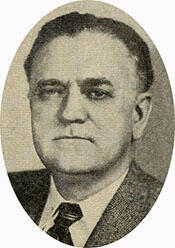
Here you will find contact information for Representative John Williams Gwynne, including email address, phone number, and mailing address.
| Name | John Williams Gwynne |
| Position | Representative |
| State | Iowa |
| District | 3 |
| Party | Republican |
| Status | Former Representative |
| Term Start | January 3, 1935 |
| Term End | January 3, 1949 |
| Terms Served | 7 |
| Born | October 20, 1889 |
| Gender | Male |
| Bioguide ID | G000543 |
About Representative John Williams Gwynne
John Williams Gwynne (October 20, 1889 – July 5, 1972) was a seven-term Republican U.S. Representative from Iowa’s 3rd congressional district, and later a member and chairman of the Federal Trade Commission during the Eisenhower Administration. A member of the Republican Party, he served in the United States Congress from 1935 to 1949, contributing to the legislative process during seven consecutive terms in office and representing the interests of his Iowa constituents during a period of profound national change.
Gwynne was born in Victor, Iowa, on October 20, 1889. He attended the public schools of his hometown and the surrounding area, receiving the basic education that prepared him for a career in law and public service. He went on to study at the University of Iowa College of Law in Iowa City, where he completed his legal education and graduated in 1914. Admitted to the bar that same year, he immediately commenced the practice of law in Waterloo, Iowa. In addition to his legal work, he engaged in agricultural pursuits, reflecting the agrarian character of his district and the broader economy of Iowa in the early twentieth century.
With the entry of the United States into the First World War, Gwynne entered military service. From 1917 to 1919, he served as a second lieutenant in the 313th Trench Mortar Battery of the 88th Infantry Division of the United States Army. His wartime service placed him among the large cohort of veterans who would later move into public life, and it provided him with leadership experience and a national perspective that would inform his later political career.
After returning to Iowa, Gwynne resumed his legal practice in Waterloo and soon entered local public office. He served as judge of the municipal court of Waterloo from 1920 to 1926, presiding over local judicial matters during a period of postwar adjustment and economic change. He then advanced to county-level office as County Attorney of Black Hawk County, Iowa, a position he held from 1929 to 1934. His tenure as county attorney coincided with the onset and deepening of the Great Depression, giving him direct experience with the legal and social challenges facing his community during that crisis.
Gwynne’s congressional career began in the context of the New Deal realignment. In 1934, he ran for Congress from Iowa’s 3rd congressional district against incumbent Democratic Congressman Albert C. Willford. Willford had been elected in 1932 as part of President Franklin D. Roosevelt’s landslide victory, in only the third instance in which the district had elected a Democrat. In the 1934 general election, Gwynne defeated Willford, returning the seat to Republican control. He took office in the 74th United States Congress on January 3, 1935, and was subsequently re-elected six times, serving in the 74th and the six succeeding Congresses, from January 3, 1935, to January 3, 1949. During these seven terms, which spanned the New Deal, World War II, and the early postwar era, he participated in the democratic process as a member of the House of Representatives and contributed to the legislative work of Congress on behalf of his constituents in northeastern Iowa.
Gwynne’s long tenure in the House came to an end following the 1948 election cycle. Seeking renomination to an eighth term, he faced a strong intra-party challenge from fellow Republican H. R. Gross, a popular radio news commentator well known to Iowa audiences. In the Republican primary, Gross defeated Gwynne, thereby ending Gwynne’s congressional service as of January 3, 1949. His departure from Congress marked the close of fourteen years in the national legislature during a transformative period in American political and economic history.
Gwynne returned to public service at the federal level during the administration of President Dwight D. Eisenhower. In 1953, Eisenhower appointed him to the Federal Trade Commission (FTC), the independent agency charged with enforcing federal antitrust and consumer protection laws. At the same time, the president appointed another Waterloo native, Edward F. Howrey, as chairman of the Commission. When Howrey resigned as chair in 1955, Gwynne was designated to succeed him. He served as chairman of the Federal Trade Commission from 1955 until 1959, overseeing the agency’s work during a period of postwar economic expansion and increasing federal attention to fair competition and trade practices.
After leaving the Federal Trade Commission, Gwynne retired to Waterloo, Iowa, the city that had long been the center of his professional and political life. He lived there quietly in retirement until his death on July 5, 1972. John Williams Gwynne was interred in Memorial Park Cemetery in Waterloo, closing a career that had encompassed military service, local and county office, seven terms in the U.S. House of Representatives, and leadership of a major federal regulatory agency.