Senator John Parker Hale
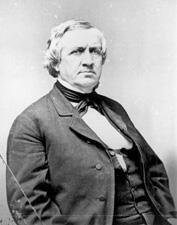
Here you will find contact information for Senator John Parker Hale, including email address, phone number, and mailing address.
| Name | John Parker Hale |
| Position | Senator |
| State | New Hampshire |
| Party | Republican |
| Status | Former Representative |
| Term Start | December 4, 1843 |
| Term End | March 3, 1865 |
| Terms Served | 4 |
| Born | March 31, 1806 |
| Gender | Male |
| Bioguide ID | H000034 |
About Senator John Parker Hale
John Parker Hale (March 31, 1806 – November 19, 1873) was an American politician, lawyer, and prominent anti-slavery leader from New Hampshire who served in both houses of the United States Congress and as United States Minister to Spain. He served in the United States House of Representatives from 1843 to 1845 and in the United States Senate from 1847 to 1853 and again from 1855 to 1865. He began his congressional career as a Democrat, helped establish the anti-slavery Free Soil Party, and later joined the Republican Party. Over the course of four Senate terms, he contributed actively to the legislative process during a period of profound national conflict over slavery and the Union.
Hale was born in Rochester, Strafford County, New Hampshire, on March 31, 1806. He was educated in local schools and later attended Phillips Exeter Academy before enrolling at Bowdoin College in Brunswick, Maine. After graduating from Bowdoin, he studied law and was admitted to the bar, establishing a legal practice in Dover, New Hampshire. His early legal career in Dover brought him into contact with the political and commercial life of the state, laying the groundwork for his entry into public office.
Hale’s formal political career began in state government. In 1832 he was elected to the New Hampshire House of Representatives, where he served as a member of the state legislature. His rising prominence in Democratic politics led to his appointment as United States Attorney for the District of New Hampshire, a position he held under Presidents Andrew Jackson and Martin Van Buren. As U.S. Attorney, he gained a reputation as a capable lawyer and public servant. On September 2, 1834, he married Lucy Hill Lambert of Berwick, Maine; the couple had two daughters, Elizabeth (“Lizzie”) (1835–1895) and Lucy (1841–1915).
In 1842 Hale was elected as a Democrat to the United States House of Representatives, serving from March 4, 1843, to March 3, 1845. During this period he began to distinguish himself as an opponent of the expansion of slavery. His outspoken opposition to the proposed annexation of Texas as a slave state led New Hampshire Democrats to deny him renomination in 1844, effectively ending his House career after a single term. Undeterred, Hale continued to campaign vigorously against slavery and the extension of slave territory, increasingly aligning himself with emerging anti-slavery elements in national politics.
Hale’s break with the Democratic Party culminated in his election to the United States Senate in 1846 as an Independent Democrat from New Hampshire. He took his seat in the Senate on March 4, 1847, and served until March 3, 1853. In the Senate he quickly became one of the strongest and most consistent opponents of slavery and of the Mexican–American War. He is widely regarded as the first U.S. senator to serve on an openly anti-slavery, or abolitionist, platform. Hale was the only senator to vote against the resolution tendering the thanks of Congress to Generals Winfield Scott and Zachary Taylor for their victories in the Mexican–American War, a stance that underscored his opposition to what he viewed as a war of territorial expansion for the benefit of slavery. During this first Senate term he also took up naval reform, opposing both flogging and the spirit ration in the United States Navy and successfully securing the abolition of flogging in September 1850.
As the national debate over slavery intensified, Hale helped establish the Free Soil Party, which opposed the expansion of slavery into the western territories. He was a candidate for the party’s presidential nomination in 1848, though the Free Soil Convention ultimately chose former President Martin Van Buren as its standard-bearer. In 1851, while still in the Senate, Hale served as counsel in the trials arising from the forcible rescue in Boston of Shadrach Minkins, a fugitive slave, reflecting his continued engagement with the legal and political struggle against the Fugitive Slave Act and the institution of slavery. His Senate term ended in March 1853, when he was succeeded by Democrat Charles G. Atherton, and he then resumed the practice of law, this time in New York City.
Hale remained a national figure in anti-slavery politics. In 1852 he secured the Free Soil Party’s presidential nomination and ran as its candidate in the general election, receiving 4.9 percent of the popular vote. The passage of the Kansas–Nebraska Act in 1854, which effectively repealed the Missouri Compromise and opened new territories to the possibility of slavery, spurred the formation of the Republican Party. Hale joined this nascent party and was elected again to the United States Senate, returning to that body in 1855. He served in the Senate from March 4, 1855, until March 3, 1865, now as a leading Republican voice. During this period he was joined in the Senate by other prominent anti-slavery advocates, including Salmon P. Chase and William H. Seward in 1849 and Charles Sumner in 1851, forming a core of committed opponents to the slave power. Hale served as chair of the Senate Republican Conference until 1862 and that year finally succeeded in repealing the Navy’s spirit ration, a reform he had first attempted during his earlier Senate service.
Throughout his long Senate career, Hale was known for his independence, his wit, and his effectiveness as an orator. Washington journalist Benjamin Perley Poore later wrote that Hale “never failed to command attention” in the Senate chamber, describing his “chasseur” style of oratory—skirmishing on the outskirts of an opponent’s position, rallying on unexpected points, and maintaining a marked independence from rigid party discipline. Though many Southern senators regarded his views as radical, even his adversaries generally did not question his motives or personal integrity. As a senator from New Hampshire, he represented his constituents during a critical era that encompassed the Mexican–American War, the rise of sectional parties, the Civil War, and the early years of Reconstruction.
In 1865, at the close of his Senate service, Hale accepted an appointment from President Abraham Lincoln as United States Minister to Spain. He served in Madrid from 1865 until he was recalled in April 1869, representing American interests during the final months of the Civil War and the early Reconstruction period. After his recall, he retired from public office and returned to New Hampshire. His family remained connected to national affairs: his elder daughter, Elizabeth, married first Edward Kinsley and later William Henry “Harry” Jacques, while his younger daughter, Lucy Lambert Hale, became briefly and secretly betrothed in 1865 to John Wilkes Booth, the assassin of President Lincoln. A photograph of Lucy Hale was found on Booth’s person when he was killed by Sergeant Boston Corbett on April 26, 1865; Lucy later married New Hampshire senator William E. Chandler.
In his later years, Hale lived quietly in New Hampshire, his health gradually declining. He died in Dover, New Hampshire, on November 19, 1873. His legacy as an early and outspoken senatorial opponent of slavery and a pioneer of anti-slavery politics in Congress has been commemorated in his home state. Hale is one of several prominent New Hampshire political figures honored with a statue at the New Hampshire State House complex in Concord, and portraits of President Abraham Lincoln and John P. Hale hang side by side in the chamber of the New Hampshire House of Representatives, reflecting his enduring association with the Union cause and the struggle against slavery.