Representative John Hickman
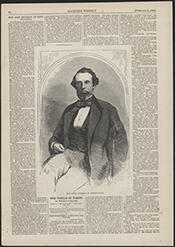
Here you will find contact information for Representative John Hickman, including email address, phone number, and mailing address.
| Name | John Hickman |
| Position | Representative |
| State | Pennsylvania |
| District | 6 |
| Party | Republican |
| Status | Former Representative |
| Term Start | December 3, 1855 |
| Term End | March 3, 1863 |
| Terms Served | 4 |
| Born | September 11, 1810 |
| Gender | Male |
| Bioguide ID | H000562 |
About Representative John Hickman
John Hickman was a United States Representative from Pennsylvania who served in the House of Representatives from 1855 to 1863, representing his constituents through four consecutive terms during a critical period in American history. Known in historical records as John Hickman (Pennsylvania politician) (1810–1875), he was a member of the Republican Party and contributed to the legislative process in the years leading up to and including the early period of the Civil War. His service in Congress placed him at the center of the nation’s intensifying sectional conflicts and the transformation of the party system in the 1850s.
Born in 1810, Hickman came of age in a rapidly changing United States marked by westward expansion, the rise of new political movements, and growing debates over slavery and states’ rights. Although detailed records of his early life and education are limited in the available sources, his later career indicates that he received sufficient legal and political training to enter public life in Pennsylvania, a state that played a pivotal role in national politics throughout the antebellum era. By the time he emerged on the national stage, he was already established within the political and legal circles of his state.
Hickman’s professional career developed in Pennsylvania, where he became active in public affairs and aligned himself with the emerging currents that would soon reshape the nation’s political landscape. His work and reputation within the state led to his election to the United States House of Representatives, where he would serve through a period of profound national crisis. As a Pennsylvania politician, he was part of a broader cohort of mid-nineteenth-century public figures from the state, which also included contemporaries such as John W. Hickman (Pennsylvania politician) (1831–1906), another American politician from Pennsylvania, reflecting the prominence of the Hickman name in the state’s political life.
Elected to Congress in 1855, Hickman entered the House at a time when the old party alignments were breaking down and new coalitions were forming in response to the Kansas–Nebraska Act and the expansion of slavery into the territories. Over the course of four terms, from 1855 to 1863, he served first amid the collapse of the Whig Party and the rise of the Republican Party, and then through the secession crisis and the opening years of the Civil War. As a member of the House of Representatives, John Hickman participated in the democratic process and represented the interests of his Pennsylvania constituents, contributing to debates and legislation that shaped the nation’s response to these challenges. His identification as a Republican placed him within the new political organization that opposed the extension of slavery and supported the preservation of the Union.
Hickman’s congressional service coincided with the Thirty-fourth through the Thirty-seventh Congresses, bodies that wrestled with issues such as territorial governance, the rights of free and enslaved people, and the constitutional limits of federal power. During these years, the House of Representatives became a central arena for conflict over the future of the Union, and Hickman’s role as a Republican representative from a key northern state ensured that he was engaged in the legislative struggles of the era. His tenure extended into the first years of the Civil War, when Congress addressed matters of military organization, finance, and wartime policy, and when the federal government began to move toward emancipation as a war aim.
After leaving Congress in 1863, Hickman returned to private life in Pennsylvania. Although the surviving summary accounts do not provide extensive detail on his later professional activities, his departure from the House came as the war continued to reshape the nation he had helped govern during its onset. He lived to see the end of the Civil War, the abolition of slavery, and the beginning of Reconstruction, a period in which many of the issues that had defined his congressional service were worked out in new constitutional and political arrangements.
John Hickman died in 1875, closing a life that spanned from the early republic through the nation’s greatest internal conflict. His career as a U.S. representative from Pennsylvania from 1855 to 1863 situates him among the legislators who guided the country through the fracturing of the old party system, the secession crisis, and the first phase of the Civil War. His service, alongside that of other figures bearing the Hickman name in American public life—such as John Hickman (Medal of Honor) (1837–1904), an American Civil War sailor and Medal of Honor recipient, and John W. Hickman (Utah politician) (born 1939), an American politician from Utah—illustrates the broader civic engagement of individuals and families who helped shape public affairs at both state and national levels.