Representative John Andrew Hiestand
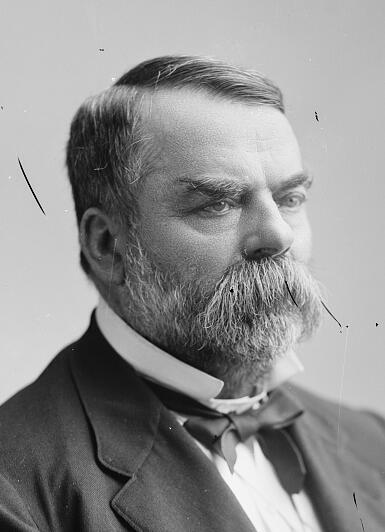
Here you will find contact information for Representative John Andrew Hiestand, including email address, phone number, and mailing address.
| Name | John Andrew Hiestand |
| Position | Representative |
| State | Pennsylvania |
| District | 9 |
| Party | Republican |
| Status | Former Representative |
| Term Start | December 7, 1885 |
| Term End | March 3, 1889 |
| Terms Served | 2 |
| Born | October 2, 1824 |
| Gender | Male |
| Bioguide ID | H000569 |
About Representative John Andrew Hiestand
John Andrew Hiestand (October 2, 1824 – December 13, 1890) was an American politician from Pennsylvania who served as a Republican member of the U.S. House of Representatives from Pennsylvania. He was born in East Donegal Township, Lancaster County, Pennsylvania, where he spent his early years in a rural community along the Susquehanna River. He attended the common schools of the area and continued his education at an academy in Marietta, Pennsylvania, reflecting the typical educational path of a mid-19th-century Pennsylvanian preparing for a professional career.
Hiestand pursued higher education at Pennsylvania College at Gettysburg (now Gettysburg College) in Gettysburg, Pennsylvania. After his collegiate studies, he read law and prepared for admission to the bar, following the customary apprenticeship model of legal training of the period. He was admitted to the bar in 1849 and commenced the practice of law in Lancaster, Pennsylvania, establishing himself in the legal profession in one of the Commonwealth’s most important and historic counties.
Hiestand’s public career began in state politics. Initially affiliated with the Whig Party, he was elected to the Pennsylvania House of Representatives in 1852, 1853, and again in 1856. His repeated elections to the state legislature demonstrated his growing influence and the confidence placed in him by his constituents. In 1858, he purchased an interest in the Lancaster Examiner, a local newspaper, and at that point relinquished the active practice of law. His move into the newspaper business placed him at the center of public discourse in Lancaster County during a time of mounting national tensions over slavery and sectional issues.
In 1861, Hiestand advanced to the upper chamber of the state legislature, serving in the Pennsylvania State Senate for the 16th district. His tenure in the State Senate coincided with the opening year of the American Civil War, a period in which Pennsylvania played a critical role in the Union war effort. After the war, he sought to extend his political career to the national level. In 1868, he was an unsuccessful candidate for election to the U.S. House of Representatives to fill the unexpired term of Thaddeus Stevens, the powerful Republican congressman from Pennsylvania who had died in office. Although he did not win that special election, Hiestand remained a notable figure in Republican politics.
Hiestand’s experience and party loyalty were recognized by the national administration when President Ulysses S. Grant appointed him naval officer at the port of Philadelphia in 1871. This federal customs post, an important patronage position in one of the nation’s major ports, involved oversight of customs collections and related maritime revenue functions. He was reappointed to the same office in 1875 and served until 1879, spanning much of the Grant administration and into the subsequent Republican administration, which underscored his standing within the party and his reputation for administrative competence.
Building on his long record of state and federal service, Hiestand was elected as a Republican to the Forty-ninth and Fiftieth Congresses, serving as a Representative from Pennsylvania in the United States Congress from March 4, 1885, to March 3, 1889. During these two terms in office, he represented his Pennsylvania constituents in the U.S. House of Representatives and contributed to the legislative process at a time of significant economic and political change in the post–Civil War and Gilded Age era. As a member of the House, John Andrew Hiestand participated in the democratic process and represented the interests of his district within the broader national debates of the period. A member of the Republican Party throughout his congressional service, he aligned with the dominant party in Pennsylvania and took part in shaping federal policy during his tenure. He was an unsuccessful candidate for reelection in 1888, bringing his congressional career to a close at the end of the Fiftieth Congress.
After leaving Congress in 1889, Hiestand returned to private life in Lancaster, Pennsylvania, where he had long been a prominent figure in legal, journalistic, and political circles. He died in Lancaster on December 13, 1890. John Andrew Hiestand was interred in Marietta Cemetery in Marietta, Pennsylvania, near the community where he had been educated and where his early life and career were rooted.