Representative John Wallace Houston
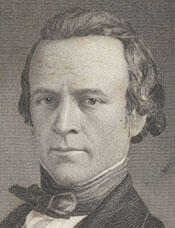
Here you will find contact information for Representative John Wallace Houston, including email address, phone number, and mailing address.
| Name | John Wallace Houston |
| Position | Representative |
| State | Delaware |
| District | At-Large |
| Party | Whig |
| Status | Former Representative |
| Term Start | December 1, 1845 |
| Term End | March 3, 1851 |
| Terms Served | 3 |
| Born | May 4, 1814 |
| Gender | Male |
| Bioguide ID | H000825 |
About Representative John Wallace Houston
John Wallace Houston (May 4, 1814 – April 26, 1896) was an American lawyer, jurist, and politician from Georgetown, in Sussex County, Delaware. A member at different times of the Whig Party and the Democratic Party, he served as U.S. Representative from Delaware from 1845 to 1851 and later as a justice of the Delaware Superior Court. Over the course of his public life he held several key offices in state and national government during a period of mounting sectional tension in the United States.
Houston was born on May 4, 1814, in Concord, Delaware. He attended local country schools and then Newark Academy, a leading preparatory institution in the state. He subsequently enrolled at Yale College, from which he graduated in 1834. While at Yale he was initiated into one of the earliest gatherings of the Skull and Bones society, a collegiate secret society that counted a number of future political leaders among its members. After completing his undergraduate education, he returned to Delaware to pursue legal studies.
Following his graduation from Yale, Houston studied law in Dover, Delaware, and was admitted to the Delaware bar in 1837. Two years later, in 1839, he moved to Georgetown, in Sussex County, where he commenced the practice of law. In this period he established himself as a prominent attorney in southern Delaware. Like many members of the political and professional class in the mid-19th-century Delaware, he was a slaveholder, a fact that placed him within the social and economic order of a border slave state on the eve of the Civil War.
Houston entered public service at the state level before his election to Congress. He served as Secretary of State of Delaware from 1841 to 1844, a position that involved responsibility for state records, official documents, and various administrative functions of the Delaware government. His performance in this statewide office helped to elevate his profile within the Whig Party and prepared him for national legislative service.
In 1844 Houston was elected as a Whig to represent Delaware in the United States House of Representatives. He served three consecutive terms in the 29th, 30th, and 31st Congresses, from March 4, 1845, to March 3, 1851. During these years, U.S. Representatives took office on March 4 and served two-year terms, with elections held on the first Tuesday after November 1. As Delaware’s at-large Representative, Houston participated in the legislative process during a significant period in American history marked by debates over territorial expansion, slavery, and the balance of power between free and slave states. In the 30th Congress he served as chairman of the Committee on Public Buildings and Grounds, overseeing matters related to federal buildings and property in the nation’s capital. He was not a candidate for renomination in 1850, concluding his three terms in the House at the end of the 31st Congress.
After leaving Congress, Houston continued his public career in the judiciary. On May 4, 1855, he was appointed an associate judge of the Delaware Superior Court. In this capacity he sat on one of the state’s principal trial courts, hearing both civil and criminal cases and contributing to the development of Delaware’s jurisprudence. He remained on the bench for nearly four decades, retiring in 1893. During his long judicial tenure he was regarded as a steady figure in Delaware’s legal system, serving through the Civil War, Reconstruction, and the late 19th-century industrial expansion.
Houston also played a role in national efforts to avert conflict on the eve of the Civil War. In 1861 he was a member of the Peace Conference held in Washington, D.C., a gathering of delegates from various states convened in an attempt to devise means to prevent the impending Civil War by proposing constitutional compromises. Although the conference ultimately failed to halt secession and war, Houston’s participation reflected Delaware’s and his own engagement with the crisis facing the Union.
John Wallace Houston died on April 26, 1896, in Georgetown, Delaware. He was buried in the Lewes Presbyterian Church cemetery in Lewes, Delaware. His family’s involvement in public life extended beyond his own career; his nephew, Robert G. Houston, later served as a U.S. Representative from Delaware, continuing the Houston family’s connection to the state’s representation in Congress.