Representative John Adams Hyman
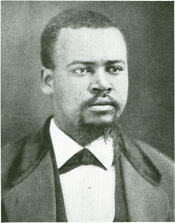
Here you will find contact information for Representative John Adams Hyman, including email address, phone number, and mailing address.
| Name | John Adams Hyman |
| Position | Representative |
| State | North Carolina |
| District | 2 |
| Party | Republican |
| Status | Former Representative |
| Term Start | December 6, 1875 |
| Term End | March 3, 1877 |
| Terms Served | 1 |
| Born | July 23, 1840 |
| Gender | Male |
| Bioguide ID | H001025 |
About Representative John Adams Hyman
John Adams Hyman (July 23, 1840 – September 14, 1891) was a Republican U.S. Congressman from North Carolina who served one term in the United States House of Representatives from 1875 to 1877. Elected from North Carolina’s 2nd congressional district, a newly configured area in the northeast of the state around New Bern, he was the first African American to represent North Carolina in the House of Representatives. His service in Congress occurred during the Reconstruction era, a significant period in American history, and he participated in the legislative process as a member of the House, representing the interests of his constituents during one term in office.
Hyman was born into slavery on July 23, 1840, near Warrenton in Warren County, North Carolina. Over the course of twenty-five years in bondage, he was sold at least eight times and was at one point enslaved in Alabama. As a child he received no formal education. By 1861 he had returned to North Carolina and was working in Warrenton as a janitor for a jeweler named King, a white Pennsylvanian who taught him to read and write. When local white residents discovered that King was educating Hyman, they forced King and his wife to leave the community. Hyman’s persistence in seeking education led to his being sold again at the age of twenty-one to a new master in Alabama, underscoring both the dangers and the determination associated with Black literacy in the antebellum South.
Following the Civil War and the emancipation of enslaved people, Hyman returned to North Carolina in 1865. He settled again in the Warrenton area, where he worked as a farmer, pursued elementary studies, and entered business by establishing a grocery store in Warrenton. His leadership and growing prominence in the African American community were quickly recognized. In 1865 he was chosen as a delegate to the state equal rights convention, an important forum for newly freed Black citizens seeking political and civil rights. He further advanced his political involvement as a delegate to the North Carolina Constitutional Convention of 1868, which helped reshape the state’s basic law during Reconstruction.
Hyman’s formal political career began in state government. In 1868 he was elected to the North Carolina Senate, where he served through successive terms until 1874. As a state senator during the Reconstruction era, he was part of the Republican coalition that sought to expand civil and political rights for African Americans and to reconstruct state institutions in the aftermath of the Civil War. His tenure in the Senate established him as one of the leading Black officeholders in North Carolina and prepared him for national office.
In 1874, Hyman was elected as a Republican to the Forty-fourth United States Congress from North Carolina’s 2nd congressional district, defeating Democrat Garland H. White. The district, newly created by the Democratic-controlled state legislature, encompassed a cluster of majority-Black counties in the northeastern part of the state and became known as the “Black Second.” Democrats had designed the district in part to concentrate Black political power in one area and reduce Black influence elsewhere, but the result was that freedmen and previously free Black residents in the region elected all but two Republican representatives over the next quarter century. Hyman served in Congress from March 4, 1875, to March 3, 1877, contributing to the legislative process as a member of the House of Representatives and participating in the democratic governance of the nation during the closing years of federal Reconstruction. In 1876 he sought the Republican renomination for his seat but was unsuccessful, losing to Curtis Brogden, the immediate past governor of North Carolina, and he subsequently returned to agricultural pursuits.
After leaving Congress, Hyman remained connected to public service. From July 1, 1877, to June 30, 1878, he served as special deputy collector of internal revenue for the fourth district of North Carolina. During this period, the political landscape in his former district continued to evolve. By 1877, New Bern, a key city in the “Black Second,” had become a black-majority town, and African Americans were elected to the board of aldermen and the Craven County Commission. In response, the Democratic-dominated state legislature eventually withdrew the county’s authority to govern itself, though Craven County and other majority-Black counties in the northeast continued to elect at least one Black legislator to the state house for another decade.
Later in life, Hyman moved to Washington, D.C., after being accused of misappropriating church funds in North Carolina, a charge that contributed to his departure from the state. In Washington he held federal positions, working for the United States Post Office Department and later for the United States Department of Agriculture. He continued to support his family, which included his wife and four children, while remaining part of the broader community of African American officeholders and activists who had emerged during and after Reconstruction.
John Adams Hyman died in Washington, D.C., on September 14, 1891. He was buried in Columbian Harmony Cemetery in Washington, D.C., a historic burial ground for African Americans. His legacy as North Carolina’s first African American member of the U.S. House of Representatives has been recognized in his native state; a North Carolina historical marker has been installed in Warrenton, about a block from his former homesite, commemorating his rise from slavery to service in the United States Congress.