Representative John Jarman
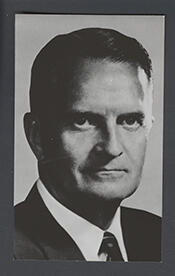
Here you will find contact information for Representative John Jarman, including email address, phone number, and mailing address.
| Name | John Jarman |
| Position | Representative |
| State | Oklahoma |
| District | 5 |
| Party | Democratic |
| Status | Former Representative |
| Term Start | January 3, 1951 |
| Term End | January 3, 1977 |
| Terms Served | 13 |
| Born | July 17, 1915 |
| Gender | Male |
| Bioguide ID | J000057 |
About Representative John Jarman
John Henry Jarman II (July 17, 1915 – January 15, 1982) was a United States Representative from Oklahoma who served in Congress for 26 years, from 1951 to 1977. Over the course of 13 consecutive terms in the House of Representatives, he represented the Oklahoma City–area district during a period of major political and social change and ultimately served as a member of both the Democratic and Republican parties. His long tenure made him a significant figure in mid‑twentieth‑century Oklahoma politics and in the legislative process at the national level.
Jarman was born in Sallisaw, Oklahoma, on July 17, 1915. He grew up in Oklahoma and pursued higher education in the Northeast, attending Yale University, from which he graduated in 1937. He then enrolled at Harvard Law School, earning his law degree in 1941. That same year he was admitted to the bar and returned to Oklahoma, where he began the practice of law in Oklahoma City. His early legal career in the state’s capital city laid the foundation for his later involvement in public service and elective office.
With the entry of the United States into World War II, Jarman enlisted in the United States Army in January 1942, about a month after the Japanese attack on Pearl Harbor. During the war he served in the Security Intelligence Corps, a branch responsible for counterintelligence and security operations, reflecting the trust placed in his legal and analytical skills. He remained on active duty throughout the conflict and was discharged from military service in December 1945. After the war, he returned to Oklahoma City and resumed his legal practice, while also beginning to build a career in state politics.
Jarman entered elective office at the state level, first winning a seat in the Oklahoma House of Representatives. He later advanced to the Oklahoma State Senate, gaining legislative experience and establishing himself as a Democrat in a state where the Democratic Party still held substantial sway at the local and state levels. His work in the Oklahoma Legislature helped position him for national office, and in 1950 he was elected to the U.S. House of Representatives as a Democrat from an Oklahoma City–area district. He took his seat in Congress in January 1951, beginning what would become 13 terms of continuous service.
In Congress, Jarman participated actively in the legislative process and represented the interests of his Oklahoma constituents during a significant period in American history, spanning the Korean War, the civil rights era, the Vietnam War, and the early stages of the Watergate period. Although his district at the presidential level leaned increasingly Republican—supporting a Democrat for president only once after Harry S. Truman—Jarman was reelected 11 times without serious difficulty for much of his career, reflecting his personal electoral strength and the continued Democratic dominance of many local offices in Oklahoma City. He developed a complex record on civil rights legislation. He did not sign the 1956 Southern Manifesto, a document opposing racial integration, and he voted in favor of the Civil Rights Act of 1960, the 24th Amendment to the U.S. Constitution abolishing the poll tax in federal elections, and the Voting Rights Act of 1965. However, he voted against the Civil Rights Acts of 1957, 1964, and 1968, illustrating a more cautious and sometimes resistant stance on key civil rights measures of the era.
By the 1970s, the political landscape of his district was shifting more decisively toward the Republican Party. In the 1974 election, amid national backlash against Republicans in the wake of the Watergate scandal, Jarman nonetheless faced an unexpectedly strong challenge from a Republican newcomer, Mickey Edwards, and was nearly defeated. The close contest underscored the changing partisan balance in Oklahoma City and foreshadowed further realignment. On January 24, 1975, Jarman formally switched parties and became a Republican. He stated that his decision was a protest against the removals of F. Edward Hébert, Wright Patman, and William R. Poage from their committee chairmanships by the House Democratic Caucus. Jarman argued that the caucus had changed over the years and now contained elements that, in his view, sought to “force their liberal views on this Congress and on this country by nullifying the seniority system and punishing those who do not adhere to the liberal party line as laid down by the caucus.” He continued to serve as a Republican for the remainder of his final term.
Jarman did not run for re‑election in 1976, bringing his 26‑year congressional career to a close in January 1977. In the ensuing election, Mickey Edwards won the seat, and the district remained in Republican hands for approximately 42 years, until Democrat Kendra Horn unseated Republican Steve Russell in the 2018 midterm elections. After leaving Congress, Jarman returned to Oklahoma City and resumed the practice of law, continuing the profession he had begun before World War II and before his long tenure in public office.
In his personal life, Jarman was married to Ruth Virginia Bewley. The couple had three children: John Henry Jarman III, Susan Jarman, and Steve Jarman. He lived and worked in Oklahoma City during his post‑congressional years until his death there on January 15, 1982.