Representative John Winston Jones
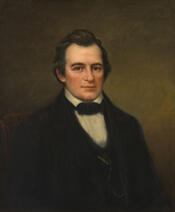
Here you will find contact information for Representative John Winston Jones, including email address, phone number, and mailing address.
| Name | John Winston Jones |
| Position | Representative |
| State | Virginia |
| District | 6 |
| Party | Democratic |
| Status | Former Representative |
| Term Start | December 7, 1835 |
| Term End | March 3, 1845 |
| Terms Served | 5 |
| Born | November 22, 1791 |
| Gender | Male |
| Bioguide ID | J000240 |
About Representative John Winston Jones
John Winston Jones (November 22, 1791 – January 29, 1848) was an American politician, lawyer, and plantation owner who served as a Democratic Representative from Virginia in the United States Congress from 1835 to 1845. Over the course of five consecutive terms in the House of Representatives, he rose to positions of major influence, including chairman of the Committee on Ways and Means, House Democratic leader, and Speaker of the House of Representatives from 1843 to 1845. He later served as Speaker of the Virginia House of Delegates in 1847, making him one of the few Virginians of his era to preside over both the federal and state lower houses.
Jones was born on November 22, 1791, in Amelia County, Virginia, to Alexander Jones and the former Mary Anne Winston. He came from a prominent Virginia family whose paternal line traced back to Peter Jones, the founder of Petersburg, Virginia. His given names honored Col. John Jones (1735–1793), Peter Jones’s son, who had served in the House of Burgesses for Brunswick County, supported the American Revolutionary War, sat in the Virginia Senate—including a term as its Speaker—and was a member of the Virginia Ratifying Convention of 1788. Raised in this tradition of public service and landed gentry, John Winston Jones received an education appropriate to his social class before traveling to Williamsburg around 1795 for further studies.
Jones pursued higher education at the College of William & Mary in Williamsburg, one of the leading institutions in the early republic. He undertook legal studies there and received a law degree in 1813. His training at William & Mary prepared him for a career at the Virginia bar and placed him within the legal and political networks that would shape his later public life. In 1815 he married Harriet Boisseau, with whom he had three children: Mary Winston, James Boisseau, and Alexander. Through his daughter Mary Winston, he became the father-in-law of George W. B. Towns, who later served as the 39th Governor of Georgia from 1847 to 1851.
After his admission to the Virginia bar, Jones established a legal practice in Chesterfield County, Virginia. His abilities as a lawyer led to his appointment in 1818 as Commonwealth’s Attorney (prosecutor) for Virginia’s 5th Judicial Circuit. He also became involved in state constitutional issues and broader questions of representation and governance. In 1829–1830 he served as one of the delegates to the Virginia Constitutional Convention, representing a Southside district composed of Amelia, Chesterfield, Cumberland, Nottoway, and Powhatan Counties and the city of Petersburg. At that convention he joined notable Virginia figures such as Benjamin W. Leigh, Samuel Taylor, and William B. Giles in debating reforms to the state’s political structure.
Jones entered national politics as a member of the Democratic Party and was elected to the United States House of Representatives in 1835. He represented Virginia in Congress for five terms, serving from 1835 to 1845 during a significant period in American history marked by debates over banking, tariffs, territorial expansion, and slavery. In the 1835 election he won his seat with 68.09 percent of the vote, defeating Whig candidate William Segar Archer. He was re-elected without opposition in 1837. In 1839 he secured re-election with 58.51 percent of the vote against a Whig opponent identified only as Taylor. He was again re-elected in 1841 with 69.47 percent of the vote, defeating Independent candidates Junius E. Leigh and Thomas Miller, and in 1843 he was returned to Congress unopposed. Throughout these campaigns he represented the interests of his Virginia constituents and participated actively in the legislative process.
Within the House of Representatives, Jones steadily rose through the Democratic ranks. He became chairman of the powerful Committee on Ways and Means, succeeding future president Millard Fillmore, and later served as House Democratic leader, following another future president, James K. Polk. His colleagues elected him Speaker of the House for the 28th Congress, which convened in 1843 and adjourned in 1845. As Speaker from 1843 to 1845, Jones presided over the House during a period of intense partisan conflict and sectional tension, overseeing debates that foreshadowed the national struggles of the coming decades. After completing his fifth term, he declined nomination for a sixth term in Congress in 1845 and returned to Virginia.
Upon his retirement from Congress, Jones resumed his legal practice and management of his plantation, Dellwood, located northwest of Petersburg, Virginia. His legal work included several prominent cases, most notably his service as lead counsel in 1846 for Thomas Ritchie Jr., who was tried for his role in the duel that resulted in the fatal wounding of abolitionist editor John Hampden Pleasants. Jones secured Ritchie’s acquittal on the grounds of self-defense. Like many members of the Virginia planter class of his time, Jones was a slaveholder; the 1830 federal census records him as owning enslaved persons in Chesterfield County. His combined roles as lawyer, planter, and former Speaker reflected the intertwined legal, political, and economic structures of antebellum Virginia.
Jones returned to state politics in the final years of his life. In 1846 he was elected to the Virginia House of Delegates, and in 1847 his fellow legislators chose him as Speaker of the House of Delegates, making him Speaker of the Virginia House in that year. He was elected to a second term in 1847, but ill health prevented him from attending the legislative session. On December 17, 1847, he resigned his seat in the House of Delegates. The vacancy created by his resignation was subsequently filled by his son, Alexander, continuing the family’s involvement in public service.
John Winston Jones died on January 29, 1848. He was buried in the family cemetery at his Dellwood Plantation northwest of Petersburg, Virginia. His career, which spanned local legal practice, service in a state constitutional convention, five terms in the U.S. House of Representatives, and the speakerships of both the United States House of Representatives and the Virginia House of Delegates, placed him among the more prominent Virginia Democrats of the antebellum era.