Representative John Adam Kasson
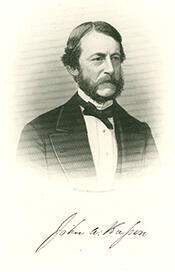
Here you will find contact information for Representative John Adam Kasson, including email address, phone number, and mailing address.
| Name | John Adam Kasson |
| Position | Representative |
| State | Iowa |
| District | 7 |
| Party | Republican |
| Status | Former Representative |
| Term Start | December 7, 1863 |
| Term End | March 3, 1885 |
| Terms Served | 6 |
| Born | January 11, 1822 |
| Gender | Male |
| Bioguide ID | K000018 |
About Representative John Adam Kasson
John Adam Kasson (January 11, 1822 – May 18, 1910) was a nineteenth-century lawyer, politician, and diplomat from south-central Iowa who served as a Republican Representative from Iowa in the United States Congress from 1863 to 1885. Elected to the U.S. House of Representatives six times, he repeatedly interrupted his congressional service to accept diplomatic appointments in a variety of important international roles, contributing significantly to both domestic legislation and American foreign policy during a transformative period in United States history.
Kasson was born in Charlotte, Chittenden County, Vermont, on January 11, 1822, the son of John Steele Kasson and Nancy Blackman. He attended local schools in Vermont before enrolling at the University of Vermont, from which he graduated in 1842. After completing his formal education, he studied law and was admitted to the bar, beginning his legal practice in St. Louis, Missouri. In 1857 he moved west to Des Moines, Iowa, where he established a law practice and became increasingly active in the emerging Republican Party in the years leading up to the Civil War.
Kasson quickly rose to prominence in national Republican politics. He served as a delegate to the Republican National Convention in 1860, where he gained a reputation for his influence and skill in party affairs. Appointed as Iowa’s representative on the platform committee, he was one of five delegates on the subcommittee charged with reconciling competing resolutions into a single party platform. He became the principal draftsman of the final document, including the antislavery planks that were later cited by several southern states as they seceded following Abraham Lincoln’s election. In 1861 President Abraham Lincoln appointed Kasson First Assistant Postmaster General, a position he held until August 1862, giving him early executive-branch experience in the administration that would lead the Union through the Civil War.
In 1862 Kasson was elected as a Republican to represent Iowa’s newly created 5th congressional district in the U.S. House of Representatives. His district comprised twenty-two counties in the southwestern quadrant of Iowa, including the city of Des Moines. He served two consecutive terms in the Thirty-eighth and Thirty-ninth Congresses, from March 4, 1863, to March 3, 1867. During this initial period of congressional service, which coincided with the Civil War and the beginning of Reconstruction, he chaired the House Committee on Coinage, Weights, and Measures from 1863 to 1867. In that capacity he drafted and helped secure passage of the Metric Act of 1866, which authorized the use of the metric system in the United States. While in Congress he also served as a commissioner from the United States to the International Postal Congress in Paris in 1863, reflecting his growing involvement in international and technical matters. Despite his influence, he lost the Republican nomination for his seat in 1866 to General Grenville M. Dodge, a noted Civil War and Indian Campaign commander.
Following his initial congressional service, Kasson continued to play a role in international affairs. In 1867 he served as a commissioner from the United States to negotiate postal conventions with Great Britain, France, Belgium, the Netherlands, Germany, Switzerland, and Italy, helping to modernize and standardize international mail arrangements. Returning to state politics, he was elected to the Iowa House of Representatives in 1868 and served there until 1872. That year he was again elected to the U.S. House, this time to represent Iowa’s new 7th congressional district, composed of ten counties in south-central Iowa. He served in the Forty-third and Forty-fourth Congresses from March 4, 1873, to March 3, 1877. During this second stretch in Congress he remained an influential Republican legislator, and contemporary reports, including from the New York Times in 1876, suggested that he would have “good chances of success” as a candidate for Speaker of the House. He chose not to seek renomination in 1876, instead turning once more to diplomatic service.
In 1877 President Rutherford B. Hayes appointed Kasson Envoy Extraordinary and Minister Plenipotentiary to Austria-Hungary, a post he held until early 1881. His tenure in Vienna coincided with a period of growing American engagement in European economic and monetary questions. At his suggestion, the United States Mint produced the four-dollar “Stella” pattern coins in 1879 and 1880, an experimental denomination intended to facilitate international trade by approximating various European gold coin standards. Returning again to electoral politics, Kasson ran for Congress in 1880 and was elected as a Republican to represent Iowa’s 7th congressional district once more. He served additional terms in the Forty-seventh and Forty-eighth Congresses, with his final period in the House extending into the mid-1880s and forming part of his overall congressional service from 1863 to 1885. During these years he continued to participate actively in the legislative process and to represent the interests of his Iowa constituents while maintaining a strong interest in international and economic policy.
Kasson’s last years in public service were dominated by high-level diplomatic assignments. In 1884 President Chester A. Arthur appointed him Envoy and head of the U.S. Legation at Berlin, Germany. He served there until 1885, when he was named a special envoy to the Congo Conference in Berlin, which addressed the international regime for the Congo Basin during the European “Scramble for Africa.” In 1889 he was appointed a special envoy to the Samoan International Conference, which sought to resolve competing claims of the United States, Germany, and Great Britain in the Samoan Islands. Later, in 1897, Kasson served as a special commissioner plenipotentiary from the United States to negotiate reciprocity treaties, reflecting the nation’s growing interest in reciprocal trade agreements. In 1898 he was a member of the United States and British Joint High Commission formed to adjust outstanding differences with Canada, including issues of fisheries, boundaries, and commercial relations.
John Adam Kasson died in Washington, D.C., on May 18, 1910. He was interred in Woodland Cemetery in Des Moines, Iowa, the city that had long been his home and political base. Throughout a career that spanned law, state politics, national legislation, and international diplomacy, Kasson played a notable role in shaping both the domestic policy and foreign relations of the United States during the second half of the nineteenth century.