Representative John Joseph Kindred
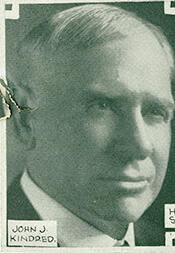
Here you will find contact information for Representative John Joseph Kindred, including email address, phone number, and mailing address.
| Name | John Joseph Kindred |
| Position | Representative |
| State | New York |
| District | 2 |
| Party | Democratic |
| Status | Former Representative |
| Term Start | April 4, 1911 |
| Term End | March 3, 1929 |
| Terms Served | 5 |
| Born | July 15, 1864 |
| Gender | Male |
| Bioguide ID | K000191 |
About Representative John Joseph Kindred
John Joseph Kindred (July 15, 1864 – October 23, 1937) was an American physician, lawyer, and Democratic politician who served as a Representative from New York in the United States Congress from 1911 to 1913 and from 1921 to 1929. Over the course of five terms in the House of Representatives, he participated in the legislative process during a significant period in American history and represented the interests of his New York constituents while maintaining a parallel professional identity as a specialist in mental diseases.
Kindred was born near Courtland, Southampton County, Virginia, on July 15, 1864. He was raised in the local community and attended the public schools there. His boyhood home in Courtland is known as Mahone’s Tavern, a structure of historical note in the region. He pursued higher education at Randolph-Macon College in Ashland, Virginia, and later attended the University of Virginia, laying the foundation for his subsequent professional training. In 1886 and 1887 he taught school in Virginia, an early occupation that preceded his formal medical studies and reflected his engagement with education and public service.
Turning to medicine, Kindred enrolled at the Hospital College of Medicine in Louisville, Kentucky, from which he graduated in 1889. That same year he moved to New York City and commenced the practice of medicine. Seeking advanced training, he specialized in mental diseases and in 1892 completed further study in that field at the University of Edinburgh in Scotland. His medical career thereafter was centered on psychiatry and the treatment of mental illness, and he became known for his work in establishing mental hospitals in several states. Over the course of his career he founded and operated institutions devoted to mental health care in New York, New Jersey, and Connecticut, contributing to the development of specialized facilities for patients with mental disorders at a time when such services were comparatively limited.
In addition to his medical pursuits, Kindred expanded his professional qualifications into the field of law. He graduated in law in 1919 and was admitted to the bar in 1926. This legal training complemented his medical expertise and later informed his work in medical jurisprudence, bridging the disciplines of law and medicine in both his teaching and professional activities.
Kindred’s national political career began with his election as a Democrat to the Sixty-second Congress, where he served as a Representative from New York from March 4, 1911, to March 3, 1913. During this initial term, he took part in the deliberations of the House of Representatives as the nation confronted issues of industrial growth, social reform, and emerging international responsibilities. He was not a candidate for renomination in 1912 and returned to private pursuits, including his medical practice. During this interval he also became interested in agricultural pursuits and in the construction of houses, diversifying his activities beyond medicine and politics.
Kindred returned to Congress in the post–World War I era. He was elected again as a Democrat to the Sixty-seventh Congress and to the three succeeding Congresses, serving from March 4, 1921, to March 3, 1929. His five terms in the House—spanning 1911 to 1913 and 1921 to 1929—placed him in the midst of major national developments, including the aftermath of the First World War, the early years of Prohibition, and the economic and social changes of the 1920s. Throughout this period he contributed to the legislative process and participated in the democratic governance of the country on behalf of his New York constituents. He was not a candidate for renomination in 1928, concluding his congressional service at the end of the Sixty-ninth Congress.
After leaving Congress, Kindred resumed the active practice of medicine in Manhattan, New York City, from 1930 to 1937, returning full-time to the profession in which he had first established his reputation. Drawing on both his medical and legal backgrounds, he also served as professor of medical jurisprudence at John B. Stetson University in DeLand, Florida, from 1933 to 1937. In this academic role he taught at the intersection of law and medicine, reflecting the breadth of his professional training and experience.
John Joseph Kindred died on October 23, 1937, in Astoria, New York. He was interred in Poughkeepsie Rural Cemetery in Poughkeepsie, New York. His career combined service as a physician specializing in mental diseases, the establishment of mental hospitals in New York, New Jersey, and Connecticut, legal training and teaching in medical jurisprudence, and five terms in the United States House of Representatives as a Democratic Representative from New York.