Representative John J. LaFalce
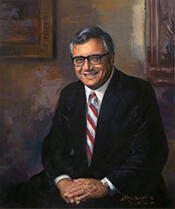
Here you will find contact information for Representative John J. LaFalce, including email address, phone number, and mailing address.
| Name | John J. LaFalce |
| Position | Representative |
| State | New York |
| District | 29 |
| Party | Democratic |
| Status | Former Representative |
| Term Start | January 14, 1975 |
| Term End | January 3, 2003 |
| Terms Served | 14 |
| Born | October 6, 1939 |
| Gender | Male |
| Bioguide ID | L000556 |
About Representative John J. LaFalce
John Joseph LaFalce (October 6, 1939 – April 11, 2025) was an American politician and attorney who served as a member of the United States House of Representatives from New York from 1975 to 2003. A Democrat, he represented a Western New York congressional district for 14 consecutive terms and 28 years, participating actively in the legislative process during a significant period in late 20th-century American political history. Over the course of his career, he rose to senior leadership roles on the House Committee on Small Business and the Committee on Financial Services, and played a central part in major financial and corporate governance legislation.
LaFalce was born in Buffalo, New York, on October 6, 1939, and was educated in the city’s Catholic school system. He graduated from Canisius High School and went on to earn a bachelor’s degree from Canisius College, a Jesuit institution in Buffalo. He then studied law at Villanova University School of Law, where he received his Juris Doctor. In recognition of his later public service and legislative work, he received honorary Doctor of Laws degrees from Niagara University (1979), St. John’s University (1989), and Villanova University School of Law (1991), as well as an honorary Doctor of Humane Letters from Canisius College in 1990.
After completing his legal education, LaFalce entered military service. From 1965 to 1967, he served on active duty in the United States Army, leaving with the rank of captain. Following his military service, he returned to Western New York and practiced law with the Buffalo-based firm of Jaeckle, Fleischmann & Mugel. His legal career quickly intersected with public affairs, and he soon became active in local and state politics, laying the groundwork for a long tenure in elected office.
LaFalce’s formal political career began in the New York State Legislature. He served as a member of the New York State Senate, representing the 53rd District, in 1971 and 1972. He then served in the New York State Assembly from the 140th District in 1973 and 1974. These early legislative roles provided him with experience in state-level policymaking and constituent service and positioned him for a successful run for Congress in the mid-1970s.
In 1974, at the age of 35, LaFalce was elected to the U.S. House of Representatives as part of the large post-Watergate Democratic freshman class often referred to as the “Watergate babies.” He became only the second Democrat, and the first since 1912, to win election to what was then New York’s 36th congressional district, based in Niagara Falls and including much of northern Buffalo and the western suburbs of Rochester. He was first elected to the 94th Congress and was subsequently re-elected to each succeeding Congress through the 107th, serving from January 3, 1975, to January 3, 2003. Over 14 terms, he rarely faced serious electoral opposition and became a prominent voice for his Western New York constituents.
During his congressional service, LaFalce developed a reputation as an influential legislator on economic, financial, and small business issues. He served on both the House Committee on Small Business and the Committee on Banking, Finance and Urban Affairs (later renamed the Committee on Financial Services). In January 1987, he was elected by the Democratic Caucus as Chairman of the House Small Business Committee, becoming the first member of his 1974 class to chair a full standing committee of the House. He held the chairmanship from 1987 to 1995, and after the change in party control of the House in 1994, he served as the committee’s ranking Democrat. In February 1998, he was elected ranking Democrat on the Financial Services Committee, a position he held from 1999 to 2003. Among his notable legislative achievements, he is credited with initiating the Competitiveness Policy Council, and he crafted legislation that became the Gramm–Leach–Bliley Act of 1999, for which he and three colleagues received the American Financial Leadership Award from the Financial Services Roundtable. He also played a key leadership role in introducing and championing reforms that ultimately became the Sarbanes–Oxley Act, signed into law in July 2002, which overhauled corporate governance and accounting oversight in the wake of major corporate scandals.
LaFalce’s district included Love Canal, the site of one of the most notorious environmental disasters in American history. He played a key role in bringing national attention to the grievances of the displaced residents and in spearheading the federal government’s response to the crisis, contributing to the development of broader environmental and hazardous waste policies. Politically, he was generally regarded as a liberal Democrat, but he was strongly opposed to abortion and, at the time of his death, served on the National Advisory Board of Democrats for Life of America. He was also among a small group of Democratic members who voted against five Iran sanctions bills that passed between 1997 and 2001, reflecting an independent streak on certain foreign policy issues.
Following the 2000 census, New York lost two congressional districts in reapportionment. One redistricting proposal would have merged LaFalce’s district with the neighboring 27th District of Republican Jack Quinn, a longtime friend who represented another portion of Buffalo. The final plan instead merged his territory with the Rochester-based 28th District of fellow Democrat Louise Slaughter. Although the new district retained Slaughter’s number, it was geographically more similar to LaFalce’s existing district, connected by a narrow band of territory from Buffalo to Rochester. Nevertheless, LaFalce chose not to seek re-election in 2002 and declined to run for the 108th Congress, effectively retiring from the House when his term ended in January 2003.
After leaving Congress, LaFalce remained active in financial and economic affairs and in regional development. He served on the Board of Directors of State Bancorp, Inc., the parent company of State Bank of Long Island, from 2007 to 2012. He was a Banking Board Member at the New York State Banking Department from 2008 to 2011, contributing his congressional experience in financial regulation to state oversight. From April 1, 2012, to May 2013, he served as Chairman and Director of the Erie County Industrial Development Agency, focusing on economic growth and job creation in Western New York. He was also a member of the advisory board to the Canadian American Business Council, reflecting his longstanding interest in cross-border economic relations important to the Buffalo–Niagara region.
LaFalce’s personal life was centered on his family and his ties to Western New York. He was married to Patricia Fisher, and they had one son, Martin. Martin LaFalce graduated from Georgetown University Law Center, worked as a public interest lawyer in New York City, and later became a law professor at St. John’s University School of Law. John J. LaFalce died from kidney failure at a hospice in Lockport, New York, on April 11, 2025, at the age of 85. His long career in public office, his leadership on small business and financial legislation, and his advocacy for his constituents, particularly in response to the Love Canal disaster, left a lasting imprint on both his district and national policy.