Representative John Davis Lodge
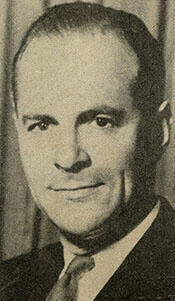
Here you will find contact information for Representative John Davis Lodge, including email address, phone number, and mailing address.
| Name | John Davis Lodge |
| Position | Representative |
| State | Connecticut |
| District | 4 |
| Party | Republican |
| Status | Former Representative |
| Term Start | January 3, 1947 |
| Term End | January 3, 1951 |
| Terms Served | 2 |
| Born | October 20, 1903 |
| Gender | Male |
| Bioguide ID | L000395 |
About Representative John Davis Lodge
John Davis Lodge (October 20, 1903 – October 29, 1985) was an American film actor, lawyer, politician, and diplomat who served as a Representative from Connecticut in the United States Congress from 1947 to 1951, as the 79th governor of Connecticut from 1951 to 1955, and later as United States ambassador to Spain, Argentina, and Switzerland. A member of the Republican Party, he contributed to the legislative process during two terms in the House of Representatives and subsequently played a prominent role in state and national politics, as well as in American diplomacy. As an actor, he was often credited simply as John Lodge and appeared in a number of notable Hollywood and European films in the 1930s.
Lodge was born in Washington, D.C., into a family deeply rooted in American political life. His father, George Cabot Lodge, was a poet and a scion of the prominent Cabot and Lodge families of Boston. Through his father, he was a grandson of Senator Henry Cabot Lodge, a great-great-grandson of Senator Elijah H. Mills, and a great-great-great-grandson of Senator George Cabot. His mother, Mathilda Elizabeth Frelinghuysen Davis, descended from the Frelinghuysen and Davis families; through her, he was a great-great-grandson of Senator John Davis, a great-grandson of Senator Frederick Theodore Frelinghuysen, a great-great-grandson of Senator Theodore Frelinghuysen, and a great-great-great-grandson of Senator Frederick Frelinghuysen. He had two siblings: Henry Cabot Lodge Jr., who became a United States senator and the Republican nominee for Vice President of the United States in 1960, and Helena Lodge de Streel, a baroness. Lodge thus belonged to four prominent political families of the Northeast—the Cabot, Lodge, Frelinghuysen, and Davis families—and was a direct descendant of at least seven U.S. senators.
Lodge received his early education at several distinguished institutions. He attended the Evans School for Boys in Mesa, Arizona; St. Albans School in Washington, D.C.; and Middlesex School in Concord, Massachusetts. He later studied law in Europe at the École de Droit in Paris, France. In 1925 he graduated from Harvard College, where he was a member of the Fox Club, and in 1929 he earned his degree from Harvard Law School. Admitted to the New York bar in 1932, he commenced the practice of law in New York City. After a brief legal career, he turned to the stage and screen, embarking on a decade-long career in acting that would bring him international recognition.
From 1933 to 1942, Lodge was active in the motion picture industry and the theater. In Hollywood he appeared in films such as Little Women (1933), in which he played Brooke; The Woman Accused (1933); The Scarlet Empress (1934), in which he played Marlene Dietrich’s lover; Menace (1934); and The Little Colonel (1935), in which he portrayed Shirley Temple’s father. He then worked extensively in British and European cinema, starring or co-starring in films including Koenigsmark (1935); The Tenth Man (1936); Ourselves Alone (1936); Sensation (1936); Bulldog Drummond at Bay (1937), in which he played the title role; Premiere (1938); Queer Cargo (1938); Bank Holiday (1938); Tonight at Eleven (1938); Lightning Conductor (1938); Just Like a Woman (1939); Heartbeat (1939); The White Slave (1939); and Sarajevo (also released as De Mayerling à Sarajevo, 1940), in which he played Archduke Franz Ferdinand. A fluent French speaker, he performed in French in several of these productions. Returning to the United States in 1941, he appeared on Broadway, including in Lillian Hellman’s Watch on the Rhine.
With the onset of World War II, Lodge entered military service. He served in the United States Navy from August 1942 to January 1946, rising from lieutenant to lieutenant commander and acting as a liaison officer between the French and American fleets. For his wartime service he was decorated as a Chevalier of the French Legion of Honor and awarded the Croix de Guerre 1939–1945 with palm by General Charles de Gaulle. After the war, he engaged in research work in economics and remained in the United States Navy Reserve, from which he retired in 1966 with the rank of captain. His military and international experience would later inform both his legislative work and his diplomatic assignments.
Lodge entered elective politics as a Republican in Connecticut. He was elected from Connecticut’s 4th congressional district to the 80th and 81st Congresses, serving in the U.S. House of Representatives from January 3, 1947, to January 3, 1951. His service in Congress occurred during a significant period in American history, encompassing the early Cold War and the immediate postwar reconstruction era. As a member of the House of Representatives, he participated in the democratic process, represented the interests of his constituents, and contributed to the legislative work of the Republican Party in Congress. He chose not to run for a third term in 1950, instead seeking the governorship of Connecticut.
In the 1950 gubernatorial election, Lodge ran as the Republican candidate against incumbent Democratic governor Chester Bowles. In what was widely described as a “bitter” campaign, Lodge sought to portray Bowles as an extreme left-winger and ultimately defeated him. He served as the 79th governor of Connecticut from January 1951 to January 1955, becoming the first governor to serve under the state’s revised system of four-year, rather than two-year, terms. During his tenure, Connecticut undertook major infrastructure projects, including the construction of the Connecticut Turnpike, later officially named the Governor John Davis Lodge Turnpike. He was a delegate from Connecticut to the Republican National Conventions in 1952 and 1960. Lodge ran for reelection as governor in 1954 but was defeated by Democrat Abraham Ribicoff, a result often attributed in local legend to discontent among Fairfield County Republicans over the disruption caused by the Turnpike’s construction.
After leaving the governorship, Lodge embarked on a distinguished diplomatic career. President Dwight D. Eisenhower appointed him United States Ambassador to Spain, a post he held from January 1955 until the end of Eisenhower’s administration in January 1961, during a period when the United States was consolidating its strategic relationship with the Franco regime in the context of the Cold War. In 1963 and 1964 he served as national president of the non-profit organization Junior Achievement, Inc. Lodge sought a return to elective office in 1964, winning the Republican nomination for the U.S. Senate from Connecticut but losing the general election to incumbent Democratic Senator Thomas J. Dodd by a margin of 35.34 percent to 64.66 percent. He remained active in public affairs as chairman of the Committee Foreign Policy Research Institute at the University of Pennsylvania from 1964 to 1969 and as a delegate and assistant floor leader at the Connecticut Constitutional Convention in 1965. He later served as United States Ambassador to Argentina from 1969 to 1973 and, in the final phase of his public career, as United States Ambassador to Switzerland in 1983. Among his writings, he authored “The Iberian Peninsula and Western Europe,” published in the Journal of International Affairs in 1962.
On July 6, 1929, Lodge married Francesca Braggiotti, an actress and ballet dancer; the couple appeared together in the 1938 film Tonight at Eleven. They had two daughters, Lily and Beatrice. Lily Lodge became director of the Actors Conservatory, and Beatrice married Antonio de Oyarzabal, who later served as ambassador of Spain to the United States, further extending the family’s international connections. John Davis Lodge was a longtime resident of Westport, Connecticut, and died in New York City on October 29, 1985. He was interred in Arlington National Cemetery. Two months after his death, the Connecticut Turnpike was officially renamed the Gov. John Davis Lodge Turnpike in his honor, commemorating both his governorship and his broader public service.