Representative John Baptiste Charles Lucas
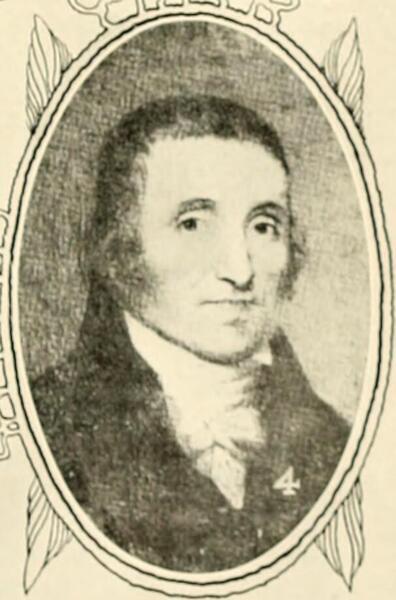
Here you will find contact information for Representative John Baptiste Charles Lucas, including email address, phone number, and mailing address.
| Name | John Baptiste Charles Lucas |
| Position | Representative |
| State | Pennsylvania |
| District | -1 |
| Party | Republican |
| Status | Former Representative |
| Term Start | October 17, 1803 |
| Term End | March 3, 1807 |
| Terms Served | 2 |
| Born | August 14, 1758 |
| Gender | Male |
| Bioguide ID | L000492 |
About Representative John Baptiste Charles Lucas
John Baptiste Charles Lucas (August 14, 1758 – August 17, 1842) was a French-born American lawyer, jurist, land commissioner, and Republican member of the U.S. House of Representatives from Pennsylvania. He was born in Pont-Audemer, Normandy, France, and came of age in the waning years of the ancien régime. Deeply influenced by Enlightenment ideas and impatient with class injustices in France, he became increasingly receptive to republican principles and the example of the new United States.
Lucas pursued formal legal training in France, attending the Honfleur and Paris law schools before completing his studies at the University of Caen. He graduated from the law department of the University of Caen in 1782 and subsequently practiced law in France. During this period he met Benjamin Franklin, then serving as an American diplomat in Europe. The encounter proved decisive: inspired by Franklin and disillusioned with the rigid social hierarchy of France, Lucas resolved to emigrate to the United States.
In 1784 Lucas immigrated to the United States and settled near Pittsburgh, Pennsylvania, where he engaged in agricultural pursuits while continuing his legal career. Integrating into the political life of his adopted state, he rose quickly in public affairs. He was elected to the Pennsylvania House of Representatives, serving from 1792 to 1798, and in 1794 he was appointed a judge of the Court of Common Pleas. These roles established his reputation as a capable lawyer and legislator on the Pennsylvania frontier and brought him to the attention of national leaders in the emerging Jeffersonian Republican movement.
With the election of Thomas Jefferson to the presidency, Lucas’s relationship with the new administration deepened. In the early 1800s Jefferson entrusted him with a secret mission to St. Louis and New Orleans, then under Spanish control. Reporting directly to the president, Lucas assessed the sentiments of Spanish officials and inhabitants toward the United States, work that contributed to Jefferson’s broader strategy for westward expansion. Armed with a letter of introduction from Franklin and enjoying strong support from Jefferson, Lucas was subsequently advanced to federal office.
Lucas was elected as a member of the Republican Party to the U.S. House of Representatives from Pennsylvania, winning a seat in the Eighth Congress and being returned for the Ninth. His service in Congress occurred during a significant period in American history, as the young republic consolidated its institutions and pursued territorial growth. He served from March 4, 1803, until his resignation in 1805, before the assembling of the Ninth Congress. During his two terms he participated in the legislative process and represented the interests of his Pennsylvania constituents as part of the Jeffersonian Republican majority. He eventually resigned and moved west, reportedly in part because he and his wife, Anne, missed French society and found in the French-influenced communities along the Mississippi a more congenial cultural environment.
Upon leaving Congress, Lucas relocated to St. Louis in the recently acquired Louisiana Territory. President Jefferson had given him a recess appointment as judge of the northern district of the Louisiana Territory, a post of considerable importance in organizing the legal and land systems of the new American domain. The U.S. Senate confirmed this appointment on January 27, 1806, by a narrow vote of 16 to 15. Lucas served as a territorial judge from 1805 until his resignation in 1820, a period that spanned the transformation of the northern district into the Missouri Territory in 1812 and the lead-up to Missouri statehood. Concurrently, he served as commissioner of land claims for northern Louisiana from 1805 to 1812, adjudicating complex disputes over titles inherited from French and Spanish regimes. After leaving the bench he resumed agricultural pursuits in the vicinity of St. Louis.
Lucas played a notable role in the civic development of St. Louis. In 1816 he donated land in downtown St. Louis for a courthouse that became known as the Old St. Louis County Courthouse, now a central feature of the Gateway Arch National Park. When the courthouse was abandoned in 1930 as court functions moved to larger quarters, his descendants unsuccessfully sought to reclaim the property. The historic courthouse, framed today by the Gateway Arch as viewed from the Mississippi River, remains a visible legacy of his contribution to the city’s early public architecture and civic life.
John Baptiste Charles Lucas died near St. Louis on August 17, 1842, and was buried at Calvary Cemetery. His family remained prominent in Missouri and national affairs, though often touched by violence: five of his sons died violently, including Charles Lucas, who was killed in a duel with Senator Thomas Hart Benton. A later descendant, his grandson Henry Van Noye Lucas, owned a major league baseball franchise in St. Louis in the late nineteenth century, extending the family’s influence into the realm of American sport.