Representative John Otho Marsh
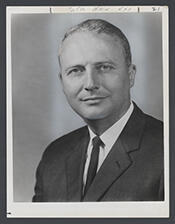
Here you will find contact information for Representative John Otho Marsh, including email address, phone number, and mailing address.
| Name | John Otho Marsh |
| Position | Representative |
| State | Virginia |
| District | 7 |
| Party | Democratic |
| Status | Former Representative |
| Term Start | January 9, 1963 |
| Term End | January 3, 1971 |
| Terms Served | 4 |
| Born | August 7, 1926 |
| Gender | Male |
| Bioguide ID | M000148 |
About Representative John Otho Marsh
John Otho Marsh Jr. (August 7, 1926 – February 4, 2019) was an American politician, lawyer, military officer, and educator who served as a Democratic Representative from Virginia in the United States Congress from 1963 to 1971 and as United States Secretary of the Army from 1981 to 1989. Over a public career spanning more than four decades, he held senior positions in both Democratic and Republican administrations and later taught law and national security at several Virginia institutions, including George Mason University School of Law.
Marsh was born in Winchester, Virginia, and grew up in the Shenandoah Valley. He graduated from Harrisonburg High School in Harrisonburg, Virginia. In 1944, during World War II, he enlisted in the United States Army and, at age eighteen, was selected for Infantry Officer Candidate School. He graduated as a second lieutenant of infantry in November 1945 and was assigned to the Army of Occupation in Germany, where he served from 1946 to 1947. After returning to the United States, he continued his military affiliation as a member of the United States Army Reserve from 1947 to 1951.
Following his early military service, Marsh pursued higher education at Washington and Lee University, from which he graduated in 1951. While there, he was a member of the Phi Kappa Psi fraternity. He entered the Virginia Army National Guard in 1951, maintaining a parallel military career as he began his work in law and public service. He later completed the Army’s Airborne School in 1964 and ultimately retired from the Army in 1976 with the rank of lieutenant colonel, reflecting more than three decades of combined active and reserve service.
Marsh was admitted to the Virginia Bar in 1952 and began practicing law in Strasburg, Virginia. In Strasburg he served as town judge, gaining experience in local judicial administration. From 1954 to 1962 he was the town attorney for New Market, Virginia, building a regional reputation as a capable lawyer and public servant. These legal and civic roles, combined with his military background, helped establish the foundation for his subsequent entry into national politics.
In 1962, Marsh was elected to the United States House of Representatives as a Democrat from Virginia, and he served four terms from January 3, 1963, to January 3, 1971. His district, which stretched from Winchester through Harrisonburg to Charlottesville, was historically associated with Senators Harry F. Byrd Sr. and Harry F. Byrd Jr. and had long been a center of conservative Democratic strength. By the time of Marsh’s first campaign, however, the district was trending away from its Southern Democratic roots; residents had been splitting their tickets since the 1930s. This shift was evident in Marsh’s initial election, in which he defeated Republican challenger J. Kenneth Robinson by only 598 votes. During his tenure in the House, Marsh participated actively in the legislative process and represented the interests of his constituents during a period marked by the civil rights movement, the escalation of the Vietnam War, and significant social and political change. Demonstrating his continued commitment to military service, he fought in the Vietnam War for about a month without informing his fellow soldiers that he was a sitting Congressman. Marsh ultimately became the last Democrat to represent this district. After he declined to seek re-election in 1970, Robinson, by then a member of the Senate of Virginia representing much of the district’s western portion, won the seat easily. The district, later numbered the 7th, remained in Republican hands until it was dismantled in 1993, and Marsh was the last Democrat to win even 40 percent of the vote there before its reconfiguration.
After leaving Congress, Marsh moved into senior national security and executive-branch roles. In 1973, he was appointed United States Assistant Secretary of Defense. In January 1974, he became National Security Advisor to Vice President Gerald R. Ford. When Ford assumed the presidency later that year, Marsh joined the White House as Counselor to the President with Cabinet rank. In this capacity he was regarded as one of Ford’s principal advisers, working alongside figures such as Secretary of State Henry Kissinger, Chief of Staff Donald Rumsfeld, and White House Counsel Philip W. Buchen. His experience in Congress, the military, and the law positioned him as a key intermediary between the executive branch, the Pentagon, and Capitol Hill during a period that included the end of the Vietnam War and the aftermath of the Watergate scandal.
Under President Ronald Reagan, Marsh returned to the Department of the Army as Secretary of the Army, serving from 1981 to 1989. His eight-year tenure, one of the longest in that office, coincided with the Reagan administration’s broader military buildup and efforts to restore morale and readiness following Vietnam. Marsh emphasized professional standards, modernization, and pride in service. Reflecting on the legacy of the Vietnam War and the Army’s role there, he stated, “I didn’t become Secretary of the Army to go around hangdog and half ashamed, apologizing for the United States Army in Vietnam, because it needed no apologies.” After leaving the Pentagon, he was selected to serve as chairman of the Reserve Forces Policy Board, a position he held from 1989 until 1994, where he continued to shape policy affecting the National Guard and Reserve components.
In the private and nonprofit sectors, Marsh held several leadership and advisory roles. He served as chairman and interim chief executive officer of Novavax, Inc., a pharmaceutical company, and later sat on its board of directors, contributing to its governance and strategic direction. He was also a member of the Markle Foundation, which focuses on public policy and technology. Marsh remained closely connected to national security circles and was known as a confidant of Vice President Dick Cheney during Cheney’s tenure in office.
Marsh devoted much of his later career to teaching and public policy education. From 1998 to 1999, he was a visiting professor of ethics at the Virginia Military Institute. He then served as an adjunct professor of law at the College of William & Mary from 1999 to 2000. He later became an adjunct professor at George Mason University School of Law, where he taught courses on technology, terrorism, and national security law and was actively teaching at the time of his death in 2019. His contributions to civic education and public policy are commemorated by the John O. Marsh Institute for Government and Public Policy at Shenandoah University, named in his honor.
Marsh lived in his hometown of Winchester, Virginia, with his wife, and they had three children and seven grandchildren. His family’s tradition of military service continued in the next generation; his son, John “Rob” Marsh, served as a U.S. Army medic during the 1993 Battle of Mogadishu in Somalia and received the Legion of Merit, two Bronze Stars, the Purple Heart, the Defense Meritorious Service Medal, and the Army Meritorious Service Medal. In 2007, when poor patient conditions at Walter Reed Army Medical Center became a national concern, Secretary of Defense Robert Gates appointed Marsh, along with former Secretary of the Army Togo West, to an independent review panel to investigate medical and leadership failures. The panel’s recommendations included closing the aging Walter Reed facility and relocating its medical services to what was then the National Naval Medical Center in Bethesda, Maryland.
John Otho Marsh Jr. died on February 4, 2019, in Raphine, Virginia, of complications from congestive heart failure at the age of 92. At the time of his death, he was still engaged in teaching and public policy work, capping a lifetime of service in the military, Congress, the executive branch, academia, and civic institutions.