Representative John R. McKernan Jr.
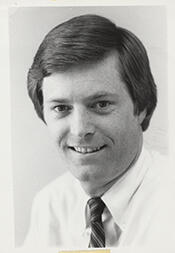
Here you will find contact information for Representative John R. McKernan Jr., including email address, phone number, and mailing address.
| Name | John R. McKernan Jr. |
| Position | Representative |
| State | Maine |
| District | 1 |
| Party | Republican |
| Status | Former Representative |
| Term Start | January 3, 1983 |
| Term End | January 3, 1987 |
| Terms Served | 2 |
| Born | May 20, 1948 |
| Gender | Male |
| Bioguide ID | M000512 |
About Representative John R. McKernan Jr.
John Rettie “Jock” McKernan Jr. (born May 20, 1948) is an American politician and attorney who served as a Representative from Maine in the United States Congress from 1983 to 1987 and as the 71st governor of Maine from 1987 to 1995. A member of the Republican Party, he served two terms in the U.S. House of Representatives and two terms as governor, contributing to the legislative and executive processes during a significant period in Maine and American political history.
McKernan was born in Bangor, Penobscot County, Maine, on May 20, 1948, the son of Barbara Guild McKernan and John R. McKernan Sr. He was raised in Bangor, where he attended the public schools and graduated from Bangor High School in 1966. He then enrolled at Dartmouth College in Hanover, New Hampshire, receiving his bachelor’s degree in 1970. After college he returned to Maine and joined the Maine Army National Guard, serving from 1970 until 1973. During this period he moved to Portland to pursue legal studies at the University of Maine School of Law, where he earned his Juris Doctor degree in 1974.
McKernan’s political career began at a young age. In 1972, at 24, he was elected to the Maine House of Representatives, becoming one of the youngest individuals ever to serve in that body. He served in the state house from 1973 to 1977 and was re-elected to a second term, during which his colleagues selected him as assistant Republican floor leader. While completing his law degree, he was already serving in the legislature, balancing legal training with legislative responsibilities. He was a delegate to the Republican National Convention in 1976. After leaving the state legislature in 1976, he began practicing law at a Portland law firm, establishing himself professionally while remaining active in Republican politics.
In 1982, McKernan successfully sought federal office and was elected as a Republican to the U.S. House of Representatives from Maine’s 1st Congressional District. He narrowly defeated Democrat John M. Kerry by a 50.4–47.9 percent margin. He was re-elected in 1984 by a much wider margin, defeating Democrat Barry Hobbins 63.5–36.5 percent, and served two terms in Congress from January 3, 1983, to January 3, 1987. During his tenure in the House of Representatives, McKernan participated in the democratic process and represented the interests of his constituents in southern Maine. GovTrack analysis later characterized him as one of the most moderate Republicans in the House, ranking him as the fifth-most moderate Republican during his tenure and slightly more moderate than his colleague Olympia Snowe. A Congressional Quarterly study found that by 1986 he had opposed President Ronald Reagan’s stated position 52 percent of the time, the 13th-highest rate of opposition among House Republicans, underscoring his reputation as a centrist within his party. He was again a delegate to the Republican National Convention in 1984. McKernan retired from Congress at the end of his second term to run for governor in 1986.
McKernan’s personal and political lives intersected in notable ways during his congressional service. While in the U.S. House, he had the unusual distinction of dating the other member of Maine’s House delegation, Olympia Snowe, a fellow Republican. The two had first met while serving in the Maine House of Representatives and began dating in 1978. During their time together in Congress, McKernan and Snowe maintained nearly identical voting records, including a shared evolution on certain foreign policy issues such as U.S. aid to Nicaraguan rebels, which both initially opposed and later supported. Although their relationship was widely known politically, it received limited coverage in the Maine press at the time.
In 1986, with Democratic Governor Joseph E. Brennan term-limited after two consecutive terms, McKernan declared his candidacy for governor of Maine. No Republican had occupied the Blaine House in two decades. In the Republican primary he faced conservative activist Porter Leighton, who criticized McKernan as a moderate who “votes more often with the other party than his own.” McKernan’s congressional record, including his frequent divergence from President Reagan’s positions, reinforced this moderate image. Nevertheless, he won the GOP primary decisively with more than 68 percent of the vote. In the general election he faced Democratic Attorney General and former Maine House Majority Leader James E. Tierney, along with two independents, Sherry Huber and John Menario. McKernan campaigned on “better schools and better jobs” as the keys to making Maine “the very best place in America to live, to work and to raise a family,” emphasizing economic development, education, and job training without major tax increases. He promoted Maine as “the opportunity state” and, after a spirited four-way race, won the governorship with about 39 percent of the vote, defeating Tierney by roughly nine points. He was sworn in as governor in January 1987 at age 38, inheriting a $46 million budget surplus.
As governor, McKernan sought to position Maine for long-term economic growth. Early in his administration he helped initiate a $1.35 million fund to create “centers of innovation,” intended to place Maine at the forefront of emerging technologies. He worked to expand job training programs designed to adapt quickly to the needs of new employers and championed an additional $5.9 million state investment in the University of Maine System to strengthen its educational and research capacity. His economic development strategy was encapsulated in the slogan “MAINE: We’re America’s Future Business,” and included the creation of “opportunity zones” to attract jobs to economically distressed areas. He also launched a public-relations campaign to improve Maine’s image as a place to do business and cited as achievements a growth management initiative, a trash reduction and recycling program, and a plan to remove the Kennebec River dam in Augusta by the end of the 1990s. McKernan credited his administration with taking decisive action against illegal drugs, including the creation of the Bureau of Intergovernmental Drug Enforcement.
McKernan’s tenure in Augusta was also marked by increasingly difficult fiscal and partisan battles, particularly with the Democratic majority in the legislature and longtime House Speaker John L. Martin. As the initial surplus gave way to budget shortfalls, disputes over spending and welfare policy intensified. McKernan advanced plans to eliminate or reduce welfare and job-training benefits for thousands of low-income Mainers, while Democrats fought to preserve higher funding levels. These conflicts became central issues in his 1990 re-election campaign, in which he again faced former governor Joseph E. Brennan. Early polling showed Brennan with a substantial lead—nine points in May 1990 and, according to McKernan, as much as twelve points two months before the election—but McKernan argued that voter support would recover as the state’s budget position stabilized. The race proved extremely close, with both candidates delaying their acceptance and concession statements until late the following morning. Brennan’s margins in his traditional southern Maine strongholds were insufficient to overcome McKernan’s strength in rural and northern Maine, and McKernan secured a narrow victory he later described as a political comeback.
During his second term, McKernan’s administration was defined by continued partisan conflict over fiscal management amid a large budget deficit and a state constitution that prohibited borrowing to cover budget gaps. He threatened to invoke a 1976 law allowing the governor to make “fair and equitable” spending reductions to maintain a balanced budget, and he drafted plans to cut spending unilaterally while revising rules to give state agencies more discretion in allocating reduced funds. Legislative Democrats challenged these actions in the Maine Supreme Judicial Court, but the court upheld the governor’s authority. McKernan also pushed for reductions in the state’s workers’ compensation costs, ultimately reaching a compromise with Democrats that produced an approximate 26 percent decrease in spending. He argued that, despite the fiscal turmoil, Maine had responded to budget difficulties with less impact on taxpayers than other New England states and noted that Maine was the only state in the Northeast with a balanced budget achieved without raising taxes.
After leaving office in 1995, McKernan remained active in business and public affairs. He became an outside director of ImmuCell Corporation, a Portland-based biotechnology company, in 1995 and has served in that capacity for many years. On September 1, 2003, he became chief executive officer of Education Management Corporation, the parent company of several for-profit colleges, a position he held until 2006; he subsequently served as executive chairman of the company. In the political realm, he continued to support Republican candidates and causes, serving, among other roles, as honorary state chairman for Senator John McCain’s 2008 presidential campaign in Maine.
McKernan’s personal life has included both public partnerships and private tragedy. His first marriage was to Judith Files, with whom he had one child, Peter McKernan. The couple divorced in 1978. On January 23, 1991, Peter died at age 20 from a previously undetected heart problem after lying in a coma for nine days. He had collapsed during baseball practice at Dartmouth College, where he played junior varsity baseball and had recently joined the Beta Theta Pi fraternity. In 1989, McKernan married Olympia Snowe, who would later serve in the U.S. Senate. The two had been dating for roughly six years, having first met while serving together in the Maine House of Representatives and later as colleagues in the U.S. House of Representatives from 1983 to 1987. Their marriage joined two of Maine’s most prominent Republican political figures of the late twentieth century.