Representative John Thompson Nixon
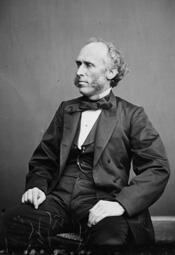
Here you will find contact information for Representative John Thompson Nixon, including email address, phone number, and mailing address.
| Name | John Thompson Nixon |
| Position | Representative |
| State | New Jersey |
| District | 1 |
| Party | Republican |
| Status | Former Representative |
| Term Start | December 5, 1859 |
| Term End | March 3, 1863 |
| Terms Served | 2 |
| Born | August 31, 1820 |
| Gender | Male |
| Bioguide ID | N000115 |
About Representative John Thompson Nixon
John Thompson Nixon (August 31, 1820 – September 28, 1889) was a United States representative from New Jersey and a United States district judge of the United States District Court for the District of New Jersey. A member of the Republican Party, he served two terms in the United States House of Representatives from 1859 to 1863 and later held a long tenure on the federal bench following his appointment by President Ulysses S. Grant in 1870.
Nixon was born on August 31, 1820, in Fairton, New Jersey. He attended the public schools of his native state before enrolling at the College of New Jersey (now Princeton University). He graduated in 1841 and continued his studies there, receiving an Artium Magister degree in 1843. Choosing a career in the law, he read law in 1844 and was admitted to the bar in 1845. Shortly thereafter, he established himself in private legal practice in Bridgeton, New Jersey, where he would remain professionally rooted for much of his life.
Nixon’s public career began in state politics. He served as a member of the New Jersey General Assembly from 1848 to 1850, gaining legislative experience and prominence in state affairs. In 1850 he was chosen Speaker of the General Assembly, presiding over the lower house and helping to guide its legislative business. During this period he continued to build his legal practice in Bridgeton, balancing professional responsibilities at the bar with increasing involvement in public life.
Nixon entered national politics as a Republican at a time of mounting sectional tension in the United States. He was elected from New Jersey’s 1st congressional district to the United States House of Representatives, serving in the 36th and 37th Congresses from March 4, 1859, to March 3, 1863. His service in Congress thus spanned the critical years immediately preceding and including the opening phase of the Civil War. As a member of the House of Representatives, John Thompson Nixon contributed to the legislative process during his two terms in office, participating in the democratic process and representing the interests of his New Jersey constituents during a significant period in American history. He was not a candidate for renomination in 1862.
After leaving Congress in March 1863, Nixon returned to Bridgeton and resumed the private practice of law. From 1863 to 1870 he reestablished himself as a practicing attorney, remaining active in the legal community while no longer holding elective office. His experience as a legislator at both the state and national levels, combined with his long-standing legal career, positioned him for later service in the federal judiciary.
Nixon was nominated by President Ulysses S. Grant on April 28, 1870, to a seat on the United States District Court for the District of New Jersey vacated by Judge Richard Stockton Field. He was confirmed by the United States Senate on April 29, 1870, and, according to existing records, received his commission on April 28, 1870. As a United States district judge, he presided over federal trial matters in New Jersey for nearly two decades, his judicial service extending through the Reconstruction era and into the late nineteenth century. Nixon’s service on the federal bench was terminated on September 28, 1889, due to his death.
John Thompson Nixon died on September 28, 1889, at his summer home in Stockbridge, Massachusetts. Following his death, he was interred in the Old Broad Street Presbyterian Church and Cemetery in Bridgeton, New Jersey, returning in burial to the community where he had long lived and practiced law.