Representative John Fox Potter
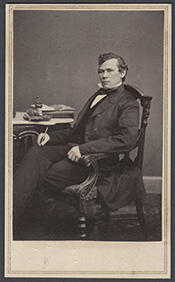
Here you will find contact information for Representative John Fox Potter, including email address, phone number, and mailing address.
| Name | John Fox Potter |
| Position | Representative |
| State | Wisconsin |
| District | 1 |
| Party | Republican |
| Status | Former Representative |
| Term Start | December 7, 1857 |
| Term End | March 3, 1863 |
| Terms Served | 3 |
| Born | May 11, 1817 |
| Gender | Male |
| Bioguide ID | P000465 |
About Representative John Fox Potter
John Fox Potter (nicknamed “Bowie Knife” Potter; May 11, 1817 – May 18, 1899) was an American lawyer, Radical Republican politician, Wisconsin pioneer, and nineteenth-century judge who became a prominent Representative from Wisconsin in the United States Congress. He was one of the first lawyers admitted to practice law in the Wisconsin Territory and later served in the Wisconsin State Assembly and the U.S. House of Representatives. Over the course of three consecutive terms, he represented Wisconsin’s 1st congressional district from 1857 to 1863, during a critical period in the nation’s history leading up to and including the early years of the Civil War.
Potter was born on May 11, 1817, and came of age in the era of rapid westward expansion and intensifying national debate over slavery. He moved to the upper Midwest as a young man and became associated with the early development of what would become the state of Wisconsin. As a pioneer settler in the region, he participated in the legal and civic life of the Wisconsin Territory, helping to lay the institutional foundations of local government and the territorial judiciary before statehood.
Educated in the law through the traditional method of legal apprenticeship and self-study common in the early nineteenth century, Potter was admitted to the bar and quickly distinguished himself as one of the first lawyers authorized to practice in the Wisconsin Territory. His legal training and early professional experience led to his appointment as probate judge of Walworth County, a position he held before Wisconsin achieved statehood in 1848. In that role, he handled matters of estates and guardianships, gaining a reputation for diligence and familiarity with the evolving legal framework of the new frontier community.
Potter’s formal political career began in state government. A committed opponent of the expansion of slavery and an early adherent of the emerging Republican Party, he was elected to the Wisconsin State Assembly for the 1856 term. His service in the Assembly coincided with the consolidation of the Republican Party in Wisconsin and the broader realignment of national politics in the 1850s. As a legislator, he aligned with the antislavery and reform currents that would soon propel him to national office.
In 1857, Potter was elected as a Republican to the U.S. House of Representatives from Wisconsin’s 1st congressional district, beginning the first of three consecutive terms that lasted until 1863. Serving in the 35th, 36th, and 37th Congresses, he participated actively in the legislative process during a period marked by sectional conflict, secession, and the outbreak of the Civil War. As a member of the House of Representatives, he represented the interests of his Wisconsin constituents while also engaging in the broader national debates over slavery, union, and federal authority. A member of the Republican Party throughout his congressional career, he was identified with the Radical Republican wing that pressed for a vigorous prosecution of the war and far-reaching measures against slavery.
Potter held significant committee responsibilities during his time in Congress. In the 37th Congress, he served as chair of the House Committee on Public Lands, a powerful position at a time when the disposition of western lands was central to national policy. In that capacity, he helped shepherd the passage of the Homestead Act of 1862, landmark legislation that opened millions of acres of public land to settlement by small farmers and further encouraged westward expansion. During the same term, he also chaired the House Select Committee on Loyalty of Federal Employees, which was charged with investigating and removing Confederate sympathizers from positions in the federal government. His vigorous pursuit of disloyalty in the public service led to notable friction with Secretary of War Simon Cameron and underscored his reputation as a determined and uncompromising Unionist.
Potter’s national prominence was heightened by a widely publicized incident that earned him his enduring nickname, “Bowie Knife” Potter. During the heated sectional tensions of the late 1850s, he was challenged to a duel by Virginia Representative Roger A. Pryor after a political dispute. Under the customs governing such affairs, Potter was entitled to choose the weapons, and he selected the bowie knife, a choice that was viewed as both unconventional and intimidating. The duel ultimately never took place, but the episode was extensively reported in political newspapers across the country and made Potter a minor national celebrity. In 1860, at the Republican National Convention, he was presented with a giant six-foot-long folding knife in commemoration of the affair; this “monster knife” later entered the collections of the Wisconsin Historical Society as a notable artifact of antebellum political culture.
After leaving Congress in 1863, Potter continued his public service in a diplomatic capacity. President Abraham Lincoln’s administration appointed him American consul general at Montreal, a strategically important post during the Civil War because of Confederate activity and intrigue in British North America. He served in Montreal from 1863 to 1866, representing U.S. commercial and political interests and helping to monitor cross-border issues during and immediately after the conflict. Following his consular service, he returned to private life, drawing on his long experience as a lawyer, judge, and legislator and remaining identified with the Republican cause and the legacy of the Union victory.
John Fox Potter died on May 18, 1899, closing a life that spanned from the post–War of 1812 era through Reconstruction and the Gilded Age. Remembered as a Wisconsin pioneer, an early territorial lawyer and probate judge, a state legislator, and a three-term Republican member of Congress, he played a notable role in shaping public land policy and in defending the loyalty of the federal government during the Civil War. His colorful “Bowie Knife” episode and his contributions to the passage of the Homestead Act of 1862 secured him a distinctive place in nineteenth-century American political history.