Representative John R. Rarick
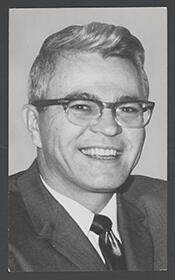
Here you will find contact information for Representative John R. Rarick, including email address, phone number, and mailing address.
| Name | John R. Rarick |
| Position | Representative |
| State | Louisiana |
| District | 6 |
| Party | Democratic |
| Status | Former Representative |
| Term Start | January 10, 1967 |
| Term End | January 3, 1975 |
| Terms Served | 4 |
| Born | January 29, 1924 |
| Gender | Male |
| Bioguide ID | R000065 |
About Representative John R. Rarick
John Richard Rarick (January 29, 1924 – September 14, 2009) was an American lawyer, jurist, World War II veteran, and Democratic politician who represented Louisiana’s 6th congressional district in the U.S. House of Representatives for four terms from 1967 to 1975. Over the course of his public life he was known both for his military service and legal career and for his staunchly segregationist, racially charged rhetoric and positions during a turbulent era in American politics.
Rarick was born in Waterford, Indiana, on January 29, 1924, to Merl Rarick and Mae Caroline (Clover) Rarick. He grew up in northern Indiana and attended Goshen High School. As a young man during the Second World War, he entered military service, enlisting in the United States Army. While a cadet, he was stationed at barracks that had been established at Louisiana State University (LSU) in Baton Rouge, an early connection to the state that would later become his adopted home and political base.
During World War II, Rarick served in the European Theater and fought in the Battle of the Bulge. In that campaign he was captured by German forces and held as a prisoner of war. His combat service and captivity earned him recognition for bravery and sacrifice; he was awarded the Bronze Star and received the Purple Heart for wounds sustained in action. After the war, he returned to Louisiana, where he would remain for the rest of his life, and began to build a civilian career grounded in higher education and the law.
Taking advantage of postwar educational opportunities, Rarick enrolled at Louisiana State University. After completing his undergraduate studies, he continued his education at Tulane University School of Law in New Orleans, earning his Juris Doctor in 1949. That same year he passed the Louisiana bar examination and entered private practice in the state. Over the next decade he established himself as a practicing attorney, which laid the foundation for his subsequent judicial and political career.
In 1961, Rarick was elected district judge of Louisiana’s Twentieth Judicial District. He served on the bench until May 15, 1966, when he resigned in order to seek a seat in Congress. His tenure as a state judge was marked by the racial tensions of the civil rights era. Attorney Lolis Elie, an African-American civil rights lawyer, later recalled encountering Rarick in a courtroom and Rarick responding to him with the remark, “I didn’t know they let you coons practice law.” In 1962, Rarick also served on the board of directors of the Citizens’ Council of Louisiana, an organization that opposed racial integration and civil rights initiatives, reflecting his alignment with segregationist currents in Southern politics at the time.
Rarick announced his candidacy for Congress in Louisiana’s 6th congressional district in 1966, challenging incumbent Democrat James H. Morrison. He did so in response to what he and many conservative white voters perceived as Morrison’s racial moderation, particularly Morrison’s vote for the Voting Rights Act of 1965, a position shared by House Majority Leader Hale Boggs but not by most of the rest of the Louisiana delegation. Rarick’s campaign portrayed Morrison as a “rubber stamp” for President Lyndon B. Johnson and his Great Society and War on Poverty programs, which were increasingly unpopular among conservative Democrats in southeastern Louisiana. Morrison, in turn, attacked Rarick as a carpetbagger from Indiana and alleged that he was a member of the Ku Klux Klan; Rarick denied being a Klansman but conspicuously refrained from criticizing the organization or its methods. In the first round of the Democratic primary, Morrison fell 1,880 votes short of outright victory, while more than 6,000 votes were cast for another candidate named James E. Morrison, which observers suspected had been intended for the incumbent. In the runoff, Morrison attempted to defend his support for universal suffrage while emphasizing his opposition to other civil rights legislation, whereas Rarick highlighted his military record and attacked Morrison as a supporter of Johnson’s social welfare programs. Rarick ultimately defeated Morrison in the runoff with 51.2 percent of the vote. In the heavily Democratic South, the primary victory was tantamount to election, and he went on to easily defeat Republican nominee Crayton G. Hall in the general election.
John Richard Rarick entered Congress with the 90th U.S. Congress in January 1967, representing Louisiana’s 6th congressional district, and he was subsequently re-elected in 1968, 1970, and 1972, serving continuously until January 3, 1975. A member of the Democratic Party, he participated in the legislative process during a period marked by the Vietnam War, the civil rights movement, and significant social and political upheaval. During his time in the House of Representatives, Rarick gained a reputation for racially tinged and often inflammatory rhetoric. He frequently used the Congressional Record to insert criticisms and personal attacks directed at prominent Black and Jewish leaders, including Supreme Court Justice Thurgood Marshall and civil rights leader Martin Luther King Jr. In 1972, after Rarick testified against a committee measure to grant Washington, D.C., self-governing home rule—arguing that groups such as the “Black Muslims” could gain control of the capital if it were allowed to govern itself—Representative Charles Diggs of Detroit publicly labeled him “the leading racist in Congress.” While serving in Congress, Rarick also made an unsuccessful bid for higher office; in 1967 he ran for governor of Louisiana, challenging incumbent Democrat John McKeithen, but lost by a wide margin.
Rarick’s congressional career came to an end in 1974. Seeking a fifth term, he was defeated in the Democratic primary by 29-year-old challenger Jeff LaCaze. His loss in the primary opened the way for a competitive general election in what had been a safely Democratic district. Republican candidate Henson Moore narrowly defeated LaCaze by 44 votes in the November general election. A court subsequently ordered the election rerun, and in the new contest Moore defeated LaCaze by a margin of 54 percent to 46 percent, marking a significant Republican gain in Louisiana’s congressional delegation.
After leaving Congress in January 1975, Rarick returned to Louisiana and resumed the practice of law, remaining active in local community causes and continuing to engage in politics from the right of the Democratic mainstream. In 1976 he attempted a political comeback by running as an independent candidate for his former congressional seat, but he was unsuccessful. He later broadened his ambitions to the national level, running for president in 1980 under the banner of the American Independent Party, a small party associated with conservative and segregationist positions; this campaign also failed to gain significant traction. In the early 1990s, Rarick remained involved in far-right politics in Louisiana. During the 1991 Louisiana gubernatorial election, he publicly supported David Duke, the former Grand Wizard of the Knights of the Ku Klux Klan, and spoke at several Duke campaign rallies around the state, underscoring his continued alignment with extremist and white nationalist figures.
John Rarick spent his later years in St. Francisville, Louisiana. He died there on September 14, 2009, at the age of 85. He was preceded in death by his first wife, Marguerite Pierce Rarick. He was survived by his second wife, Frances Eldred Campbell Rarick, as well as three children. His papers and political legacy, including the John R. Rarick Political Collection, are preserved at the Center for Southeast Louisiana Studies at Southeastern Louisiana University, and his official congressional service is documented in the Biographical Directory of the United States Congress.