Representative John Henry Ray
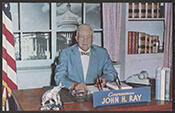
Here you will find contact information for Representative John Henry Ray, including email address, phone number, and mailing address.
| Name | John Henry Ray |
| Position | Representative |
| State | New York |
| District | 15 |
| Party | Republican |
| Status | Former Representative |
| Term Start | January 3, 1953 |
| Term End | January 3, 1963 |
| Terms Served | 5 |
| Born | September 27, 1886 |
| Gender | Male |
| Bioguide ID | R000077 |
About Representative John Henry Ray
John Henry Ray (September 27, 1886 – May 21, 1975) was an American lawyer, business executive, and Republican politician who served five terms as a United States Representative from New York. Representing the state’s 15th congressional district, which at the time encompassed parts of Staten Island and Brooklyn, he served in the U.S. House of Representatives from January 3, 1953, to January 3, 1963, participating in the legislative process during a significant period in American history and representing the interests of his constituents over the course of ten years.
Ray was born in Mankato, Minnesota, on September 27, 1886. He attended local schools before enrolling at the University of Minnesota, from which he graduated in 1908. He then pursued legal studies at Harvard Law School, earning his law degree in 1911. Following his admission to the bar, Ray returned to Minnesota, where he practiced law and began building a career that combined legal expertise with financial and corporate responsibilities.
Early in his professional life, Ray served as an assistant trust officer for the Wells–Dickey Trust Company in Minneapolis, a role that drew on his legal training and exposed him to complex financial and fiduciary matters. With the outbreak of World War I, he entered military service, joining the United States Army. He served first as a first lieutenant in the Judge Advocate General’s Corps, applying his legal skills to military justice and administrative matters. After the Armistice, he was assigned as an assistant to the special representative of Secretary of War Newton D. Baker during post-war armistice discussions with Allied governments, work that placed him in the midst of high-level international negotiations. In recognition of his contributions, particularly in connection with the Italian government, he was presented in 1920 with the Order of the Crown of Italy.
In 1923, Ray moved to New York City and settled in the Dongan Hills neighborhood of Staten Island, where he continued to practice law. His legal and managerial abilities led him into the telecommunications industry. In 1937, he became vice president and general counsel of Western Electric, the manufacturing arm of the Bell System. His responsibilities expanded further in 1942, when he was promoted to vice president and general counsel of the American Telephone and Telegraph Company (AT&T). In that capacity, he oversaw major legal and regulatory issues for one of the nation’s largest corporations during World War II and the early postwar era. Ray remained in this position until his retirement from AT&T in 1951, after which he turned more fully to public service and electoral politics.
Ray entered elective office relatively late in life. Representing New York as a Republican, he was first elected to Congress in 1952 at the age of 66. He took his seat in the 83rd Congress on January 3, 1953, and was subsequently reelected four times, serving in the 83rd, 84th, 85th, 86th, and 87th Congresses until January 3, 1963. During his decade in the House of Representatives, he served on the Merchant Marine and Judiciary Committees, where his legal background and corporate experience informed his work on maritime, commercial, and judicial legislation. He sought the establishment of tax-free pensions and advocated tax incentives for firms purchasing anti-pollution equipment, reflecting an interest in both social welfare policy and emerging environmental concerns.
Ray’s congressional tenure coincided with the early civil rights era, and his voting record reflected a mixed stance on key measures. He voted in favor of the Civil Rights Act of 1960, supporting efforts to strengthen federal enforcement of voting rights. However, he voted against the Civil Rights Act of 1957 and opposed the 24th Amendment to the Constitution, which prohibited poll taxes in federal elections. In addition to his formal committee assignments, Ray played a behind-the-scenes role in one of the most consequential investigations of the period: he served as a legal advisor to then-Congressman Gerald R. Ford when Ford was a member of the Warren Commission, the presidential commission established to investigate the assassination of President John F. Kennedy.
Following the 1960 Census, congressional redistricting in New York altered the political landscape of Staten Island and surrounding areas. Ray’s 15th district was reconfigured, and he was redistricted into the new 16th district. Rather than seek reelection in the new constituency, he chose to retire from Congress in 1962. In that year’s election, his former seat was won by Democrat John Murphy, marking the end of Ray’s decade-long service in the House.
In retirement, Ray continued to reside on Staten Island, maintaining his home in the Dongan Hills neighborhood. He lived there until his death on May 21, 1975. He was cremated, closing a long life that spanned service in World War I, leadership in one of the nation’s major corporations, and ten years in the United States Congress representing New York’s 15th district.