Representative John Schmitz
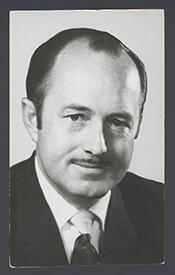
Here you will find contact information for Representative John Schmitz, including email address, phone number, and mailing address.
| Name | John Schmitz |
| Position | Representative |
| State | California |
| District | 35 |
| Party | Republican |
| Status | Former Representative |
| Term Start | January 3, 1970 |
| Term End | January 3, 1973 |
| Terms Served | 2 |
| Born | August 12, 1930 |
| Gender | Male |
| Bioguide ID | S000133 |
About Representative John Schmitz
John George Schmitz (August 12, 1930 – January 10, 2001) was an American politician and United States Marine Corps officer who served as a Republican member of the United States House of Representatives and the California State Senate from Orange County, California. A staunch conservative, he was also a prominent member of the John Birch Society and, in 1972, the presidential candidate of the American Independent Party, later known as the American Party. He represented California’s 35th congressional district in the U.S. House of Representatives from 1969 to 1973, serving two terms during a period of significant political and social upheaval in the United States.
Schmitz was born in Milwaukee, Wisconsin, on August 12, 1930. He was raised in a Roman Catholic family and educated in parochial schools in the Milwaukee area. After high school he entered the United States Marine Corps, beginning a military association that would shape much of his public image. He later attended Marquette University in Milwaukee, where he studied philosophy, and subsequently moved to California. In California he pursued graduate studies at California State University, Long Beach, and at Claremont Graduate School (now Claremont Graduate University), where he deepened his interest in political theory and conservative thought.
Following his initial period of active duty, Schmitz continued his service in the United States Marine Corps Reserve, eventually attaining the rank of colonel. His military background became a central element of his political identity, reinforcing his reputation as a hard-line anti-communist and law-and-order conservative. After relocating to Orange County, he worked as a college instructor, teaching political science and philosophy at local institutions, including Santa Ana College. His classroom experience and growing involvement in conservative activism helped launch his political career in one of the most reliably Republican regions of California.
Schmitz entered elective office in the California State Senate, representing an Orange County district as a Republican. In the state legislature he quickly aligned himself with the far-right wing of the party and with the ultraconservative John Birch Society, of which he became a longtime leader. His rhetoric and positions were characterized by strong opposition to communism, the counterculture, and liberal social policies. In 1969 he moved to the national stage when he was elected to the U.S. House of Representatives from California’s 35th congressional district. He won a special election in 1970 after an all-party primary in which he led the field with 103,127 votes (49.30 percent), advancing to a runoff against Democrat David N. Hartman. In the runoff, held for the special election in California’s 35th district, Schmitz defeated Hartman decisively, receiving 67,209 votes (72.37 percent) to Hartman’s 25,655 (27.63 percent). He was subsequently elected to a full term in the general election later that year, winning 192,765 votes (67.04 percent) against Democrat Thomas Lenhart, who received 87,019 votes (30.27 percent), with Francis R. Halpern of the Peace and Freedom Party taking 7,742 votes (2.69 percent).
During his service in Congress from 1969 to 1973, Schmitz participated in the legislative process as a Republican member of the House of Representatives and represented the interests of his Orange County constituents at a time marked by the Vietnam War, civil rights struggles, and the emerging culture wars. He became known nationally for his extreme right-wing sympathies and for inflammatory slurs directed at African Americans, Asian Americans, Hispanics, women, Jews, and homosexuals. By one quantitative measure of congressional voting records, he was later found to be the third-most conservative member of Congress to have served between 1937 and 2002. His association with the John Birch Society, an organization already on the far right of American politics, was so pronounced that even that group ultimately expelled him for what it deemed extremist rhetoric. On October 25, 1971, he wrote the introduction to the highly controversial conspiracy-oriented book “None Dare Call It Conspiracy,” authored by Gary Allen with Larry Abraham, further cementing his status as a leading figure in the radical right.
In 1972 Schmitz’s congressional career intersected with national third-party politics. Initially a Republican, he became angered by President Richard Nixon’s role in his political setbacks and by the defeat of fellow conservative John Ashbrook in the Republican presidential primaries. After being nominated as the presidential candidate of the American Independent Party, he changed his party registration to that party. At the 1972 American Independent Party National Convention he secured the nomination with 330 delegate votes (71.74 percent), far outpacing rivals George L. Garfield, Allen Grear, Thomas J. Anderson, Richard B. Kay, and a small residual vote for George Wallace. His running mate was Thomas J. Anderson, a fellow member of the John Birch Society. In the general election, the Schmitz–Anderson ticket received 1,100,868 votes, or 1.42 percent of the national total, and no electoral votes. The campaign drew notable support from actor Walter Brennan, a three-time Academy Award winner and John Birch Society member, who served as finance chairman. Schmitz’s best results came in the West: he won 9.30 percent of the vote in Idaho, finishing second ahead of Democrat George McGovern in several heavily conservative Mormon counties, including Fremont, Jefferson, Madison, and Lemhi. In Jefferson County, Idaho, his vote share was the strongest for a third-party presidential candidate in any non-Southern county since 1936. He also received 7.25 percent of the vote in Alaska, 5.97 percent in Utah, and between four and five percent in Oregon, Montana, Washington State, and Louisiana. In the Republican primary for his House seat that same year, however, he was defeated; Andrew J. Hinshaw won the 1972 Republican primary in California’s 35th congressional district with 42,782 votes (45.63 percent) to Schmitz’s 40,261 (42.94 percent), ending his tenure in Congress in January 1973.
After leaving the House of Representatives, Schmitz remained active in conservative politics and sought higher office. He ran in the Republican primary for the United States Senate from California in 1980, finishing third with 442,839 votes (18.96 percent), behind Paul Gann, who received 934,433 votes (40.00 percent), and former Los Angeles mayor Sam Yorty, who received 668,583 votes (28.62 percent). Two years later he again entered a Republican primary for the U.S. Senate from California in 1982, but this time his support had eroded significantly; he received 48,267 votes (2.13 percent), trailing Pete Wilson, Pete McCloskey, Barry Goldwater Jr., Bob Dornan, Maureen Reagan, and others in a crowded field. These unsuccessful bids reflected both the persistence of his political ambitions and the declining appeal of his brand of ultraconservatism within the broader Republican electorate.
Schmitz’s personal life became a major public controversy and effectively ended his political career. He married Mary E. “Mary Kay” Schmitz, who became a well-known conservative political commentator in her own right. Together they had seven children: John P. Schmitz (born 1955), who later served as Deputy Counsel to the Vice President (George H. W. Bush) during the Reagan administration and as Deputy Counsel to the President in the George H. W. Bush administration; Joseph E. Schmitz (born 1956), who became Inspector General of the Department of Defense in the George W. Bush administration and later Chief Operating Officer and Chief Legal Counsel of the private security firm Blackwater; Mary Kay Letourneau (born 1962, died 2020), a schoolteacher later convicted in 1997 of child sexual abuse; Philip (born 1970, died 1973); and Jerome, Theresa, and Elizabeth. In 1982 it was revealed—and Schmitz admitted—that he had engaged in an extramarital affair with one of his former college students, Carla Stuckle, with whom he had fathered two children: John (born John George Stuckle on June 10, 1981) and Eugenie. The scandal brought intense media scrutiny and effectively ended Schmitz’s viability as an elected official, as well as his wife Mary’s career as a conservative commentator.
In his later years Schmitz largely withdrew from frontline politics, though he remained a symbolic figure in far-right circles and continued to be cited as an exemplar of uncompromising conservative ideology. His long association with the Marine Corps remained important to his public identity, and he retained the rank of colonel in the Marine Corps Reserve. John George Schmitz died of prostate cancer on January 10, 2001, at the age of 70. In recognition of his military service, he was buried with full military honors at Arlington National Cemetery.