Representative John Kinley Tener
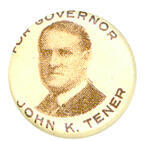
Here you will find contact information for Representative John Kinley Tener, including email address, phone number, and mailing address.
| Name | John Kinley Tener |
| Position | Representative |
| State | Pennsylvania |
| District | 24 |
| Party | Republican |
| Status | Former Representative |
| Term Start | March 15, 1909 |
| Term End | March 3, 1911 |
| Terms Served | 1 |
| Born | July 25, 1863 |
| Gender | Male |
| Bioguide ID | T000123 |
About Representative John Kinley Tener
John Kinley Tener (July 25, 1863 – May 19, 1946) was an Irish-born American politician, businessman, and Major League Baseball player and executive who served one term as a United States Representative from Pennsylvania and later as the 25th governor of Pennsylvania. A member of the Republican Party, he represented Pennsylvania’s 24th congressional district in the U.S. House of Representatives from 1909 to 1911 and subsequently held the governorship from 1911 until 1915. He later became president of the National League, playing a prominent role in the administration of professional baseball.
Tener was born on July 25, 1863, in County Tyrone, Ireland, and emigrated to the United States with his family as a child, settling in Pennsylvania. Growing up in the industrial environment of western Pennsylvania, he was educated in the local public schools while working from a young age, and he developed both an interest in business and a talent for athletics, particularly baseball. His early years in the United States coincided with the rapid growth of organized baseball, and his abilities on the field soon opened a path into professional sports.
Before entering public office, Tener pursued a career in professional baseball during the late nineteenth century. He played as a pitcher and outfielder for several major league clubs, including the Baltimore Orioles of the American Association, the Chicago White Stockings of the National League, and the Pittsburgh Burghers of the short‑lived Players’ League. His playing career placed him among the early generation of professional ballplayers at a time when the sport was consolidating its major leagues and experimenting with rival organizations. After retiring from active play, Tener moved into business and civic affairs in Pennsylvania, gaining experience in banking and local enterprises, and he remained closely associated with the game that had first brought him national attention.
Tener entered national politics as a Republican and was elected to the Sixty-first Congress, serving as a Representative from Pennsylvania from March 4, 1909, to March 3, 1911. Representing Pennsylvania’s 24th congressional district, he served one term in the U.S. House of Representatives during a significant period in American political and economic development, participating in the legislative process and representing the interests of his western Pennsylvania constituents. Although he initially planned to run for re‑election in 1910, his growing prominence within the state Republican organization led party leaders to put him forward instead as their candidate for governor.
In 1910 the Republican Party nominated Tener for governor of Pennsylvania amid a turbulent political climate shaped by scandal over the construction of the new Pennsylvania State Capitol. State Treasurer William H. Berry had uncovered more than $7.7 million in unappropriated costs, including numerous questionable charges, leading to the conviction of the building’s architect and a former state treasurer. After failing to secure the Democratic nomination, Berry formed the Keystone Party, drawing independent Republicans and Democrats and creating a three‑way race. In the general election, Tener won with 415,614 votes (41.7 percent), defeating Berry, who received 382,127 votes (38.2 percent), aided in part by a 45,000‑vote margin in the City of Philadelphia; the Democratic nominee, State Senator Webster Grim of Doylestown, finished third with about 13 percent of the vote. When he took office in January 1911, Tener became the first Pennsylvania governor since the American Revolution to have been born outside the United States and only the second in the state’s history to have been born outside Pennsylvania.
As governor from 1911 to 1915, Tener pursued an ambitious program of educational, infrastructural, and conservation reforms. He signed into law the School Code of 1911, which created a State Board of Education empowered to set minimum standards and minimum salaries for teachers and administrators, and mandated compulsory school attendance for all children between the ages of eight and sixteen regardless of race or color. In the field of transportation, he approved the Sproul Highway Bill, which transferred responsibility for approximately 9,000 miles of public roads from counties and municipalities to the state, laying the groundwork for a modern, statewide highway system. When voters rejected a bond issue to finance these improvements, Tener supported legislation dedicating automobile registration and driver’s license fees to road construction and maintenance. He also signed a 1913 law requiring hunting licenses in Pennsylvania, with the resulting fees earmarked for conservation programs, and that same year approved a measure leading to the creation of the Pennsylvania Historical Commission, an agency that later became part of the Pennsylvania Historical and Museum Commission and enabled the Commonwealth to fund the preservation of historic properties and to administer the Pennsylvania Historic Markers Program.
During and after his gubernatorial term, Tener remained deeply involved in professional baseball administration. He served as president of the National League while still governor, at times juggling the dual responsibilities of state executive and league chief. His tenure coincided with the challenge posed by the Federal League, which declared itself a major league in 1914 and began competing aggressively for players. Tener mediated several high‑profile disputes, including a conflict between Chicago Cubs owner Charles Murphy and star second baseman and manager Johnny Evers, in which questions arose over Evers’s dismissal and the prospect of his jumping to the Federal League. Concerned about both contract integrity and league stability, Tener helped arrange for newspaper publisher Charles P. Taft, a minority shareholder, to purchase the Cubs and force Murphy out, thereby resolving a contentious situation within the National League’s ownership ranks.
Tener also confronted emerging labor issues in baseball. In 1914, when the Baseball Players’ Fraternity, led by Dave Fultz, threatened a strike over the transfer of player Clarence Kraft from the Brooklyn Robins to the minor leagues, Tener helped broker a compromise under which Brooklyn paid for Kraft’s rights and sent him to its Newark club, averting a wider confrontation. In April 1915 he ruled Benny Kauff, a standout player from the Federal League’s Brooklyn Tip‑Tops, ineligible to join the New York Giants without formal reinstatement, asserting the National League’s authority over “jumpers” from organized baseball. In 1917, when Fultz presented a broader set of demands to improve conditions for minor league players and threatened to affiliate with the American Federation of Labor and call a strike, Tener rejected several of the demands as beyond the scope of Major League Baseball and noted that one had already been addressed in the 1917 standard contract. Although he had himself belonged to the Brotherhood of Professional Players in his playing days and had earlier recognized the Players’ Fraternity, he opposed the strike threat. With limited support from major leaguers and little enthusiasm from AFL leader Samuel Gompers, the Fraternity lost leverage; the National Commission withdrew its recognition, and the organization soon declined and ceased to function.
In November 1917 Tener accepted a one‑year extension as National League president but grew increasingly disillusioned by internal disputes among league owners. In 1918 a controversy over pitcher Scott Perry’s contractual rights pitted the National League against the American League and involved Philadelphia Athletics owner Connie Mack. Tener believed Mack had violated an agreement by resorting to the courts, and he urged the National League to sever relations with the American League, a step that could have jeopardized the World Series. When the National League owners refused to support such drastic action, Tener resigned as league president in August 1918. He subsequently returned to private business and civic activities, maintaining his standing as a respected public figure in Pennsylvania.
John Kinley Tener died on May 19, 1946, in Pittsburgh, Pennsylvania. Remembered as both a public servant and a sports executive, he occupied a distinctive place in American life as an immigrant who rose from professional athletics to the halls of Congress, the governor’s office, and the leadership of one of baseball’s major leagues.