Senator John Milton Thayer
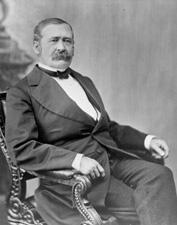
Here you will find contact information for Senator John Milton Thayer, including email address, phone number, and mailing address.
| Name | John Milton Thayer |
| Position | Senator |
| State | Nebraska |
| Party | Republican |
| Status | Former Representative |
| Term Start | March 4, 1867 |
| Term End | March 3, 1871 |
| Terms Served | 1 |
| Born | January 24, 1820 |
| Gender | Male |
| Bioguide ID | T000148 |
About Senator John Milton Thayer
John Milton Thayer (January 24, 1820 – March 19, 1906) was a general in the Union Army during the American Civil War and later a United States Senator from Nebraska, Governor of Wyoming Territory, and Governor of Nebraska. A member of the Republican Party, he served one term in the United States Senate from 1867 to 1871, representing Nebraska during a significant period of Reconstruction-era American history.
Thayer was born in Bellingham, Massachusetts, on January 24, 1820. He attended and later taught in rural schools before pursuing higher education. He graduated from Brown University in 1841 and subsequently established a law practice in Worcester, Massachusetts. In Worcester he was also editor of the Worcester Magazine and the Historical Journal, reflecting an early interest in historical and literary pursuits. He served as a lieutenant in the local militia company, gaining initial military experience that would later shape his Civil War career. On December 27, 1842, he married Mary Torrey Allen; the couple had six children.
In 1854 Thayer moved with his family to the Nebraska Territory, where he quickly affiliated himself with the emerging Republican Party and became active in territorial politics. He owned a large farm near Omaha and, in 1855, was appointed major general of the Nebraska Territorial Militia. That same year, acting under the direction of Acting Nebraska Territorial Governor Thomas B. Cuming, he led a council with Pawnee chiefs near present-day Leshara, Nebraska, in an effort to calm tensions following a series of raids on local settlers. The Pawnee delegation was led by the chief Pitalesharo, for whom the town is named. Throughout the 1850s Thayer gained a reputation as an “Indian fighter,” a reputation that culminated in his role in the so‑called Pawnee War of 1859. Politically, he was a delegate to the 1860 state constitutional convention that organized the Republican Party in the Nebraska Territory and was elected to the Nebraska Territorial Legislature in 1860, where he introduced a bill to abolish slavery in the territory.
With the outbreak of the Civil War, Thayer sought an active command. He wrote to Secretary of War Simon Cameron requesting authority to raise a Nebraska regiment in response to President Abraham Lincoln’s call for volunteers. Resigning his legislative seat in June 1861, he became colonel of the 1st Nebraska Infantry Regiment and served throughout the war in the Western Theater. Under the overall command of General Lew Wallace, he led a brigade in key engagements including the battles of Fort Donelson and Shiloh and the Siege of Corinth. Promoted to brigadier general of volunteers in October 1862, he commanded a brigade in the XV Corps and saw action at Chickasaw Bayou, Fort Hindman (Arkansas Post), and the Siege of Vicksburg. The 1st Nebraska Infantry also provided support and refuge for freedom seekers escaping from enslavers, and Thayer’s home in Lincoln, Nebraska, is listed on the National Underground Railroad Network to Freedom in recognition of this role.
Later in the war Thayer was assigned to cavalry operations and placed in command of the District of the Frontier, with headquarters at Fort Smith, Arkansas. He participated in the Camden Expedition and other actions in the region, seeing considerable combat at the Battle of Prairie D’Ane. At the Battle of Jenkins’ Ferry he commanded the rearguard of Major General Frederick Steele’s force, engaging Confederate troops under Sterling Price for more than four hours and forcing Price to disengage, thereby enabling Steele to extricate his army to safety. In February 1865 Thayer was relieved of command at Fort Smith and reassigned to the smaller post at St. Charles, Arkansas, with a regiment of Kansas cavalry and a single artillery battery. As part of the omnibus promotions of leading generals at the close of the war, he was brevetted major general of volunteers in 1865.
After the Civil War, Thayer returned to Nebraska politics and served as a member of the 1866 state constitutional convention. Upon the admission of Nebraska into the Union as a state in 1867, he was elected as one of its first two United States Senators. He served as a Senator from Nebraska in the United States Congress from 1867 to 1871. During his single term in office, he participated in the legislative process in the early Reconstruction period and represented the interests of his constituents as a Republican senator. He was unsuccessful in securing reelection in 1871 and returned to private life in Nebraska.
Thayer’s public service continued in federal territorial administration. In February 1875 President Ulysses S. Grant appointed him Governor of the Territory of Wyoming, and he took the oath of office on March 1, 1875. His tenure as territorial governor lasted until May 29, 1878, after which he returned to Nebraska and resumed the practice of law. Remaining an influential figure in state Republican politics, he secured the party’s gubernatorial nomination in 1886 and was elected the sixth Governor of Nebraska by popular vote. He served two full terms as Governor of Nebraska from 1887 to 1892.
The close of Thayer’s gubernatorial career was marked by a protracted legal and constitutional dispute. After Democrat James E. Boyd won the 1890 Nebraska gubernatorial election, Thayer, who was not a candidate in that election, challenged Boyd’s citizenship and thus his eligibility to hold the office. The challenge delayed Boyd’s inauguration until January 15, 1891. Boyd then took office as governor but served only until May 5, 1891, when the Supreme Court of Nebraska ruled that he was ineligible to be governor; Thayer thereupon resumed the governorship on May 5. Boyd appealed in the case of Boyd v. Nebraska ex rel. Thayer to the Supreme Court of the United States, where the case was argued on December 8, 1891. On February 1, 1892, the Court ruled that Boyd was eligible to serve, and he reassumed the office from Thayer on February 8, 1892, serving out the remainder of his term. Following this decision, Thayer retired from public life to pursue literary and historical interests.
John M. Thayer died at his home in Lincoln, Nebraska, on March 19, 1906, and was buried in Wyuka Cemetery in that city. His legacy is reflected in several commemorations: Thayer County, Nebraska, is named in his honor, and a bust of Thayer stands on the grounds of Vicksburg National Military Park in Mississippi. The bust, sculpted by T. A. R. Kitson, was erected in May 1915, recognizing his service as a Union general in the campaign that secured control of the Mississippi River.